September 25, 2025
NIRF Rankings: 7 Powerful Gains in India’s Higher Ed Quality
National Institutional Ranking Framework (NIRF)
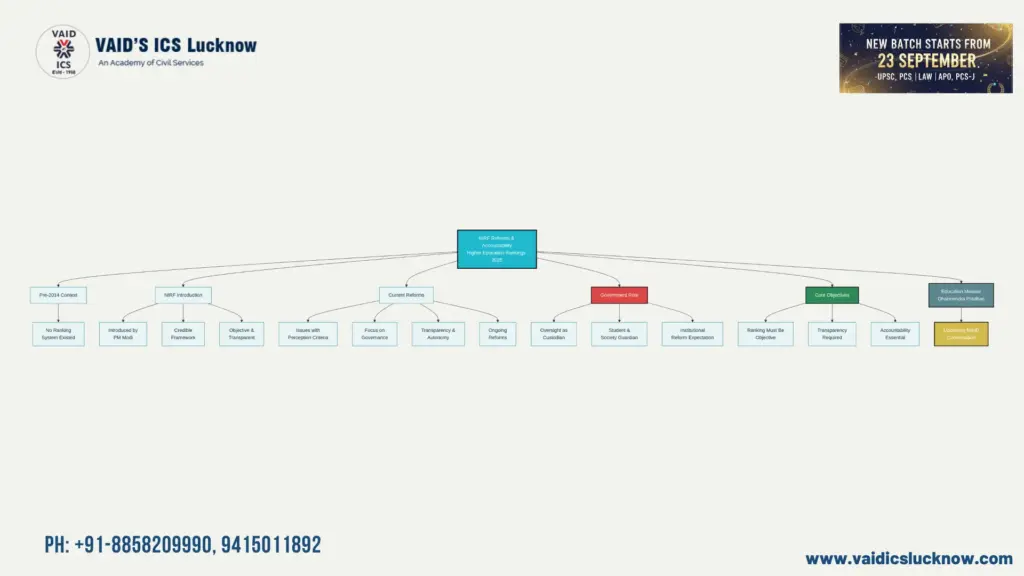
Union Education Minister Dharmendra Pradhan highlighted the need for objective, transparent, and accountable functioning of the NIRF and NAAC during The Hindu MIND conversation series.
- He emphasized ongoing reforms and the government’s role as the custodian of students and society in higher education rankings.
Objective & Transparent Ranking:
- NIRF must be objective, transparent, and open.
- Institutions like NIRF and NAAC are given utmost autonomy but must ensure accountability and good governance.
Government Oversight:
- The government ensures that societal expectations are considered in the ranking system.
- Autonomous institutions need to reform themselves and improve governance practices.
Importance & Background:
- Before 2014, India had no national ranking system for higher education institutions.
- The NIRF was envisioned by Prime Minister Narendra Modi to provide a structured and credible ranking framework.
Recent Developments:
• Pradhan highlighted issues with certain ranking parameters, such as perception criteria, encouraging continuous reforms.
• Institutions are actively working on improving transparency and governance.
Next Session of The Hindu MIND Series:
• Telangana Deputy CM Bhatti Vikramarka and Kerala Finance Minister K.N. Balagopal will speak on GST and its implementation in the upcoming session.
About National Institutional Ranking Framework (NIRF):
NIRF is a ranking system for higher education institutions in India, launched by the Ministry of Education (MoE) to assess and rank universities and colleges based on performance.
Objectives:
Encourage Excellence: Promote quality improvements in higher education.
Transparency & Accountability: Provide an objective and open ranking to students, parents, and society.
Benchmarking: Enable institutions to compare performance and strive for better standards.
Informed Choices: Help students make better choices for admissions based on rankings.
Key Parameters for Ranking:
Teaching, Learning & Resources (TLR): Faculty quality, student-teacher ratio, learning resources.
Research & Professional Practice (RP): Publications, patents, projects, and research impact.
Graduation Outcomes (GO): Student success, placements, higher studies.
Outreach & Inclusivity (OI): Representation of women, disadvantaged groups, and regional diversity.
Perception (PR): Peer perception by employers, academics, and society.
Significance:
- Helps improve institutional governance and academic standards.
• Encourages competition and innovation among universities and colleges.
• Facilitates policy-making and funding decisions by the government.
About NAAC (National Assessment and Accreditation Council):
Definition:
• NAAC is an autonomous body established by the University Grants Commission (UGC) in 1994 to assess and accredit higher education institutions in India.
• Its goal is to ensure quality, accountability, and continuous improvement in higher education.

October 17, 2025
October 16, 2025
October 6, 2025
September 24, 2025

