May 20, 2026
Zwan-Wolf Effect:
Context & The Breakthrough:
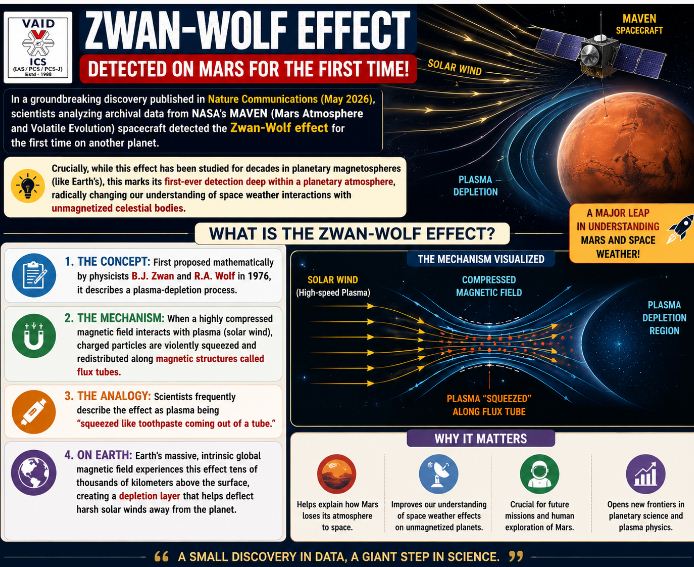
In a groundbreaking discovery published in Nature Communications (May 2026), scientists analyzing archival data from NASA’s MAVEN (Mars Atmosphere and Volatile Evolution) spacecraft detected the Zwan-Wolf effect for the first time on another planet.
Crucially, while this effect has been studied for decades in planetary magnetospheres (like Earth’s), this marks its first-ever detection deep within a planetary atmosphere, radically changing our understanding of space weather interactions with unmagnetized celestial bodies.
What is the Zwan-Wolf Effect?:
- The Concept: First proposed mathematically by physicists B.J. Zwan and R.A. Wolf in 1976, it describes a plasma-depletion process.
- The Mechanism: When a highly compressed magnetic field interacts with plasma (solar wind), charged particles are violently squeezed and redistributed along magnetic structures called flux tubes.
- The Analogy: Scientists frequently describe the effect as plasma being “squeezed like toothpaste coming out of a tube.”
- On Earth: Earth’s massive, intrinsic global magnetic field experiences this effect tens of thousands of kilometers above the surface, creating a depletion layer that helps deflect harsh solar winds away from the planet.
The Discovery at Mars: How It Differs From Earth?
The Martian Environment:
Unlike Earth, Mars lacks an intrinsic, planet-wide global magnetic field. Instead, it possesses a weak, localized induced magnetosphere created when the supersonic solar wind directly slams into and interacts with its ionosphere.
MAVEN’s Observation:
- The Event: MAVEN captured the signatures during a massive solar storm/space weather event that hit Mars in December 2023.
- The Altitude: The effect was detected deep in the Martian ionosphere, below an altitude of 200 kilometers (124 miles), where solar radiation strips electrons from atoms to create an abundance of electrically charged plasma.
- The Trigger: Under normal conditions, the effect occurs at baseline levels too weak for MAVEN’s instruments to isolate. However, the extreme pressure pulse of the 2023 solar storm heavily compressed the induced magnetic shield, amplifying the effect enough to produce distinct “wiggles” and anomalous ion temperature spikes in MAVEN’s magnetic field data.
Technical/Scientific Implications:
New Atmospheric Physics:
It proves that a robust planetary magnetic shield is not a prerequisite for the Zwan-Wolf effect. An induced magnetosphere, interacting directly with an unmagnetized planet’s upper atmosphere, can replicate large-scale plasma-depletion dynamics previously thought unique to Earth.
Atmospheric Erosion and Evolution:
- MAVEN’s primary mandate (since entering orbit in 2014) is determining how Mars transitioned from a warm, wet, habitable world to a cold desert. Understanding how the Zwan-Wolf effect “squeezes” and alters the dynamics of Martian atmospheric plasma provides critical clues into the exact mechanisms behind historical atmospheric loss to space.
Comparative Planetology:
- This discovery provides a direct blueprint for studying space weather interactions at other unmagnetized or weakly magnetized bodies with thick atmospheres, specifically Venus and Saturn’s moon Titan.
Future Human Exploration:
- Mapping how extreme space weather events deform the Martian ionosphere is an operational safety imperative for designing communication systems, orbital assets, and radiation shielding for future manned missions to Mars.
Quick Facts for Prelims:
- MAVEN Mission: Launched by NASA in November 2013, it has been orbiting Mars since September 2014. It studies the planet’s upper atmosphere, ionosphere, and interactions with the Sun. (Note: NASA established an anomaly review board after losing contact with the ageing orbiter in December 2025, but data processing of its historic hauls continues to yield massive discoveries).
- Ionosphere: The layer of a planet’s atmosphere that is ionized by solar and cosmic radiation.
- Unmagnetized Body: A celestial body lacking an internal dynamo to generate a global intrinsic magnetic field.
ज्वान-वुल्फ प्रभाव:
‘नेचर कम्युनिकेशंस’ (Nature Communications) पत्रिका में प्रकाशित एक अभूतपूर्व अध्ययन के अनुसार, वैज्ञानिकों ने नासा के मेवेन (MAVEN – Mars Atmosphere and Volatile Evolution) अंतरिक्ष यान के पुराने संचित आंकड़ों (archival data) का विश्लेषण करके पहली बार किसी अन्य ग्रह पर ‘ज्वान-वुल्फ प्रभाव’ (Zwan-Wolf effect) की उपस्थिति दर्ज की है।
महत्वपूर्ण तथ्य यह है कि दशकों से इस प्रभाव का अध्ययन केवल ग्रहीय चुंबकमंडल (जैसे पृथ्वी का magnetosphere) में ही किया जाता रहा है। यह पहली बार है जब इस प्रभाव को किसी ग्रह के वायुमंडल की गहराई में देखा गया है, जो वैश्विक चुंबकीय क्षेत्र विहीन (unmagnetized) खगोलीय पिंडों के साथ अंतरिक्षीय मौसम (space weather) की अंतःक्रियाओं के बारे में हमारी समझ को मौलिक रूप से बदलता है।
ज्वान-वुल्फ प्रभाव क्या है?:
- अवधारणा: वर्ष 1976 में भौतिकविदों बी.जे. ज्वान और आर.ए. वुल्फ द्वारा गणितीय रूप से प्रतिपादित यह सिद्धांत एक ‘प्लाज्मा-न्यूनीकरण प्रक्रिया’ (plasma-depletion process) को दर्शाता है।
- कार्यप्रणाली: जब एक अत्यधिक संपीड़ित (compressed) चुंबकीय क्षेत्र प्लाज्मा (सौर पवन) के साथ संपर्क करता है, तो आवेशित कण (charged particles) अत्यधिक दबाव के कारण संकुचित हो जाते हैं और ‘फ्लक्स ट्यूब’ (flux tubes) नामक चुंबकीय संरचनाओं के समानांतर पुनर्वितरित हो जाते हैं।
- पृथ्वी पर स्थिति: पृथ्वी का विशाल, आंतरिक वैश्विक चुंबकीय क्षेत्र सतह से हजारों किलोमीटर ऊपर इस प्रभाव का अनुभव करता है, जिससे एक ‘न्यूनीकरण परत’ (depletion layer) का निर्माण होता है। यह परत हानिकारक सौर पवनों को पृथ्वी से दूर मोड़ने में सहायक होती है।
मंगल पर खोज: पृथ्वी से यह कैसे भिन्न है?:
मंगल का पर्यावरण:
पृथ्वी के विपरीत, मंगल के पास अपना कोई आंतरिक या वैश्विक चुंबकीय क्षेत्र नहीं है। इसके बजाय, इसके पास एक कमजोर और स्थानीयकृत ‘प्रेरित चुंबकमंडल’ (induced magnetosphere) होता है, जो तब बनता है जब तीव्र पराध्वनिक सौर पवन (supersonic solar wind) सीधे उसके आयनमंडल (ionosphere) से टकराती है।
मेवेन (MAVEN) का अवलोकन:
- घटना: मेवेन ने इन विशिष्ट संकेतों को दिसंबर 2023 में मंगल ग्रह से टकराने वाले एक विशाल सौर तूफान (solar storm) के दौरान दर्ज किया था।
- ऊंचाई: यह प्रभाव मंगल के आयनमंडल के भीतर, 200 किलोमीटर (124 मील) से कम की ऊंचाई पर देखा गया, जहां सौर विकिरण परमाणुओं से इलेक्ट्रॉनों को अलग करके विद्युत आवेशित प्लाज्मा की प्रचुरता पैदा करता है।
- उत्प्रेरक: सामान्य परिस्थितियों में यह प्रभाव इतना कमजोर होता है कि मेवेन के उपकरण इसे अलग से पहचान नहीं पाते। हालांकि, 2023 के सौर तूफान के अत्यधिक दबाव ने मंगल के प्रेरित चुंबकीय ढाल को भारी रूप से संपीड़ित कर दिया, जिससे यह प्रभाव इतना बढ़ गया कि मेवेन के चुंबकीय क्षेत्र के आंकड़ों में स्पष्ट विचलन (wiggles) और आयन तापमान में असामान्य वृद्धि दर्ज की गई।
तकनीकी एवं वैज्ञानिक निहितार्थ:
नवीन वायुमंडलीय भौतिकी:
यह खोज प्रमाणित करती है कि ज्वान-वुल्फ प्रभाव के लिए एक मजबूत ग्रहीय चुंबकीय ढाल (magnetic shield) का होना अनिवार्य शर्त नहीं है। एक प्रेरित चुंबकमंडल भी, बिना वैश्विक चुंबकीय क्षेत्र वाले ग्रह के ऊपरी वायुमंडल के साथ सीधे संपर्क करके, बड़े पैमाने पर प्लाज्मा-न्यूनीकरण की उन प्रक्रियाओं को दोहरा सकता है जिन्हें पहले केवल पृथ्वी के लिए विशिष्ट माना जाता था।
वायुमंडलीय क्षरण और विकास:
वर्ष 2014 से कक्षा में मौजूद मेवेन मिशन का मुख्य उद्देश्य यह पता लगाना है कि मंगल एक गर्म, आर्द्र और रहने योग्य ग्रह से ठंडे रेगिस्तान में कैसे बदल गया। यह समझना कि ज्वान-वुल्फ प्रभाव किस प्रकार मंगल के वायुमंडलीय प्लाज्मा को संकुचित और परिवर्तित करता है, अंतरिक्ष में ऐतिहासिक वायुमंडलीय नुकसान (atmospheric loss) के सटीक तंत्र को समझने में महत्वपूर्ण सुराग प्रदान करता है।
तुलनात्मक ग्रह विज्ञान (Comparative Planetology):
यह खोज घने वायुमंडल वाले अन्य चुंबकीय क्षेत्र विहीन या कमजोर चुंबकीय क्षेत्र वाले खगोलीय पिंडों, विशेष रूप से शुक्र (Venus) और शनि के चंद्रमा टाइटन (Titan) पर अंतरिक्षीय मौसम के प्रभावों का अध्ययन करने के लिए एक सीधा ब्लूप्रिंट प्रदान करती है।
भावी मानव अन्वेषण:
तीव्र सौर घटनाओं के दौरान मंगल का आयनमंडल किस प्रकार विकृत होता है, इसका मानचित्रण करना भविष्य के मानवयुक्त मंगल मिशनों के लिए संचार प्रणाली, कक्षीय परिसंपत्तियों (orbital assets) और विकिरण सुरक्षा कवच (radiation shielding) को डिजाइन करने के दृष्टिकोण से एक परिचालन सुरक्षा अनिवार्यता है।
प्रारंभिक परीक्षा (Prelims) के लिए त्वरित तथ्य:
- मेवेन (MAVEN) मिशन: नासा द्वारा नवंबर 2013 में प्रक्षेपित यह यान सितंबर 2014 से मंगल की परिक्रमा कर रहा है, जो इसके ऊपरी वायुमंडल, आयनमंडल और सूर्य के साथ होने वाली अंतःक्रियाओं का अध्ययन करता है।
- आयनमंडल: किसी ग्रह के वायुमंडल की वह परत जो सौर और ब्रह्मांडीय विकिरण द्वारा आयनीकृत (ionized) होती है।
- अचुम्बकीय पिंड (Unmagnetized Body): ऐसा खगोलीय पिंड जिसके पास वैश्विक आंतरिक चुंबकीय क्षेत्र उत्पन्न करने के लिए आंतरिक डायनेमो (internal dynamo) का अभाव होता है।

May 19, 2026
October 17, 2025
October 16, 2025
October 6, 2025

