September 28, 2026
World Ecological Zones:Western Ghats: Ecologically Sensitive Area (ESA)
Why in News?
On 22 September 2026, the Karnataka Legislature unanimously passed a resolution rejecting the K. Kasturirangan Committee recommendations in their present form. The issue relates to the seventh draft notification issued by the Ministry of Environment, Forest and Climate Change on 27 July 2026, proposing parts of the Western Ghats as an Ecologically Sensitive Area (ESA).
Western Ghats: A Global Ecological Zone
-
The Western Ghats are one of the world’s major biodiversity hotspots and are recognised as a UNESCO World Heritage Site.
-
They form a major biogeographical zone along India’s western coast, influencing:
-
Indian monsoon
-
river systems and freshwater availability
-
tropical forests and biodiversity
-
climate regulation and carbon storage
-
-
The region is characterised by high endemism, meaning many species found here occur nowhere else.
-
It contains important tiger and elephant corridors, protected areas and biologically rich landscapes.
-
The Western Ghats extend across Gujarat, Maharashtra, Goa, Karnataka, Kerala and Tamil Nadu.
Ecological Significance:
Biodiversity hotspot → High endemism → Forest ecosystem → Water security → Climate regulation → Wildlife corridors
What is an Ecologically Sensitive Area (ESA)?
An ESA is an ecologically fragile area where certain economic and developmental activities are prohibited or regulated to protect environmental systems.
The idea is based on the principle of:
Conservation + Sustainable Development + Local Livelihood Security
ESA notification does not necessarily mean a complete ban on human activity; rather, activities with significant ecological impacts are restricted or regulated.
Kasturirangan Committee: Key Points
-
The High Level Working Group (HLWG) was headed by K. Kasturirangan and constituted in 2012.
-
It reviewed the earlier Madhav Gadgil Committee (WGEEP) report of 2011.
-
It identified the Western Ghats through a combination of natural and cultural landscapes.
-
Out of the identified 1.64 lakh sq. km Western Ghats region, it recommended about 59,940 sq. km as ESA.
-
The proposed ESA covered 4,156 villages across six States.
Latest Draft:
-
Proposed ESA: about 56,825 sq. km
-
Villages: 4,402
-
Final boundaries are expected to depend on:
-
State government recommendations
-
stakeholder views
-
Expert Committee examination
-
State-wise ESA under Kasturirangan Recommendation:
-
Karnataka: 20,668 sq. km — 1,576 villages
-
Maharashtra: 17,340 sq. km — 2,159 villages
-
Kerala: 13,108 sq. km — 123 villages
-
Tamil Nadu: 6,914 sq. km — 135 villages
-
Goa: 1,461 sq. km — 99 villages
-
Gujarat: 449 sq. km — 64 villages
Karnataka has the largest proposed ESA area among the six States.
Major Restrictions Proposed:
Activities to be Prohibited:
-
Mining and quarrying
-
Sand extraction
-
Red-category industries
-
Thermal power plants
-
Construction of buildings exceeding 20,000 sq. m
-
Township and area-development projects
Activities to be Regulated:
-
Infrastructure and development projects requiring environmental clearance
-
Hydroelectric projects, subject to specified conditions
-
Projects within 10 km of the ESA requiring environmental clearance under the EIA Notification, 2006
Other Measures:
-
Green-growth incentives
-
Financial mechanisms for conservation
-
Decision-support and monitoring centre
Gadgil vs Kasturirangan
| Aspect | Gadgil Committee | Kasturirangan Committee |
|---|---|---|
| Approach | Stronger ecological protection | Conservation with greater consideration of development |
| ESA coverage | Entire Western Ghats | About 60,000 sq. km |
| Proposed area | About 1.29 lakh sq. km | About 59,940 sq. km |
| Classification | ESZ 1, 2 and 3 | Natural & Cultural Landscapes |
| Human settlements | Greater restrictions across ecological zones | Greater distinction between natural and inhabited landscapes |
| Core concern | Ecological protection | Ecological protection + livelihood/development concerns |
Karnataka’s Major Concerns:
Karnataka argues that ESA demarcation should:
-
Focus primarily on notified and other forest areas.
-
Exclude plantations, agricultural/horticultural land and residential areas, where appropriate.
-
Be based on ground/physical surveys, rather than satellite data alone.
-
Properly distinguish forest and revenue land.
-
Consider Forest Rights, Bagair Hukum claims, land grants, deemed forests and pending legal cases.
-
Provide livelihood alternatives and transition support.
-
Avoid declaring an entire village as ESA merely because a portion of it contains forest land.
Core Issue:
The Western Ghats debate represents a classic development–environment–livelihood triangle:
Ecological Fragility
↓
Need for Conservation
↕
Development & Infrastructure
↕
Livelihoods of Local Communities
The challenge is to ensure that ecological protection does not become socially disruptive, while developmental pressures do not undermine the long-term ecological security of the Western Ghats.
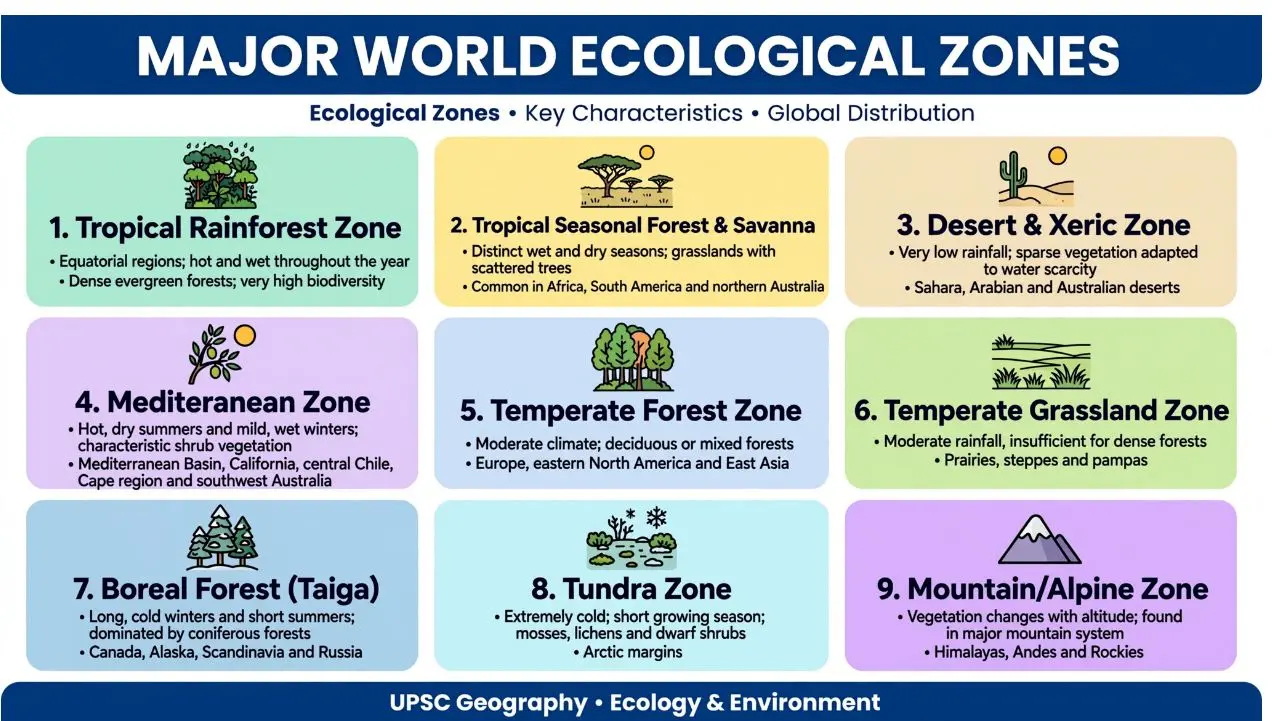
World Ecological Zones:
Meaning:
Ecological zones are large geographical regions characterised by relatively similar climate, vegetation, soils, wildlife and ecological processes.
They are broader than individual ecosystems and help in understanding the global distribution of biodiversity and natural vegetation.
Major World Ecological Zones:
-
Tropical Rainforest Zone: Equatorial regions; hot and wet throughout the year; dense evergreen forests; very high biodiversity.
-
Tropical Seasonal Forest & Savanna: Distinct wet and dry seasons; grasslands with scattered trees; common in Africa, South America and northern Australia.
-
Desert & Xeric Zone: Very low rainfall; sparse vegetation adapted to water scarcity; Sahara, Arabian and Australian deserts.
-
Mediterranean Zone: Hot, dry summers and mild, wet winters; characteristic shrub vegetation; Mediterranean Basin, California, central Chile, Cape region and southwest Australia.
-
Temperate Forest Zone: Moderate climate; deciduous or mixed forests; Europe, eastern North America and East Asia.
-
Temperate Grassland Zone: Moderate rainfall, insufficient for dense forests; prairies, steppes and pampas.
-
Boreal Forest (Taiga): Long, cold winters and short summers; dominated by coniferous forests; Canada, Alaska, Scandinavia and Russia.
-
Tundra Zone: Extremely cold; short growing season; mosses, lichens and dwarf shrubs; Arctic margins.
-
Mountain/Alpine Zone: Vegetation changes with altitude; found in major mountain systems such as the Himalayas, Andes and Rockies.
Key Concept:
Climate → Soil → Vegetation → Fauna → Ecological Zone
Ecological Hotspots vs Ecological Zones:
-
Ecological Zone: Large region sharing broadly similar ecological characteristics.
-
Biodiversity Hotspot: Region identified for exceptionally high endemic biodiversity and significant habitat loss.
UPSC Mains Focus:
“The Western Ghats are not merely a biodiversity hotspot but a critical ecological-security zone for peninsular India.” Discuss in the context of the Gadgil and Kasturirangan approaches.

May 19, 2026
October 17, 2025
October 16, 2025
October 6, 2025

