September 10, 2026
Women’s Political Participation in Local Governance
Why in News?
The experience of women representatives in Panchayati Raj Institutions shows that political reservation has increased women’s representation, but patriarchy, caste discrimination and proxy politics continue to restrict their effective participation.
Constitutional Provisions:
-
73rd Constitutional Amendment Act, 1992: Constitutionalised Panchayati Raj Institutions.
-
74th Constitutional Amendment Act, 1992: Constitutionalised Urban Local Bodies.
-
Article 243D: At least one-third of seats and chairperson positions in Panchayats are reserved for women.
-
Reservation also applies to SC/ST women in proportion to their population.
-
Several States have increased women’s reservation in local bodies to 50%.
Key Issues:
-
Proxy representation: Elected women may face interference from husbands or male relatives.
-
Patriarchy: Women often struggle to exercise independent decision-making authority.
-
Caste and gender discrimination: Dalit and other marginalised women face multiple layers of exclusion.
-
Limited voice: Women may formally hold office but face resistance in meetings and decision-making.
-
Administrative barriers: Delays, lack of institutional support and limited access to resources weaken their effectiveness.
-
Violence and intimidation: Women leaders challenging entrenched caste or political interests may face threats and attacks.
-
Capacity gap: Training and leadership programmes are often inadequate or irregular.
Positive Impact:
-
Reservation has brought millions of women into grassroots politics.
-
Created a new generation of women political leaders and decision-makers.
-
Improved attention to issues such as water, sanitation, roads, education and basic services.
-
Increased awareness of Gram Sabha, legal rights and public accountability.
-
Women increasingly moving from symbolic representation to active political agency.
-
Collective organisations and civil society have strengthened women’s bargaining power and leadership.
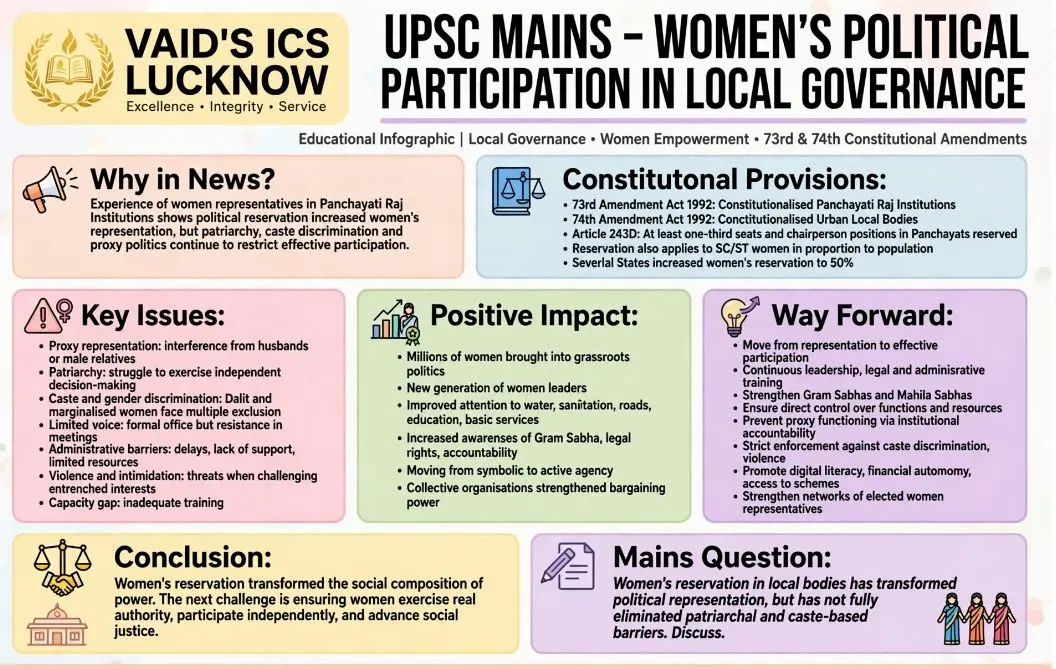
Way Forward:
-
Move from representation to effective participation.
-
Provide continuous leadership, legal and administrative training.
-
Strengthen Gram Sabhas and Mahila Sabhas.
-
Ensure women representatives have direct control over official functions and resources.
-
Prevent proxy functioning through stronger institutional accountability.
-
Strictly enforce laws against caste discrimination, violence and intimidation.
-
Promote digital literacy, financial autonomy and access to government schemes.
-
Strengthen networks and federations of elected women representatives.
Conclusion:
Women’s reservation in local governance has transformed the social composition of political power. The next challenge is to ensure that women are not merely present in institutions but are able to exercise real authority, participate independently and advance social justice.
UPSC Mains Question:
“Women’s reservation in local bodies has transformed political representation, but not fully eliminated patriarchal and caste-based barriers. Discuss.”
स्थानीय शासन में महिलाओं की राजनीतिक भागीदारी: UPSC मुख्य परीक्षा
Why in News?
स्थानीय निकायों में महिलाओं के लिए राजनीतिक आरक्षण ने महिलाओं की राजनीतिक भागीदारी बढ़ाई है, लेकिन पितृसत्ता, जातिगत भेदभाव और प्रतिनिधि के स्थान पर पुरुषों द्वारा निर्णय लेने की प्रवृत्ति अभी भी प्रभावी भागीदारी में बाधा बनी हुई है।
संवैधानिक प्रावधान:
-
73वाँ संविधान संशोधन अधिनियम, 1992: पंचायती राज संस्थाओं को संवैधानिक दर्जा दिया।
-
74वाँ संविधान संशोधन अधिनियम, 1992: शहरी स्थानीय निकायों को संवैधानिक दर्जा दिया।
-
अनुच्छेद 243D: पंचायतों में कम-से-कम एक-तिहाई सीटें और अध्यक्ष पद महिलाओं के लिए आरक्षित हैं।
-
अनुसूचित जाति और अनुसूचित जनजाति के लिए आरक्षित सीटों में भी महिलाओं के लिए आरक्षण का प्रावधान है।
-
कई राज्यों ने स्थानीय निकायों में महिलाओं के लिए आरक्षण बढ़ाकर 50% कर दिया है।
प्रमुख मुद्दे:
-
प्रतिनिधि के स्थान पर पुरुषों का नियंत्रण: निर्वाचित महिला प्रतिनिधि के स्थान पर पति या पुरुष रिश्तेदार द्वारा निर्णय लेना।
-
पितृसत्तात्मक सोच: महिलाओं की स्वतंत्र निर्णय लेने की क्षमता को स्वीकार न करना।
-
जाति और लैंगिक भेदभाव: दलित एवं वंचित वर्ग की महिलाओं को दोहरे भेदभाव का सामना।
-
निर्णय प्रक्रिया में सीमित भागीदारी: पद पर होने के बावजूद बैठकों और निर्णयों में पर्याप्त आवाज न मिलना।
-
प्रशासनिक बाधाएँ: संसाधनों तक सीमित पहुँच, प्रक्रियात्मक देरी और संस्थागत सहयोग की कमी।
-
धमकी और हिंसा: प्रभावशाली जातीय एवं राजनीतिक समूहों को चुनौती देने पर दबाव और हिंसा।
-
प्रशिक्षण की कमी: महिला प्रतिनिधियों के लिए निरंतर प्रशासनिक एवं नेतृत्व प्रशिक्षण का अभाव।
सकारात्मक प्रभाव:
-
आरक्षण ने बड़ी संख्या में महिलाओं को जमीनी राजनीति में प्रवेश दिया।
-
महिलाओं की एक नई राजनीतिक नेतृत्वकारी पीढ़ी विकसित हुई।
-
जल, स्वच्छता, सड़क, शिक्षा और मूलभूत सेवाओं जैसे मुद्दों पर अधिक ध्यान आया।
-
महिलाओं में ग्राम सभा, कानूनी अधिकार और सरकारी योजनाओं के प्रति जागरूकता बढ़ी।
-
महिलाएँ धीरे-धीरे प्रतीकात्मक प्रतिनिधित्व से वास्तविक राजनीतिक भागीदारी की ओर बढ़ रही हैं।
-
महिला संगठनों और नागरिक समाज ने उनकी सामूहिक शक्ति और निर्णय क्षमता को मजबूत किया है।
आगे की राह:
-
केवल प्रतिनिधित्व नहीं, बल्कि प्रभावी भागीदारी सुनिश्चित करना।
-
महिला प्रतिनिधियों को निरंतर प्रशासनिक, कानूनी और नेतृत्व प्रशिक्षण देना।
-
ग्राम सभा और महिला सभा को अधिक प्रभावी बनाना।
-
निर्वाचित महिलाओं को वास्तविक प्रशासनिक अधिकार और संसाधनों पर नियंत्रण देना।
-
प्रतिनिधि के स्थान पर पुरुषों द्वारा कार्य करने की प्रवृत्ति पर प्रभावी रोक।
-
जातिगत भेदभाव, हिंसा और धमकी के विरुद्ध कानूनों का प्रभावी क्रियान्वयन।
-
महिलाओं की डिजिटल एवं वित्तीय क्षमता बढ़ाना।
-
निर्वाचित महिला प्रतिनिधियों के संगठनों और नेटवर्क को मजबूत करना।
निष्कर्ष:
स्थानीय शासन में महिला आरक्षण ने राजनीतिक शक्ति की सामाजिक संरचना को बदला है। अब चुनौती महिलाओं की संख्या बढ़ाने से आगे बढ़कर उन्हें स्वतंत्र निर्णय लेने की शक्ति, वास्तविक अधिकार और सामाजिक न्याय को आगे बढ़ाने की क्षमता प्रदान करना है।
UPSC मुख्य परीक्षा प्रश्न:
“स्थानीय निकायों में महिलाओं के आरक्षण ने राजनीतिक प्रतिनिधित्व को व्यापक बनाया है, लेकिन पितृसत्तात्मक और जातिगत बाधाएँ अभी भी बनी हुई हैं। चर्चा कीजिए।”

May 19, 2026
October 17, 2025
October 16, 2025
October 6, 2025

