September 23, 2026
Women in Agriculture: Recognition and Empowerment/कृषि में महिलाएँ: पहचान एवं सशक्तीकरण
Why in News?
-
2026 has been designated the International Year of the Woman Farmer, highlighting women’s contribution to agriculture and food security.
-
Women constitute a significant share of India’s agricultural workforce, but many remain under-recognised as farmers because formal recognition is often linked to land ownership.
-
The focus is shifting towards recognising women as cultivators, entrepreneurs and decision-makers across the agricultural value chain.
Present Status:
-
Women contribute to sowing, transplanting, weeding, harvesting, livestock, fisheries, food processing and marketing.
-
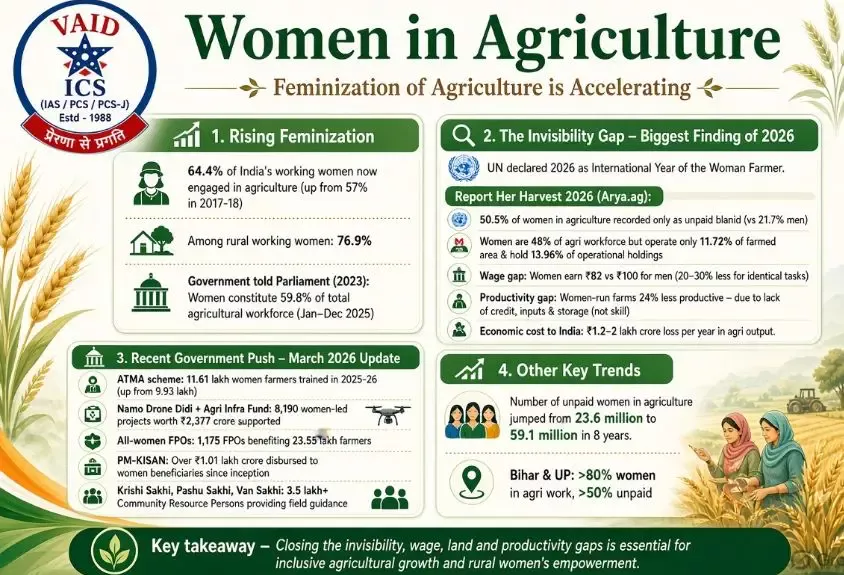
Around 59.8% of India’s agricultural workforce was female in 2025.
-
More than 8 crore women agricultural and allied workers were registered on the e-Shram portal by 2025.
-
Increasing male migration has contributed to the feminisation of agriculture.
-
Despite high participation, women often have limited land ownership, credit, technology, extension services and market access.
Major Issues:
-
Recognition gap: Women may cultivate land without being its legal owners.
-
Land ownership: Limited ownership restricts access to credit, insurance and farmer-oriented schemes.
-
Credit constraints: Lack of collateral and formal land records.
-
Technology gap: Lower access to mechanisation, drones and digital agriculture.
-
Unpaid work: Agricultural work overlaps with household and care responsibilities.
-
Market exclusion: Limited control over farm income, marketing and value chains.
-
Gender wage gap: Women agricultural labourers often have weaker bargaining power.
Recent Government Steps:
PM-KISAN
-
Eligible women landholding farmer families receive ₹6,000 per year.
-
More than ₹1 lakh crore has been transferred to women beneficiaries since the scheme began.
ATMA
-
Provides training, demonstrations and agricultural extension to women farmers.
-
Over 11.6 lakh women farmers were trained during 2025–26 up to February 2026.
Namo Drone Didi
-
Promotes women-led drone-based agricultural services, creating both technological access and livelihood opportunities.
Women-led FPOs
-
Over 1,175 all-women Farmer Producer Organisations have been supported, benefiting millions of farmers.
Krishi Sakhi
-
Trains women SHG members as community-level agricultural resource persons.
DAY-NRLM / Lakhpati Didi
-
Uses women’s Self-Help Groups to promote farm and non-farm livelihoods, entrepreneurship and income enhancement.
Significance:
-
Food security: Women are major contributors to food production and household nutrition.
-
Productivity: Better access to inputs and technology can improve farm efficiency.
-
Rural income: Women’s economic participation strengthens household resilience.
-
Inclusive growth: Recognition increases women’s participation in agricultural decision-making.
-
Climate resilience: Women farmers can play an important role in adopting sustainable and climate-resilient agriculture.
Way Forward:
-
Recognise actual cultivators and agricultural workers, not merely landowners.
-
Promote joint land titles and effective inheritance rights.
-
Expand women’s access to credit, insurance, technology and extension services.
-
Strengthen women-led FPOs, SHGs and cooperatives.
-
Promote access to drones, mechanisation and digital agriculture.
-
Increase women’s participation in markets and agricultural value chains.
-
Improve gender-disaggregated agricultural data.
-
Reduce unpaid work through labour-saving technology and rural care infrastructure.
Conclusion:
Recognising women as farmers is essential for transforming their agricultural contribution into economic ownership, decision-making power and sustainable rural development.
Mains Question:
“Women constitute a significant share of India’s agricultural workforce, yet their contribution remains inadequately recognised. Examine the challenges faced by women farmers and discuss the measures required for their effective empowerment.”
कृषि में महिलाएँ: पहचान एवं सशक्तीकरण
चर्चा में क्यों?
-
वर्ष 2026 को ‘अंतरराष्ट्रीय महिला किसान वर्ष’ के रूप में मनाया जा रहा है, जिससे कृषि एवं खाद्य सुरक्षा में महिलाओं की भूमिका पर ध्यान केंद्रित हुआ है।
-
भारत के कृषि कार्यबल में महिलाओं की महत्वपूर्ण भागीदारी है, फिर भी अनेक महिलाएँ किसान के रूप में पर्याप्त रूप से मान्यता प्राप्त नहीं कर पाती हैं, क्योंकि औपचारिक पहचान प्रायः भूमि-स्वामित्व से जुड़ी होती है।
-
अब महिलाओं को कृषक, कृषि उद्यमी एवं कृषि मूल्य श्रृंखला में निर्णयकर्ता के रूप में मान्यता देने पर जोर बढ़ रहा है।
वर्तमान स्थिति:
-
महिलाएँ बुवाई, रोपाई, निराई-गुड़ाई, कटाई, पशुपालन, मत्स्यपालन, खाद्य प्रसंस्करण एवं विपणन में महत्वपूर्ण योगदान देती हैं।
-
वर्ष 2025 में भारत के कृषि कार्यबल में महिलाओं की हिस्सेदारी लगभग 59.8% थी।
-
वर्ष 2025 तक 8 करोड़ से अधिक महिला कृषि एवं संबद्ध क्षेत्र के श्रमिक ई-श्रम पोर्टल पर पंजीकृत थे।
-
पुरुषों के ग्रामीण से शहरी क्षेत्रों की ओर प्रवासन ने कृषि के बढ़ते स्त्रीकरण में योगदान दिया है।
-
उच्च भागीदारी के बावजूद महिलाओं की भूमि-स्वामित्व, ऋण, प्रौद्योगिकी, कृषि विस्तार सेवाओं एवं बाजारों तक पहुँच सीमित है।
प्रमुख समस्याएँ:
-
मान्यता का अभाव: महिलाएँ भूमि की वास्तविक खेती करती हैं, परंतु कानूनी स्वामित्व उनके नाम नहीं होता।
-
भूमि स्वामित्व की कमी: इससे ऋण, बीमा एवं किसान-केंद्रित योजनाओं तक पहुँच प्रभावित होती है।
-
ऋण संबंधी बाधाएँ: पर्याप्त संपार्श्विक एवं औपचारिक भूमि अभिलेखों का अभाव।
-
प्रौद्योगिकी अंतर: कृषि यंत्रीकरण, ड्रोन एवं डिजिटल कृषि तक सीमित पहुँच।
-
अवैतनिक कार्य: कृषि कार्य के साथ घरेलू एवं देखभाल संबंधी दायित्वों का भार।
-
बाजार से जुड़ाव की कमी: कृषि आय, विपणन एवं मूल्य श्रृंखला पर सीमित नियंत्रण।
-
लैंगिक वेतन अंतर: महिला कृषि श्रमिकों की सौदेबाजी क्षमता अपेक्षाकृत कमजोर।
हालिया सरकारी कदम:
PM-KISAN
-
पात्र महिला भू-धारक किसान परिवारों को ₹6,000 वार्षिक सहायता मिलती है।
-
योजना के प्रारंभ से महिलाओं को ₹1 लाख करोड़ से अधिक की राशि हस्तांतरित की जा चुकी है।
ATMA
-
महिला किसानों को प्रशिक्षण, प्रदर्शन एवं कृषि विस्तार सेवाएँ उपलब्ध कराता है।
-
2025–26 में फरवरी 2026 तक 11.6 लाख से अधिक महिला किसानों को प्रशिक्षण दिया गया।
नमो ड्रोन दीदी
-
महिला समूहों को कृषि ड्रोन आधारित सेवाओं से जोड़कर तकनीकी पहुँच एवं आजीविका के अवसर बढ़ाने पर बल।
महिला-नेतृत्व वाले FPO
-
1,175 से अधिक सर्व-महिला किसान उत्पादक संगठनों (FPOs) को सहायता प्रदान की गई है।
कृषि सखी
-
स्वयं सहायता समूहों की महिलाओं को सामुदायिक स्तर की कृषि संसाधन व्यक्तियों के रूप में प्रशिक्षित किया जाता है।
DAY-NRLM एवं लखपति दीदी
-
महिला स्वयं सहायता समूहों के माध्यम से कृषि एवं गैर-कृषि आजीविका, उद्यमिता तथा आय वृद्धि को बढ़ावा दिया जा रहा है।
महत्त्व:
-
खाद्य सुरक्षा: महिलाएँ खाद्य उत्पादन एवं घरेलू पोषण में महत्वपूर्ण भूमिका निभाती हैं।
-
कृषि उत्पादकता: बेहतर तकनीक एवं कृषि निवेश तक पहुँच से उत्पादकता बढ़ सकती है।
-
ग्रामीण आय: महिलाओं की आर्थिक भागीदारी से परिवारों की आर्थिक क्षमता मजबूत होती है।
-
समावेशी विकास: किसान के रूप में पहचान से कृषि संबंधी निर्णयों में महिलाओं की भागीदारी बढ़ती है।
-
जलवायु अनुकूलन: महिला किसान टिकाऊ एवं जलवायु-अनुकूल कृषि पद्धतियों को अपनाने में महत्वपूर्ण भूमिका निभा सकती हैं।
आगे की राह:
-
केवल भूमि-मालिकों के बजाय वास्तविक कृषकों एवं कृषि श्रमिकों को किसान के रूप में मान्यता दी जाए।
-
संयुक्त भूमि स्वामित्व एवं प्रभावी उत्तराधिकार अधिकारों को बढ़ावा दिया जाए।
-
महिलाओं के लिए ऋण, बीमा, तकनीक एवं कृषि विस्तार सेवाओं की पहुँच बढ़ाई जाए।
-
महिला FPOs, SHGs एवं सहकारी संस्थाओं को मजबूत किया जाए।
-
ड्रोन, कृषि यंत्रीकरण एवं डिजिटल कृषि तक महिलाओं की पहुँच बढ़ाई जाए।
-
कृषि बाजार एवं मूल्य श्रृंखला में महिलाओं की भागीदारी बढ़ाई जाए।
-
बेहतर लिंग-विभेदित कृषि आँकड़े तैयार किए जाएँ।
-
श्रम-बचत तकनीक एवं ग्रामीण देखभाल अवसंरचना के माध्यम से अवैतनिक कार्य का बोझ कम किया जाए।
निष्कर्ष:
महिलाओं को किसान के रूप में वास्तविक पहचान प्रदान करना केवल लैंगिक समानता का विषय नहीं, बल्कि कृषि उत्पादकता, खाद्य सुरक्षा, ग्रामीण समृद्धि एवं समावेशी विकास की आवश्यकता है।
Mains Question:
“भारत के कृषि कार्यबल में महिलाओं की महत्वपूर्ण भागीदारी के बावजूद उनका योगदान पर्याप्त रूप से मान्यता प्राप्त नहीं है। महिला किसानों के समक्ष प्रमुख चुनौतियों का परीक्षण करते हुए उनके प्रभावी सशक्तीकरण के लिए आवश्यक उपायों की चर्चा कीजिए।”

May 19, 2026
October 17, 2025
October 16, 2025
October 6, 2025

