August 4, 2026
Wild Fire – Causes & solution
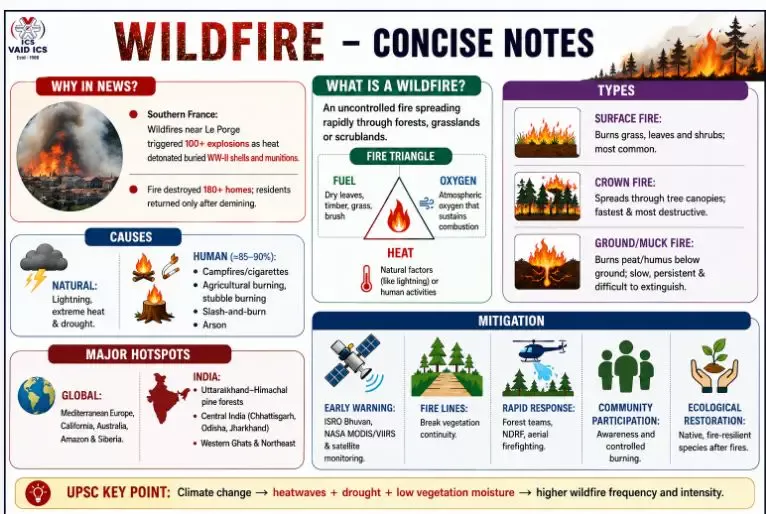
Why in News?
-
Event: Recent wildfires in southern France (Le Porge village) uncovered a cache of approximately 400 historic World War II shells and munitions.
-
Key Points:
-
Intense heat from the wildfires caused buried historic explosives to detonate, which locals initially mistook for exploding gas cylinders.
-
Over 100 explosions were heard, creating a war zone-like atmosphere.
-
The blaze destroyed more than 180 homes, and residents were only allowed to return after demining operations were completed.
-
What is a Wildfire?
-
Definition: An uncontrolled and rapidly spreading fire that occurs in forests, grasslands, or brushlands.
-
The Fire Triangle: Three essential elements are required for a wildfire to ignite and sustain:
-
Fuel: Dry leaves, timber, grass, and brush.
-
Oxygen: Atmospheric oxygen that sustains combustion.
-
Heat Source: Natural factors (like lightning) or human activities.
-
Types of Wildfires:
-
Surface Fire: Burns surface litter, dry grass, fallen leaves, and small shrubs. This is the most common type of forest fire and causes relatively less damage to mature trees.
-
Crown Fire: Spreads from tree canopy to canopy. It is the most destructive and fastest-moving fire, typically driven by strong winds.
-
Ground Fire / Muck Fire: Burns beneath the surface in organic matter, peat, or humus layers. It smolders slowly for long periods and is the most difficult to extinguish.
Causes of Wildfires:
-
Natural Causes:
-
Lightning: A primary natural trigger when lightning strikes dry vegetation.
-
High Temperatures & Heatwaves: Extreme heat and global warming reduce forest moisture content, making vegetation highly combustible.
-
-
Anthropogenic (Human) Causes (approx. 85–90% of cases):
-
Negligence: Unattended campfires, discarded cigarette butts, or burning debris.
-
Agricultural Practices: Slash-and-burn farming (shifting cultivation) or stubble burning getting out of control.
-
Arson: Intentionally set fires driven by mischief, land clearing, or illegal encroachment.
-
Major Regions – Global and India:
-
Global Level:
-
Mediterranean Region: Southern Europe (France, Spain, Portugal, Greece) prone to hot, dry summers.
-
California and Australia: Known for severe brushfires and chaparral fires due to dry, windy conditions.
-
Amazon and Siberian Forests: Experiencing unprecedented wildfires driven by climate change and prolonged droughts.
-
-
Major Regions in India:
-
Uttarakhand and Himachal Pradesh Pine Forests: Chir pine needles contain flammable resin, making these regions highly susceptible during summers.
-
Central and Northeastern India: Deciduous forests in states like Chhattisgarh, Odisha, and Jharkhand.
-
Western Ghats and Northeast Hills: Prone to dry-season fires largely triggered by anthropogenic activities.
-
Solutions and Mitigation Measures:
-
Early Warning Systems: Utilizing satellite data (such as ISRO’s Bhuvan portal or NASA’s MODIS/VIIRS) for real-time monitoring and predictive tracking.
-
Community Engagement & Awareness: Educating local populations, farmers, and tourists on fire safety, campfires, and waste disposal.
-
Creation of Fire Lines: Clearing strips of vegetation within forests to act as barriers and prevent the lateral spread of fire.
-
Rapid Response Teams: Equipping forest departments and disaster management forces (like NDRF) with modern firefighting tools and aerial tankers.
-
Ecological Restoration: Post-fire recovery efforts involving the plantation of fire-resistant native tree species.

May 19, 2026
October 17, 2025
October 16, 2025
October 6, 2025

