October 12, 2026
What Public Officials Must Ask: Whom Do We Serve?
Theme: Ethics, Integrity and Aptitude | GS Paper IV | Public Service Values
1. Introduction:
The fundamental question of public administration is not merely how to govern, but whom to serve. Public officials are entrusted with public power and resources to promote the welfare of citizens, particularly the poor, vulnerable and marginalised.
The philosophies of Mahatma Gandhi, Sardar Vallabhbhai Patel, Lal Bahadur Shastri and Deen Dayal Upadhyaya provide an ethical framework for responsible, accountable and citizen-centric governance.
2. Ethical Teachings of Indian Thinkers:
Mahatma Gandhi: Public Office as Trusteeship
-
Trusteeship: Public power and resources should be treated as a trust held for the welfare of society, especially its weakest sections.
-
Talisman: Before taking a decision, officials should recall the poorest and weakest person and assess whether their action will improve that person’s life and restore their control over it.
-
Ethical principle: Compassion, social justice, simplicity and service to the last person.
-
Administrative application: Prioritising welfare delivery, reducing inequality and ensuring that public funds benefit intended beneficiaries.
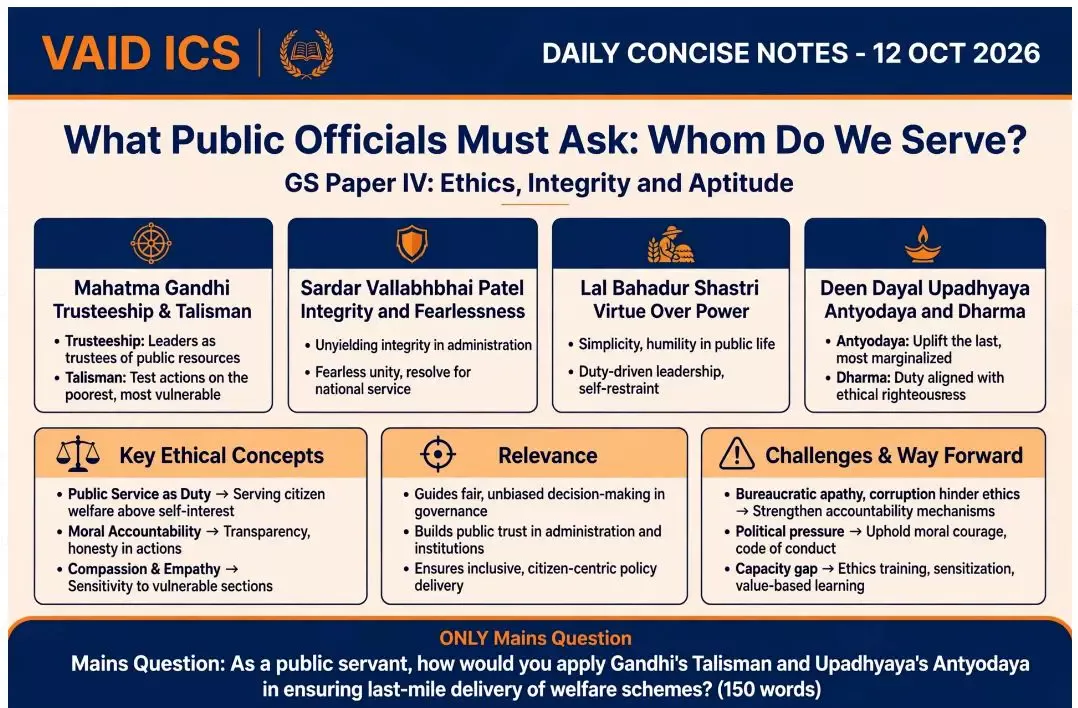
Sardar Vallabhbhai Patel: Integrity and Fearless Administration
-
Integrity: Civil servants must maintain honesty, impartiality and professional discipline.
-
Fearless advice: Officials should express their honest and reasoned opinions, even when they differ from those of political superiors.
-
Constitutional responsibility: Civil servants must uphold the rule of law and protect citizens without discrimination.
-
Administrative application: Resisting undue pressure, recording objective advice and taking timely action during crises.
Lal Bahadur Shastri: Virtue Over Power
-
Ethical leadership: Public office should be guided by moral character and service rather than status or authority.
-
Equal access: Government services must be accessible to all citizens, without dependence on VIP recommendations or personal connections.
-
Innovation and foresight: Officials should go beyond mechanical rule-following and develop practical solutions to public problems.
-
Administrative application: Simplifying procedures, reducing delays and ensuring responsive, equitable service delivery.
Deen Dayal Upadhyaya: Antyodaya and Dharma
-
Antyodaya: The progress of society should be assessed by the welfare of its last and most disadvantaged person.
-
Dharma: Public office is a moral duty that demands righteous conduct, responsibility and integrity.
-
Moral independence: Officials should uphold ethical principles and public interest despite political or bureaucratic pressure.
-
Administrative application: Inclusive development, targeted support for marginalised groups and equitable distribution of opportunities.
3. Key Ethical Concepts:
Trusteeship: The idea that wealth, power and resources must be used responsibly for the welfare of society.
Antyodaya: The upliftment of the last, poorest and most disadvantaged person, associated with Deen Dayal Upadhyaya.
Dharma: Righteous conduct, moral duty and adherence to ethical principles in personal and public life.
Integrity: Consistency between ethical values, official decisions and actual conduct.
Impartiality: Treating citizens fairly without favouritism, prejudice or discrimination.
Accountability: Being answerable for official decisions, actions and the use of public resources.
4. Relevance to Civil Services Today:
-
Citizen-centric governance: Treat citizens as rights-holders rather than passive recipients of government benefits.
-
Ethical decision-making: Evaluate policies by their impact on vulnerable communities.
-
Political neutrality: Provide objective advice and implement lawful government decisions impartially.
-
Transparency: Prevent corruption, favouritism and misuse of public funds.
-
Empathy and responsiveness: Make grievance redressal and public services accessible to all.
-
Innovation: Combine adherence to rules with initiative, foresight and problem-solving.
5. Challenges in Ethical Public Administration:
-
Political interference and pressure from influential groups.
-
Red-tapism and excessive dependence on procedures.
-
Corruption, favouritism and conflicts of interest.
-
Weak accountability and delays in grievance redressal.
-
Exclusion of vulnerable citizens due to digital, financial or social barriers.
6. Way Forward:
-
Strengthen ethical training and value-based leadership.
-
Protect professional independence and encourage reasoned, fearless advice.
-
Improve transparency through social audits, citizen charters and effective grievance redressal.
-
Promote technology-driven services while ensuring access for digitally excluded citizens.
-
Evaluate administrative performance through measurable improvements in citizens’ welfare, especially among disadvantaged groups.
7. Conclusion:
The central purpose of public service is public welfare, not personal power or privilege. Gandhi’s trusteeship, Patel’s integrity, Shastri’s emphasis on virtue and equitable access, and Upadhyaya’s Antyodaya collectively underline that good governance must be ethical, impartial and inclusive.
A civil servant should therefore ask not merely, “Is this decision legally permissible?” but also, “Is it fair, humane and beneficial to the people I serve?”
लोक सेवकों को स्वयं से पूछना चाहिए — हम किसकी सेवा करते हैं?
विषय: नैतिकता, सत्यनिष्ठा एवं अभिवृत्ति | सामान्य अध्ययन प्रश्नपत्र–IV | लोक सेवा मूल्य
प्रस्तावना:
लोक प्रशासन का मूल प्रश्न केवल यह नहीं है कि शासन कैसे किया जाए, बल्कि यह भी है कि हम किसकी सेवा करते हैं। लोक सेवकों को प्रदत्त शक्तियाँ एवं सार्वजनिक संसाधन जनता के कल्याण के लिए न्यास के रूप में प्राप्त होते हैं। इनका प्रमुख उद्देश्य निर्धन, वंचित एवं समाज के कमजोर वर्गों सहित सभी नागरिकों के हितों की रक्षा करना है।
महात्मा गांधी, सरदार वल्लभभाई पटेल, लाल बहादुर शास्त्री एवं दीनदयाल उपाध्याय के विचार उत्तरदायी, पारदर्शी, निष्पक्ष एवं नागरिक-केंद्रित प्रशासन के लिए महत्त्वपूर्ण नैतिक मार्गदर्शन प्रदान करते हैं।
भारतीय विचारकों की नैतिक शिक्षाएँ:
महात्मा गांधी: न्यासिता के रूप में लोक पद
-
न्यासिता (Trusteeship): सार्वजनिक शक्ति एवं संसाधनों को समाज के कल्याण हेतु धरोहर के रूप में माना जाना चाहिए, विशेषकर समाज के सबसे कमजोर वर्गों के हित में।
-
गांधीजी का तावीज: किसी निर्णय से पूर्व लोक सेवक को समाज के सबसे गरीब एवं कमजोर व्यक्ति का स्मरण करना चाहिए तथा यह विचार करना चाहिए कि उसका निर्णय उस व्यक्ति के जीवन में सुधार लाएगा या नहीं और उसे अपने जीवन पर अधिक नियंत्रण प्रदान करेगा या नहीं।
-
नैतिक मूल्य: करुणा, सामाजिक न्याय, सादगी एवं जनसेवा।
-
प्रशासनिक अनुप्रयोग: कल्याणकारी योजनाओं को प्राथमिकता देना, असमानता कम करना तथा यह सुनिश्चित करना कि सार्वजनिक धन वास्तविक लाभार्थियों तक पहुँचे।
सरदार वल्लभभाई पटेल: सत्यनिष्ठा एवं निर्भीक प्रशासन
-
सत्यनिष्ठा: लोक सेवकों को ईमानदारी, निष्पक्षता एवं व्यावसायिक अनुशासन बनाए रखना चाहिए।
-
निर्भीक परामर्श: अधिकारियों को अपने वरिष्ठों से असहमति होने पर भी अपने निष्पक्ष एवं तर्कसंगत विचार स्पष्ट रूप से प्रस्तुत करने चाहिए।
-
संवैधानिक उत्तरदायित्व: लोक सेवकों का दायित्व विधि के शासन को बनाए रखना तथा बिना किसी भेदभाव के नागरिकों की रक्षा करना है।
-
प्रशासनिक अनुप्रयोग: अनुचित दबाव का विरोध करना, अभिलेखों में तथ्यपरक एवं ईमानदार अभिमत दर्ज करना तथा संकट की परिस्थितियों में समयबद्ध कार्रवाई करना।
लाल बहादुर शास्त्री: सत्ता से अधिक सदाचार
-
नैतिक नेतृत्व: लोक पद का उद्देश्य प्रतिष्ठा एवं अधिकार का प्रदर्शन नहीं, बल्कि जनसेवा और नैतिक मूल्यों का पालन होना चाहिए।
-
समान पहुँच: सरकारी सेवाएँ सभी नागरिकों को समान रूप से उपलब्ध होनी चाहिए। इनके लिए विशिष्ट व्यक्तियों की अनुशंसा अथवा व्यक्तिगत संपर्क पर निर्भरता नहीं होनी चाहिए।
-
नवाचार एवं दूरदर्शिता: अधिकारियों को केवल नियमों के यांत्रिक अनुपालन तक सीमित न रहकर समस्याओं के व्यावहारिक समाधान विकसित करने चाहिए।
-
प्रशासनिक अनुप्रयोग: प्रक्रियाओं का सरलीकरण, विलंब में कमी तथा त्वरित एवं समानतापूर्ण सेवा वितरण।
दीनदयाल उपाध्याय: अंत्योदय एवं धर्म
-
अंत्योदय: समाज की प्रगति का आकलन उसके अंतिम एवं सर्वाधिक वंचित व्यक्ति के कल्याण के आधार पर किया जाना चाहिए।
-
धर्म: लोक पद को नैतिक दायित्व के रूप में ग्रहण किया जाना चाहिए, जिसमें सदाचरण, कर्तव्यनिष्ठा एवं सत्यनिष्ठा का पालन आवश्यक है।
-
नैतिक स्वतंत्रता: अधिकारियों को राजनीतिक अथवा प्रशासनिक दबाव के बावजूद नैतिक सिद्धांतों एवं जनहित के प्रति प्रतिबद्ध रहना चाहिए।
-
प्रशासनिक अनुप्रयोग: समावेशी विकास, वंचित वर्गों के लिए लक्षित सहायता तथा अवसरों का न्यायसंगत वितरण।
प्रमुख नैतिक अवधारणाएँ:
न्यासिता (Trusteeship): वह अवधारणा जिसके अनुसार धन, शक्ति एवं संसाधनों का उपयोग व्यक्तिगत स्वार्थ के बजाय समाज के कल्याण के लिए उत्तरदायित्वपूर्वक किया जाना चाहिए।
अंत्योदय (Antyodaya): समाज के अंतिम, निर्धनतम एवं सर्वाधिक वंचित व्यक्ति का उत्थान। यह अवधारणा दीनदयाल उपाध्याय के विचारों से विशेष रूप से जुड़ी है।
धर्म (Dharma): व्यक्तिगत एवं सार्वजनिक जीवन में सदाचरण, नैतिक कर्तव्य तथा उचित आचरण का पालन।
सत्यनिष्ठा (Integrity): व्यक्ति के नैतिक मूल्यों, निर्णयों एवं वास्तविक आचरण के बीच एकरूपता।
निष्पक्षता (Impartiality): पक्षपात, पूर्वाग्रह अथवा भेदभाव से मुक्त होकर सभी नागरिकों के साथ न्यायपूर्ण व्यवहार करना।
उत्तरदायित्व (Accountability): अपने निर्णयों, कार्यों तथा सार्वजनिक संसाधनों के उपयोग के लिए जवाबदेह होना।
समकालीन सिविल सेवाओं में प्रासंगिकता:
-
नागरिक-केंद्रित शासन: नागरिकों को सरकारी योजनाओं के निष्क्रिय लाभार्थियों के बजाय अधिकार-संपन्न व्यक्तियों के रूप में देखना।
-
नैतिक निर्णय-निर्माण: नीतियों एवं प्रशासनिक निर्णयों के प्रभाव का आकलन कमजोर वर्गों के दृष्टिकोण से करना।
-
राजनीतिक तटस्थता: वस्तुनिष्ठ परामर्श देना तथा विधिसम्मत सरकारी निर्णयों का निष्पक्ष क्रियान्वयन करना।
-
पारदर्शिता: भ्रष्टाचार, पक्षपात एवं सार्वजनिक धन के दुरुपयोग को रोकना।
-
संवेदनशीलता एवं उत्तरदायित्व: शिकायत निवारण तथा सार्वजनिक सेवाओं को सभी नागरिकों के लिए सुलभ बनाना।
-
नवाचार: नियमों के अनुपालन के साथ पहल, दूरदर्शिता एवं समस्या-समाधान की क्षमता विकसित करना।
नैतिक प्रशासन के समक्ष प्रमुख चुनौतियाँ:
-
राजनीतिक हस्तक्षेप एवं प्रभावशाली समूहों का अनुचित दबाव।
-
लालफीताशाही एवं प्रक्रियात्मक जटिलताएँ।
-
भ्रष्टाचार, पक्षपात एवं हितों का टकराव।
-
कमजोर जवाबदेही एवं शिकायतों के निवारण में विलंब।
-
डिजिटल, आर्थिक अथवा सामाजिक बाधाओं के कारण कमजोर वर्गों का सेवाओं से वंचित रह जाना।
आगे की राह:
-
नैतिक प्रशिक्षण एवं मूल्य-आधारित नेतृत्व को सुदृढ़ किया जाए।
-
लोक सेवकों की व्यावसायिक स्वतंत्रता की रक्षा की जाए तथा निर्भीक एवं तर्कसंगत परामर्श को प्रोत्साहित किया जाए।
-
सामाजिक अंकेक्षण, नागरिक चार्टर एवं प्रभावी शिकायत निवारण के माध्यम से पारदर्शिता बढ़ाई जाए।
-
प्रौद्योगिकी-आधारित सेवाओं के साथ डिजिटल रूप से वंचित नागरिकों की पहुँच सुनिश्चित की जाए।
-
प्रशासनिक कार्य-निष्पादन का मूल्यांकन विशेष रूप से वंचित वर्गों के जीवन में हुए वास्तविक सुधार के आधार पर किया जाए।
निष्कर्ष:
लोक सेवा का मूल उद्देश्य व्यक्तिगत सत्ता अथवा विशेषाधिकार नहीं, बल्कि जनकल्याण है। गांधीजी की न्यासिता, सरदार पटेल की सत्यनिष्ठा, लाल बहादुर शास्त्री का सदाचार एवं समान पहुँच पर बल तथा दीनदयाल उपाध्याय का अंत्योदय का सिद्धांत यह स्पष्ट करते हैं कि सुशासन नैतिक, निष्पक्ष एवं समावेशी होना चाहिए।
अतः लोक सेवक को केवल यह नहीं पूछना चाहिए कि “क्या यह निर्णय विधिसम्मत है?” बल्कि यह भी विचार करना चाहिए कि “क्या यह निर्णय न्यायसंगत, मानवीय तथा उन लोगों के हित में है, जिनकी सेवा का दायित्व मुझे सौंपा गया है?”

May 19, 2026
October 17, 2025
October 16, 2025
October 6, 2025

