July 22, 2026
What is the White-bellied Heron?
Why in News:
The Forest Advisory Committee (FAC) under the Union Environment Ministry granted in-principle clearance for the 1,200-MW Kalai-II hydroelectric project on the Lohit River in Arunachal Pradesh.
Controversy arose because the project’s Environmental Impact Assessment (EIA) completely omitted the presence of the White-bellied Heron, a critically endangered bird species living directly in the river basin. :
Relevance:
- Prelims Focus: Direct questions on species status, geographical habitat, river systems, and legal protections (e.g., White-bellied Heron, Lohit River, WPA Schedule-I).
- Mains Focus (GS Paper 3 – Environment & Ecology
What is the White-bellied Heron?
- Identity: One of the rarest and largest herons in the world (stands up to 4 feet tall).
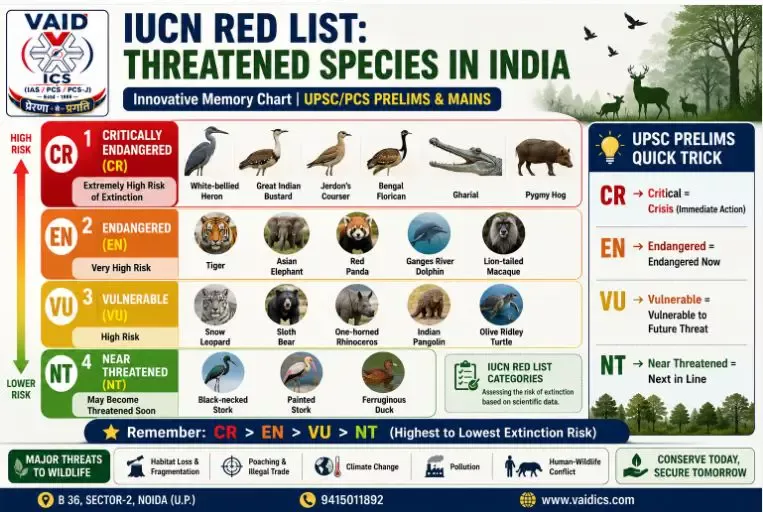
- Conservation Status: * IUCN Red List: Critically Endangered (global population is extremely small, numbering fewer than 60 individuals).
-
- Wildlife Protection Act, 1972: Schedule I (Highest legal protection in India).
- Habitat & Behavior: * Inhabits fast-flowing Himalayan rivers and old-growth mature riparian forests up to 1,500m above sea level.
-
- Strictly depends on clean, undisturbed rivers to catch fish. It requires absolute zero human/anthropogenic disturbance.
- Distribution in India: Highly restricted to pockets in Arunachal Pradesh, primarily along the Lohit River basin and its tributaries (like the Lahm River).
Core Issues Highlighted:
- Flawed EIA Reports: The consultancy firm (WAPCOS) left the White-bellied Heron out of the assessment because they only looked at a narrow, isolated project diversion site rather than studying the broader, connected river ecosystem.
- Absurd Compensatory Afforestation: To make up for cutting down over 33,000 trees in the fragile Eastern Himalayan biodiversity hotspot, authorities approved compensatory tree-planting over 1,000 kilometres away in Madhya Pradesh. Ecologists point out that you cannot recreate an ancient, complex Himalayan forest in a completely different state.
- Ignoring Local Realities: Local tribal communities and public hearings raised strong objections over land submergence, inaccurate baseline data, and the omission of local flora, fauna, and cultural markers.
Way forward :
- Basin-Level Approach: Assess river health and wildlife impacts across the entire connected river basin (like the Lohit basin) rather than in isolated patches.
- Stricter Accountability for EIA Agencies: Impose strict penalties on consultancy firms that overlook or skip endangered Schedule-I species during baseline surveys.
- Balanced Conservation: Move away from focusing only on big animals (like tigers and elephants) and give rare, critical indicator species like the White-bellied Heron urgent, targeted protection.
Allied important topics for prelims:
Environmental Impact Assessment (EIA):
A policy and planning tool used to predict, evaluate, and mitigate the environmental, social, and economic consequences of proposed developmental projects (such as dams, industries, or highways) before financial commitments or approvals are finalized.
- Legal Backing in India: Governed under the Environment (Protection) Act, 1986 via the EIA Notification (most notably the framework outlined in 2006 and subsequent amendments).
Key Stages of the EIA Process:
- Screening: Deciding whether a project requires an EIA based on its scale and location.
- Scoping: Determining the terms of reference (ToR) and boundaries of the study.
- Baseline Data Collection: Documenting existing environmental parameters (flora, fauna, socio-economic conditions).
- Impact Prediction & Public Consultation: Assessing potential damages and conducting mandatory public hearings with local communities.
- Decision Making & Monitoring: Environmental Clearance (EC) is either granted or rejected by regulatory authorities (like the Expert Appraisal Committee or Forest Advisory Committee).
Wildlife Protection Act (WPA), 1972:
A comprehensive central legislation enacted to protect wild animals, birds, and plants, and to ensure ecological and environmental security across India.
- Key Provisions & Schedules: The Act categorizes flora and fauna into different schedules based on the degree of legal protection they require:
- Schedule I and Part II of Schedule II: Provide absolute legal protection; offenses under these carry the highest penalties (e.g., protecting endangered species like the White-bellied Heron, Tigers, or Rhinos).
- Schedules III and IV: Cover species with lower levels of protection.
- Schedule V: Covers vermin (animals that can be hunted, like common crows or certain rodents under specific conditions).
- Schedule VI: Regulates and prohibits the cultivation, collection, and trade of specified endemic plants.
- Protected Areas Established Under WPA: Sanctuaries, National Parks, Conservation Reserves, and Community Reserves.
- Significance: Serves as the primary legal shield against habitat destruction, poaching, and illegal wildlife trade, empowering forest officials to intercept destructive industrial activities within or near protected wildlife zones.
CAMPA (Compensatory Afforestation Fund Management and Planning Authority):
A institutional mechanism established to manage funds collected from user agencies when forest land is diverted for non-forest purposes (like building dams, mining, or railways).
- Core Principle: Under the Forest (Conservation) Act, 1980, if forest land is cleared, equivalent non-forest land must be provided for afforestation, or degraded forest land twice the size must be replanted. CAMPA acts as the national and state-level custodian of these financial collections.
- Institutional Setup: * Operates at both National (National CAMPA) and State levels (State CAMPA funds).
- Backed by the Compensatory Afforestation Fund (CAF) Act, 2016, which institutionalized the sharing and utilization of these accumulated funds (90% to states, 10% to the Centre).

May 19, 2026
October 17, 2025
October 16, 2025
October 6, 2025

