February 25, 2026
What is the Golden Horizon?
Why in the News? As of February 25, 2026, Prime Minister Narendra Modi is on a landmark two-day State visit to Israel. This visit is particularly significant as it marks a “second-tier” upgrade of the relationship.
Key Highlights of the Visit:
-
Historic Knesset Address: PM Modi became the first Indian Prime Minister to address the Israeli Parliament (the Knesset). The building was symbolically illuminated in the Indian tricolour to mark the occasion.
-
Special Strategic Partnership: The leaders aim to elevate ties to a “Special” category, reserved for Israel’s closest allies like the US and Germany.
-
Free Trade Agreement (FTA): Formal negotiations for the India–Israel FTA officially launched in New Delhi (February 23–26) to coincide with the visit.
-
Defense & AI: Discussions focused on high-end tech, including the Heron MK-2 drones, cybersecurity, and potentially Israel’s Iron Dome technology.
2. Detailed History of the Relation:
The relationship has moved through three distinct phases:
Phase I: The Cold Shoulder (1947–1991):
-
Recognition without Ties: India recognized Israel in 1950 but refused to establish full diplomatic relations. This was largely to avoid alienating Arab nations (on whom India relied for oil) and to maintain its leadership in the Non-Aligned Movement (NAM).
-
Discreet Support: Despite no official “embassy,” Israel secretly helped India with weapons and intelligence during the 1962 (China) and 1965/1971 (Pakistan) wars.
Phase II: The Diplomatic Opening (1992–2014):
-
Normalization (1992): Under PM P.V. Narasimha Rao, India finally established full diplomatic ties. This happened after the Cold War ended and the Israel-Palestine “Oslo Accords” made it politically easier for India to move forward.
-
Kargil War (1999): Israel was the only country to provide immediate, high-tech military aid (laser-guided bombs) to India during the conflict, cementing their status as a “reliable” partner.
Phase III: The “De-Hyphenation” Era (2014–Present)
-
PM Modi’s 2017 Visit: The first-ever visit by an Indian PM. India adopted the “De-hyphenation Policy”—meaning India treats its relationship with Israel and Palestine as two separate, independent tracks.
-
I2U2 Grouping: India and Israel are now partners in the “West Asian Quad” (with USA and UAE), focusing on global food security and energy.
3. Key Pillars of Cooperation:
| Pillar | Key Area | Example Project |
| Defense | India is Israel’s largest arms buyer. | Barak-8 Surface-to-Air Missile (Jointly built). |
| Agriculture | Drip irrigation and water management. | 31 Centres of Excellence in 13 Indian states. |
| Innovation | The I4F Fund for tech startups. | Joint R&D in AI and Green Energy. |
| Diplomacy | I2U2 & IMEC | Strategic corridors connecting India to Europe via Israel. |
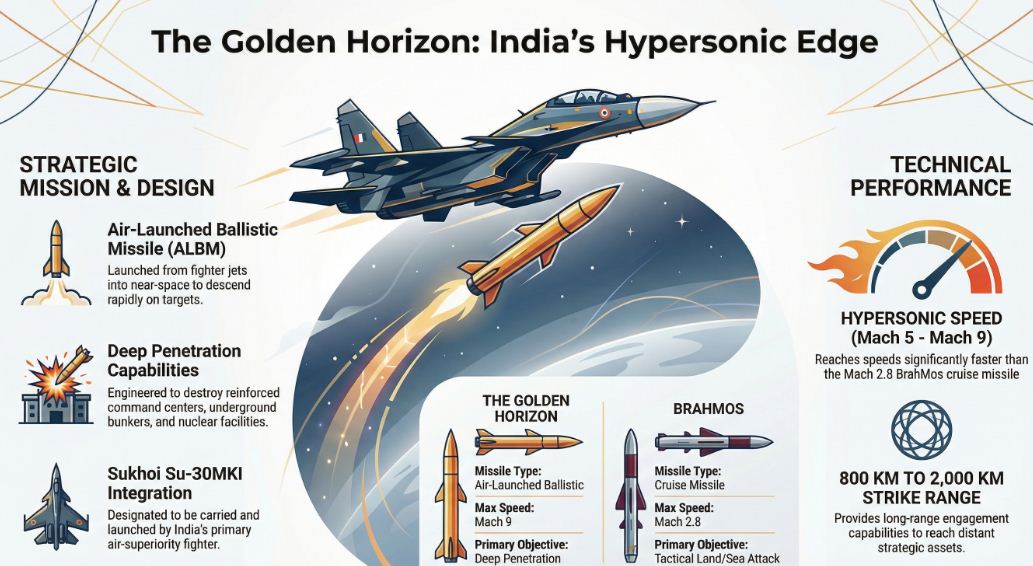
What is the Golden Horizon?
The Golden Horizon is an Air-Launched Ballistic Missile (ALBM). Unlike traditional cruise missiles (like the BrahMos) that fly like a plane, this is a ballistic missile launched from a fighter jet that travels into near-space before screaming down at its target.
-
Speed: It is Hypersonic, reaching speeds between Mach 5 and Mach 9. For comparison, India’s BrahMos travels at Mach 2.8.
-
Range: Estimates suggest a strike range of 800 km to 2,000 km.
-
Purpose: It is designed for “Deep Penetration”—meaning it can destroy underground bunkers, nuclear facilities, and reinforced command centers that normal missiles cannot reach.
-
Launch Platform: It is expected to be integrated with India’s Sukhoi Su-30MKI fighter jets.

October 17, 2025
October 16, 2025
October 6, 2025
September 24, 2025

