February 13, 2026
What is Substantive Motion?
Why in the News?
Recently , Nishikant Dubey moved a substantive motion in the Lok Sabha seeking the termination of Rahul Gandhi’s parliamentary membership.
The move has sparked a fierce debate in Parliament because it goes beyond a standard “privilege motion.” Dubey is calling for Gandhi’s permanent expulsion and a lifetime ban from contesting elections, alleging that Gandhi is working with “anti-India forces” to destabilize the country.
Key Points of the Controversy
- The Trigger: The motion follows Rahul Gandhi’s speech where he attacked the government over a recent India-US trade deal, accusing the Prime Minister of “selling the nation” and compromising India’s energy and financial security.
- The Allegations:
-
- Foreign Links: Dubey alleged that Gandhi is “hand-in-glove” with organizations like the George Soros Foundation, the Ford Foundation, and USAID.
- Unpublished Memoir: Dubey criticized Gandhi for referencing an unpublished memoir by former Army Chief General M.M. Naravane to attack the Ministry of Defence.
- “Anti-India” Forces: The BJP MP accused the LoP of acting like an “urban Naxal” and lowering the dignity of the Supreme Court and the Election Commission.
What is a Substantive Motion?
In parliamentary procedure, a substantive motion is a self-contained, independent proposal submitted by a Member of Parliament (MP). Unlike “subsidiary” or “incidental” motions, it does not depend on any other pending matter.
- The Purpose: It is used to discuss and decide on matters of high importance or to criticize the conduct of persons in high constitutional authority (like the President, Judges, or the Speaker).
- The Procedure: It must be drafted in a way that allows the House to express a clear “Yes” or “No” through a vote.
- The Weight: Because it targets high-ranking individuals, the language must be precise and cannot contain “unparliamentary” or vague insults.
Constitutional & Legal Framework:
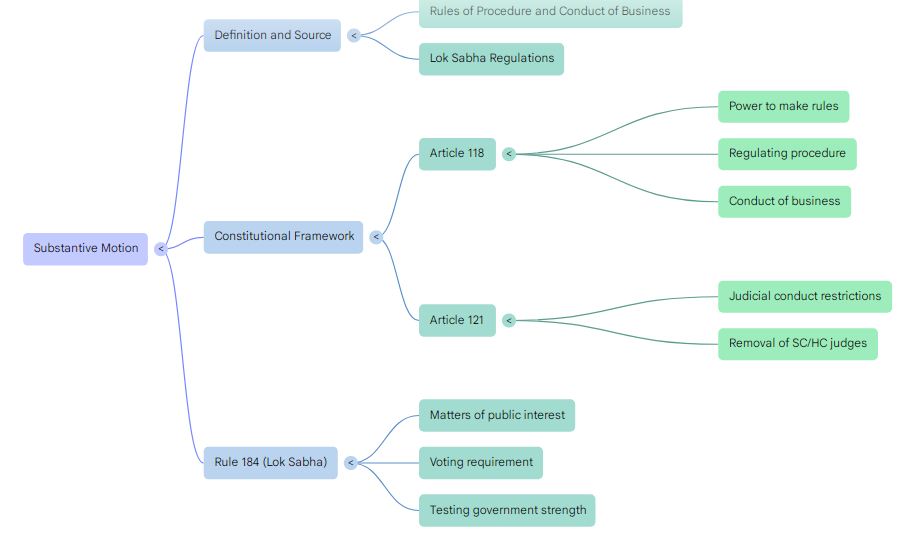
While the term “Substantive Motion” is defined in the Rules of Procedure and Conduct of Business in Lok Sabha, its power is derived from several Constitutional Articles:
| Article | Relevance |
| Article 118 | Grants each House of Parliament the power to make rules for regulating its procedure and the conduct of its business. |
| Article 121 | Restricts discussion on the conduct of Supreme Court or High Court judges except upon a substantive motion for their removal. |
| Rule 184 (Lok Sabha) | Governs motions on matters of public interest; if a substantive motion is admitted under this rule, it involves a vote that can test the government’s strength. |
Historical Context & Key Precedents:
Historically, substantive motions are rare because they are seen as “nuclear options” used to remove people from power or formally censure them.
- The 2005 “Cash-for-Query” Scandal: This is the most famous modern example. A substantive motion was moved to expel 11 MPs who were caught on camera accepting money to ask questions in Parliament. The motion led to their immediate removal from the House.
- Impeachment Proceedings: Any move to remove a Judge or the President begins as a substantive motion (often called a “Removal Motion”). For example, the 1993 motion against Justice V. Ramaswami was a substantive motion that reached the voting stage.
- 2024–2026 Shift: Recently, the frequency of these motions has increased as a tool for the ruling party to target the conduct of the Leader of the Opposition (LoP) or vice versa, moving beyond mere “Privilege Motions” (which only deal with breaches of parliamentary rules) to “Substantive Motions” (which can seek permanent expulsion).
Substantive vs. Privilege Motion:
It’s easy to confuse the two, but they have different “teeth”:
- Privilege Motion: Focuses on a specific lie or “breach of decorum” within the house. It usually goes to a Committee.
- Substantive Motion: Focuses on the conduct or fitness of an individual to hold office. It is a direct attack on their right to remain in the House.
types of Motions in Parliament :
Motions in Parliament uphold democracy by enabling representatives to raise issues, express viewpoints, and hold the government accountable, fostering transparency and participation. These motions can be grouped into three main categories.
- Substantive Motion: It is an independent, self-contained proposal that addresses significant issues, such as theimpeachment of the President or the removal of the Chief Election Commissioner.
- Substitute Motion: This motion is introduced in Parliament as an alternative to the original motion, replacing it if adopted by the House.
- Subsidiary Motion: This motion in Parliament, on its own, lacks meaning and cannot determine the House’s decision without reference to the original motion or ongoing proceedings. It is further classified into three types:
- Ancillary Motion: It is used as the standard procedure for handling different types of business.
- Superseding Motion: It is presented during a debate on another issue, aiming to override that issue.
- Amendment: The amendment proposes to modify or replace only a specific part of the original motion.
Closure Motion:
A Closure Motion in Parliament, proposed by a member of the concerned House, seeks to end debate on a matter. If accepted, the debate is halted, and the matter is put to a vote. Types of closure motions are as follows:
- Simple Closure:Made when a member proposes that the ‘matter having been sufficiently discussed be now put to a vote’.
- Closure by Compartments:In this case, the clauses of a bill or a lengthy resolution are divided into sections before the debate begins.
- The debate addresses each section as a whole, and the entire section is then put to a vote.
- Kangaroo Closure: Only the key clauses of a bill or resolution are debated and voted on, while the other clauses are bypassed and considered as passed.
- Guillotine Closure:It occurs when, due to time constraints, the remaining undiscussed clauses of a bill or resolution are put to a vote along with the already discussed ones, after the allotted time for discussion has expired.
Calling Attention Motion
Calling Attention Motion can be introduced by a member of Parliament to bring a matter of urgent public importance to the attention of a minister and to request an authoritative statement on the issue. It is an Indian innovation in parliamentary procedure, introduced in 1954 similar to the Zero Hour. Unlike the Zero Hour, it is specified in the Rules of Procedure.
Privilege Motion:
Privilege Motion in Parliament addresses the violation of parliamentary privileges by a minister. It is raised by a Member of Parliament when he/she believes a minister has infringed upon the privileges of the House or its members by withholding relevant information or presenting false or misleading facts. The Privilege motion aims to censure the minister involved.
Adjournment Motion:
The Adjournment Motion in Parliament is introduced to highlight a specific matter of urgent public importance, requiring the support of 50 members for its acceptance. As it disrupts the normal business of the House, it is viewed as an exceptional procedure.
- The debate on an adjournment motion must last at least two hours and thirty minutes.
- Typically, such a motion implies censure of the government, which is why it is not permitted in the Rajya Sabha.
- Conditions for Moving an Adjournment Motion
- Must address a specific, recent, factual, urgent, and significant public issue.
- Should focus on one matter and not revisit previously discussed topics.
- Cannot involve privilege questions, court cases, or issues addressable through other motions.
No Confidence Motion
The No Confidence Motion in India can only be introduced in the Lok Sabha. For the no-confidence motion to be allowed for discussion, it must receive the support of at least 50 members of the Lok Sabha.
- If such a motion proceeds, the lower house of Parliament debates and votes on it.
- Moreover, if the majority of members vote in favour, the no-confidence motion is passed, and the Government must resign.
- Thefirst No Confidence Motion was introduced in 1963 by Acharya Kriplani against the Nehru Government.
- The highest number filed against the Indira Gandhi Government.
Confidence Motion:
The Confidence Motion in Parliament has emerged as a procedural tool to address situations of fractured mandates resulting in hung parliaments, minority governments, and coalition governments. Governments with a slim majority may be required by the President to prove their majority on the floor of the House.
- Furthermore, in some cases, the government may voluntarily move a confidence motion to demonstrate its support.
- However, If such a motion is rejected, it leads to the government’s downfall.
Censure Motion
The Censure Motion can only be introduced in the Lok Sabha by the Opposition. It may be moved against the Council of Ministers, an individual Minister, or a group of Ministers for their failure to act or due to certain policies and actions.
- Features:The censure motion in Parliament can express the House’s regret, indignation, or surprise at the Ministers’ failure to perform their duties.
- Moreover, such a motion must be specific and self-explanatory(unlike the No-Confidence motion, which does not require detailed reasons).
- If the Censure Motion is passed, the Council of Ministers is not required to resign, but it must seek the confidence of the Lok Sabha as soon as possible.
Motion of Thanks:
The Motion of Thanks in Parliament follows the President’s address at the start of each general election session and every fiscal year. In this address, the President outlines the government’s policies and programs, both from the previous year and the upcoming one.
- The motion debated in both Houses of Parliament must be passed; failure to do so signifies the government’s defeat.
- This speech provides an opportunity for members to discuss, debate, and criticize the government’s performance.
No Day Yet Named Motion:
A No Day Yet Named Motion in Parliament refers to a motion that is accepted by the Speaker, but no specific date has been set for its discussion. The Speaker, after reviewing the House’s business and consulting with the leader of the House or following the recommendation of the Business Advisory Committee, schedules a day or part of a day for its debate.
Dilatory Motion:
A Dilatory Motion in Parliament seeks to adjourn the debate on a bill, motion, or resolution, or to slow down the progress of business in the House. It can be moved by a member of the Parliament at any time after a motion has been made.
- The debate on this motion islimited to its content, and if the Speaker believes it misuses the House’s rules, they may either immediately put the question or reject it.
Cut Motion:
A Cut Motion is a tool used by members of Lok Sabha to oppose the government’s proposed allocation of funds in the Finance Bill as part of the Demand for Grants. If such a motion is adopted, it serves as a no-confidence vote. The government is then required to resign if it cannot secure majority support in the Lok Sabha.
- The Speaker has the sole discretion to decide the admissibility of a cut motion.
- Disapproval of Policy Cut: A disapproval of policy cut demands reducing the budget allocation to Re 1, signaling disagreement with the policy.
- The member must specify the policy aspects for debate, limiting the discussion to those points.
- Economic Cut:An economic cut motion aims to reduce a specific budget allocation. This reduction can either be a flat amount or the removal or decrease of a particular item.
- The notice must clearly state the specific issue to be debated.
- Token Cut:A token cut motion reduces the budget allocation by a symbolic Rs 100 to bring attention to a specific grievance under the Indian government’s purview.

October 17, 2025
October 16, 2025
October 6, 2025
September 24, 2025

