January 19, 2026
What is Project Suncatcher?
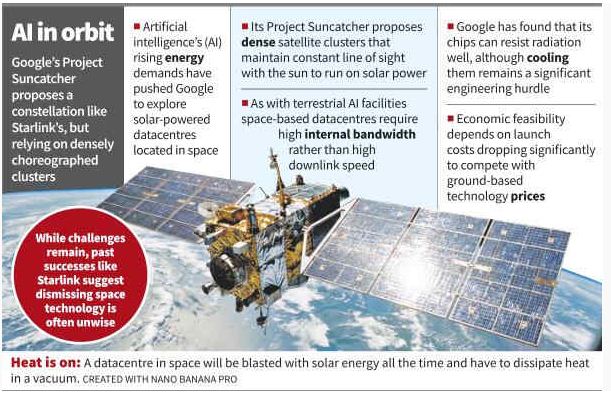
Project Suncatcher is Google’s “moonshot” research project aimed at moving AI data centers off the planet and into Earth’s orbit. It was officially unveiled in late 2025 as a radical solution to the massive energy and environmental costs of AI on Earth.
- Why is it in the news now (2026)?
- The AI Energy Crisis: Terrestrial data centers are consuming record amounts of electricity and water (for cooling). Global demand is expected to rise by 165% by 2030, putting immense pressure on power grids.
- Milestone Announcement: Google recently confirmed it is moving from “theory” to “testing,” partnering with the satellite company Planet Labs to launch the first prototypes.
- The Space Race 2.0: It’s not just Google; companies like SpaceX, Nvidia, and ISRO are all racing to claim “orbital real estate” for computing, making this a top tech and geopolitical headline.
- Core Aims & Objectives
- Harness Unlimited Energy: In space, solar panels are 8x more productive than on Earth. By using “dawn–dusk” orbits, satellites can stay in near-constant sunlight, providing 24/7 power without batteries.
- Zero-Resource Cooling: It aims to eliminate the need for millions of gallons of Earth’s fresh water by using the vacuum of space and specialized radiators for cooling.
- Infinite Scalability: Moving to space bypasses Earthly constraints like land availability, local regulations, and aging power grids.
- Data Sovereignty: Since space isn’t owned by any nation, orbital data centers could potentially bypass strict regional data laws, offering a new kind of “international” cloud.
- Key Technical Specs
- The Brain: Uses Trillium v6e TPUs (Google’s custom AI chips), which have been tested to survive space radiation for at least 5 years.
- The Network: Uses Laser Links (Free-Space Optical Links) to beam data between satellites at tens of terabits per second—essential for complex AI “thinking.”
- The Formation: Satellites will fly in dense clusters (81 satellites in a group), spaced as close as 200 meters apart to act as a single, giant supercomputer.
- Roadmap & Future
- 2027 Mission: Launch of two prototype satellites to test if the chips and lasers actually work in the harsh environment of orbit.
- 2030s Goal: As launch costs drop toward $200/kg (thanks to rockets like SpaceX Starship), Google believes space-based AI will become cheaper than building on the ground.

Gist of daily Article /The Hindu 17oct 2025
October 17, 2025
Daily Gist of the Hindu/Indian Express : 16 Oct 2025
October 16, 2025
Daily Gist of The Hindu/Indian Express: 6 Oct 2025
October 6, 2025
Daily Gist of Article /The Hindu /Indian Express: 24 Sep 2025
September 24, 2025

