March 28, 2026
What is Pink Bollworm?
The Crisis of Bt Cotton and Pink Bollworm:
Pink Bollworm (PBW) – Pectinophora gossypiella
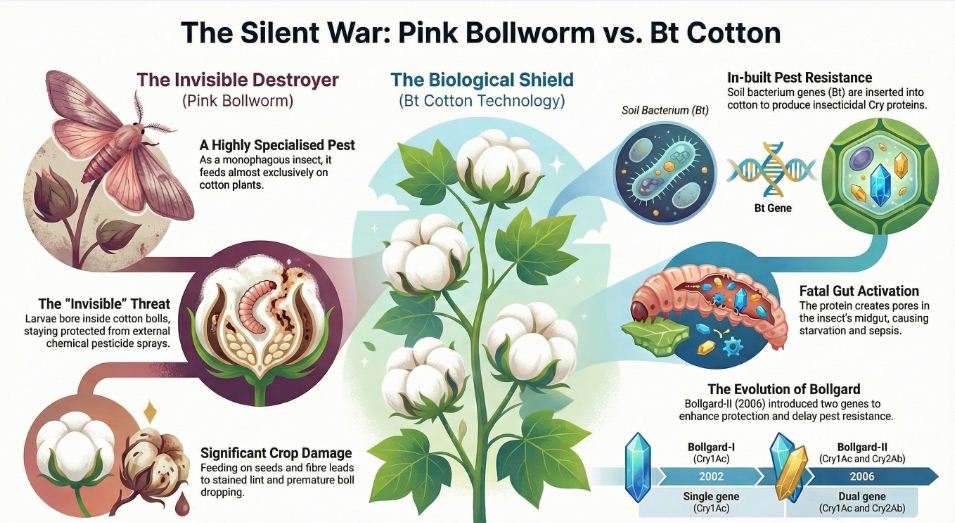
The Pink Bollworm is one of the most destructive pests for cotton globally. Unlike other pests, it is monophagous, meaning it feeds almost exclusively on cotton.
- Mechanism of Damage: The larvae bore into the cotton bolls (the fruit). Once inside, they feed on the seeds and destroy the lint (fiber).
- The “Invisible” Threat: Because the larvae stay inside the boll, they are protected from external chemical pesticide sprays. This makes them much harder to control than the American Bollworm.
- Impact on Quality: It causes “stained” lint and premature dropping of bolls, significantly reducing the market value of the crop.
Bt Cotton: India’s Only Commercial GM Crop:
Bt Cotton is a genetically modified variety developed to provide in-built resistance against specific pests (primarily the Bollworm complex).
- The Science: It involves the insertion of genes from the soil bacterium Bacillus thuringiensis (Bt).
- The Toxins: These genes produce Cry proteins (Crystal proteins), specifically Cry1Ac and Cry2Ab.
- Mode of Action: When a larva ingests the Bt protein, it is activated in the alkaline environment of the insect’s midgut. It binds to the gut wall, creating pores that cause the insect to stop feeding and eventually die of starvation/sepsis.
- Evolution in India: * Bollgard-I (2002): Contained a single gene (Cry1Ac).
- Bollgard-II (2006): Contained two genes (Cry1Ac and Cry2Ab) to provide better protection and delay resistance.
The Breakdown: Why is the Technology Failing?
By 2014-15, reports from Gujarat and later Haryana/Punjab confirmed that PBW had developed resistance to Bollgard-II.
- Genetic Resistance: Constant exposure to the same toxins led to the survival of “resistant” mutant pests, which then bred and passed on the resistance.
- Refugia Failure: The government mandated a “Refuge” policy (planting non-Bt cotton around the Bt field). The goal was to allow non-resistant pests to survive and mate with any resistant ones, diluting the resistance gene. In India, small landholdings and lack of awareness led to poor compliance.
- Long-duration Hybrids: Indian farmers often extend the cotton season. This provides a continuous food supply to the PBW, allowing it to complete multiple life cycles and build a larger population.
Socio-Economic Repercussions:
The failure of Bt technology has led to a “Double Whammy” for farmers like those in Hisar and Sirsa:
- Rising Input Costs: Farmers are now forced to use expensive chemical sprays on top of the high cost of Bt seeds.
- Stagnant Yields: Average yields have dropped by nearly 50% in several districts of Haryana over the last 5 years.
- Ecological Shift: Farmers are shifting to Paddy (Rice), which is catastrophic for the water table in semi-arid regions.
Way Forward: Integrated Pest Management (IPM);
- Short-term: Use of Pheromone Traps to disrupt mating and Light Traps for mass trapping of moths.
- Mid-term: Promoting Desi Cotton (G. arboreum) varieties, which are naturally more hardy and pest-resistant. The Haryana government’s ₹3,000/acre incentive for Desi cotton is a step in this direction.
- Long-term: Expediting the approval of Bollgard-III (which adds a third gene, Vip3A) or moving towards Hereditary Biotechnology (Gene Drive) to control pest populations.
- Policy: Strengthening the “Mera Pani-Meri Virasat” scheme to make non-paddy alternatives (like pulses) more profitable than rice.

October 17, 2025
October 16, 2025
October 6, 2025
September 24, 2025

