February 25, 2026
What is Human Papillomavirus (HPV)?
Why in the News? The Union Health Ministry has launched a special vaccination campaign targeting 14-year-old girls across India.
-
The Target: Approximately 1.15 crore (11.5 million) girls aged 14 will be vaccinated annually.
-
The Vaccine: The government is using Gardasil (a quadrivalent vaccine) provided free of cost at government health centers (Ayushman Arogya Mandirs).
-
The Strategy: Unlike routine immunization, this is a “special drive” tracked via the U-WIN portal (similar to CoWIN).
-
Dose Regimen: India has adopted a single-dose schedule based on recent WHO and NTAGI (National Technical Advisory Group on Immunisation) recommendations, which found one dose provides robust, long-term protection for this age group.
What is HPV?
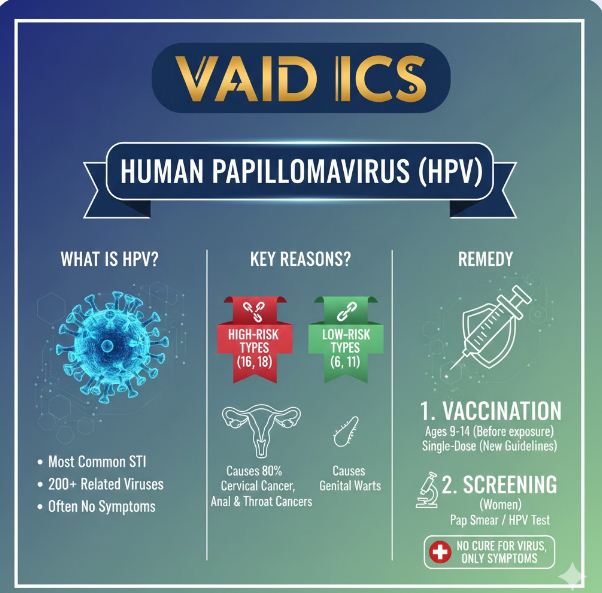
HPV stands for Human Papillomavirus. It is actually a group of more than 200 related viruses. It is the most common sexually transmitted infection (STI) globally—so common that nearly all sexually active people will get it at some point in their lives if they aren’t vaccinated.
-
Low-Risk HPV: These types (like HPV 6 and 11) usually cause genital warts. They are uncomfortable but do not cause cancer.
-
High-Risk HPV: These types (like HPV 16 and 18) can cause cancers. They often have no symptoms until the cancer has actually started to develop.
-
What can it cause?
While the body’s immune system clears the virus on its own in 90% of cases within two years, persistent infections can lead to:
-
Cervical Cancer: Almost all cases are caused by HPV.
-
Other Cancers: It can also cause cancer of the anus, throat (oropharyngeal), penis, vagina, and vulva.
-
Warts: Common warts on hands/feet or genital warts.
3. How is it spread?
HPV is spread through intimate skin-to-skin contact.
-
It is most commonly passed during vaginal, anal, or oral sex.
-
Important Note: Because it is skin-to-skin, condoms do not provide 100% protection (though they significantly reduce the risk), as the virus can be on skin not covered by the condom.
4. Prevention & Treatment:
-
Vaccination: This is the most effective tool. Vaccines like Gardasil are highly effective if given before a person becomes sexually active (ideally between ages 9–14).
-
Screening: For women, regular Pap smears or HPV tests can find “precancerous” cells before they ever turn into cancer.
-
Treatment: There is no cure for the virus itself, but doctors can treat the health problems it causes, such as removing warts or treating precancerous cell changes.

October 17, 2025
October 16, 2025
October 6, 2025
September 24, 2025

