March 21, 2026
What is Green Water ?
The article, titled “Our water challenge is stark. Here are four ways to reimagine the solution,” addresses India’s critical water crisis. It outlines a shift from viewing water as an infinite free resource to managing it as a strategic national asset.
The Issue: A “Strange Contradiction”:
India faces a paradox where water is revered culturally but managed poorly. Key challenges include:
- Scarcity: India holds 18% of the world’s population but only 4% of its freshwater.
- Declining Availability: Per capita water availability dropped from 1,816 cubic metres in 2001 to roughly 1,486 in 2021. By 2050, it is expected to hit the “scarcity threshold” of 1,000 cubic metres.
- Climate Change: Erratic monsoons and extreme weather events (floods/droughts) cost India approximately ₹5 lakh crore between 2019 and 2023.
- Agricultural Inefficiency: Agriculture consumes nearly 90% of India’s water, yet productivity is low (about one-third of China’s).
The Solutions: Four Strategic Shifts:
The authors propose four pillars to transform water management:
- Recognize “Green Water”: Move beyond “blue water” (rivers/lakes) to focus on water stored in soil. Protecting upstream forests and promoting regenerative farming (mulching, no-till) helps soil retain moisture.
- Fix Agricultural Distortions: Shift subsidies away from water-intensive rice and wheat toward millets and pulses. Diversifying just 3.6 million hectares could save 29 billion cubic metres of water annually.
- Launch a National Circular Water Economy: Treat wastewater as a resource rather than waste. Currently, only 28% of urban used water is treated. Proper reuse could unlock a market worth ₹3.2 lakh crore by 2047.
- Reimagine “Sponge Cities”: Use blue-green infrastructure (wetlands, urban forests, permeable surfaces) to allow cities to absorb rainwater and recharge aquifers rather than letting it cause floods.
Steps Taken & Implementation:
The article mentions the need for specific governance and infrastructure shifts:
- Swachh Bharat Mission 3.0: Expanding focus to peri-urban areas for decentralized waste treatment.
- Digital Public Infrastructure: Using real-time water accounting and bulk water trading to ensure transparency.
- Governance Reform: Moving toward “cost recovery” tariffs for those who can pay, while maintaining subsidies for the vulnerable.
Conclusion:
The authors conclude that water is a finite resource that can no longer be planned for poorly. If India strengthens its governance and adopts these four shifts, water can become a catalyst for economic transformation rather than a constraint on growth. The collective response will determine not just India’s environment, but its economic destiny.
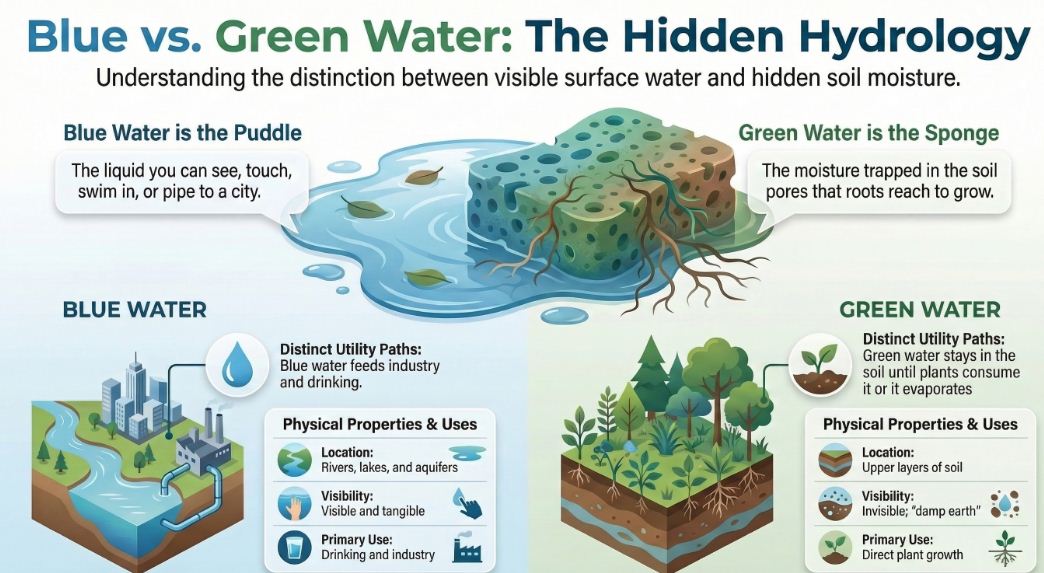
n common sense terms, think of Green Water as the water that is “hidden” inside the soil and plants, while Blue Water is the water you can actually see and pour.
If you imagine a sponge sitting in a shallow puddle:
- Blue Water is the liquid in the puddle. You can pump it out, swim in it, or pipe it to a city.
- Green Water is the moisture trapped inside the holes of the sponge. You can’t “pump” it out easily, but if you plant a seed in that sponge, it’s the only water the roots can reach to grow.
A Simple Comparison:
| Feature | Blue Water | Green Water |
| Where it is | Rivers, lakes, aquifers, and reservoirs. | Trapped in the upper layers of soil. |
| Visibility | You can see it, touch it, and swim in it. | Invisible; it’s just “damp earth.” |
| How we use it | Drinking, industry, and irrigation. | Direct plant growth and forest health. |
| Movement | It flows or sits in one place. | It stays in the soil until plants suck it up or it evaporates. |
Why the “Green” name?
It is called “Green” because it is the lifeblood of greenery. Rain falls, and before it can run off into a river (becoming blue water), it stays in the dirt. This soil moisture is what allows crops and forests to survive between rainfalls.
Why it matters for India (Common Sense)
Most of our farming doesn’t use fancy pipes or pumps (irrigation); it relies entirely on the rain that stays in the dirt. If the soil is healthy (like a good sponge), it holds onto that “Green Water” for a long time. If the soil is degraded (like a piece of hard plastic), the rain just bounces off, causing floods and leaving the crops thirsty.

October 17, 2025
October 16, 2025
October 6, 2025
September 24, 2025

