March 31, 2026
What is Global Warming Potential (GWP)?
Global Warming Potential (GWP) is a measure of how much heat a greenhouse gas traps in the atmosphere compared to CO2 (reference = 1) over a specific time period.
What is GWP?
- Definition: It is a standardized scale used to compare the warming impact of different gases.
- Reference Point: Carbon dioxide (CO2) is used as the baseline because it is the most prevalent greenhouse gas emitted by human activities.
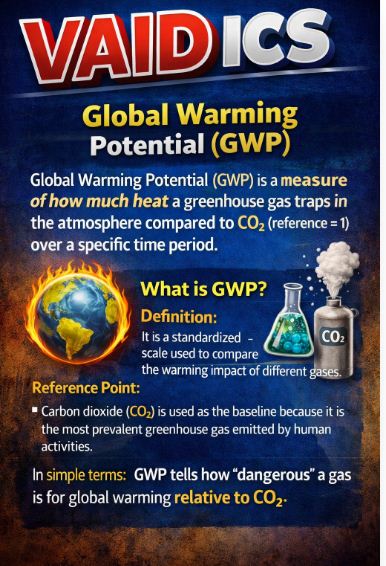
In simple terms: GWP tells how “dangerous” a gas is for global warming relative to CO2.
🔹 Key Concepts:
The GWP values of common greenhouse gases (on a 100-year basis) include:
- CO2 (Carbon Dioxide) → GWP = 1 (The baseline)
- CH4 (Methane) → ~28 times stronger than CO2
- N2O (Nitrous Oxide) → ~300 times stronger than CO2
- Fluorinated gases (F-gases) → Extremely high GWP (can be thousands of times stronger than CO2)
It Depends On:
The GWP of a gas is calculated based on three primary factors:
- Heat-trapping ability (Radiative Efficiency): How effectively the gas absorbs energy.
- Atmospheric lifetime: How long the gas remains in the atmosphere before breaking down or being removed.
- Time period: The specific time horizon used for the calculation—typically 20, 100, or 500 years.
Why It Matters?
- Policy Planning: It helps governments and scientists decide which gas emissions to prioritize for reduction.
- Carbon Accounting: GWP allows different gases to be converted into “CO2equivalents” (CO2) so that total emissions can be tracked as a single number.
About Fluorinated Gases (F-gases):
What are F-gases?
Fluorinated gases (F-gases) are man-made greenhouse gases containing fluorine, known for their very high Global Warming Potential (GWP) and long atmospheric life.
In simple terms:
They are extremely powerful heat-trapping gases used in modern industries.
Types of F-gases:
Hydrofluorocarbons (HFCs):
- Used in refrigerators, air conditioners
Perfluorocarbons (PFCs):
- Used in electronics & aluminum production
Sulphur hexafluoride (SF₆):
- Used in electrical equipment (insulator)
Nitrogen trifluoride (NF₃):
- Used in semiconductor manufacturing
Key Features:
- Very high GWP (hundreds to thousands times CO₂)
- Long atmospheric lifetime
- Synthetic (not naturally occurring)
- Small quantity →huge warming impact

October 17, 2025
October 16, 2025
October 6, 2025
September 24, 2025

