August 12, 2026
What is Exchange Traded Fund?एक्सचेंज ट्रेडेड फंड
Why in news?:
Financial regulators and market experts emphasize the growing role of Exchange Traded Funds in modern financial markets as key tools for retail investment and portfolio diversification.
What is an ETF?:
-
ETF stands for Exchange Traded Fund.
-
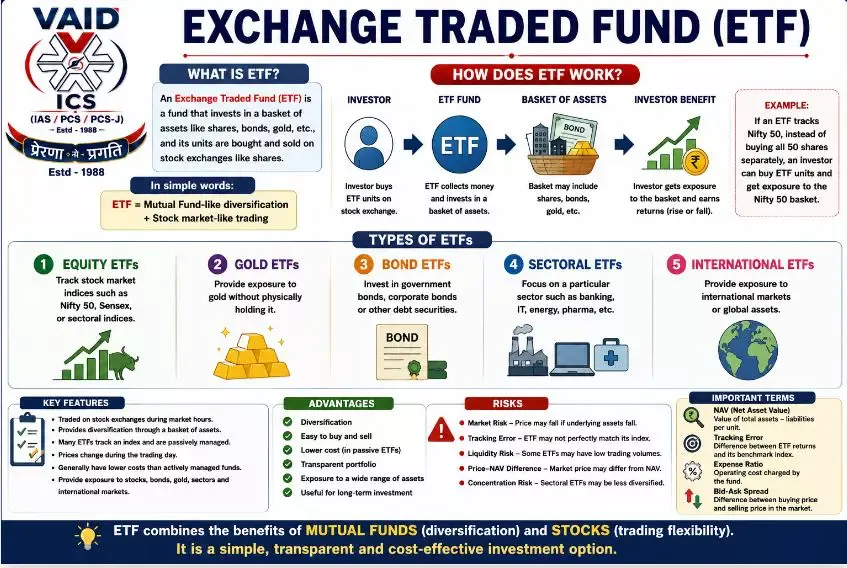
An ETF is a fund that invests in a basket of assets such as shares, bonds, gold, etc., and its units are bought and sold on a stock exchange like shares.
-
In simple words:
ETF equals Mutual Fund-like diversification plus Stock market-like trading.
How does an ETF Work?:
-
Process: Investor buys ETF unit, the ETF invests in a basket of assets, and the investor gets exposure to that basket.
-
Example: If an ETF tracks an index like Nifty 50, instead of buying all fifty shares separately, an investor can buy units of the ETF and gain exposure to the entire basket.
Main Features:
-
Traded on stock exchanges during market hours.
-
Provides diversification through a basket of assets.
-
Many ETFs track an index and are therefore passively managed.
-
ETF prices change continuously during the trading day.
-
Generally have lower costs than many actively managed funds.
-
Can provide exposure to stocks, bonds, gold, sectors, and international markets.
Major Types of ETFs:
-
Equity ETFs: Track stock-market indices such as broad-market or sectoral indices.
-
Gold ETFs: Provide exposure to gold without requiring physical storage.
-
Bond ETFs: Invest in government or corporate bonds and debt securities.
-
Sectoral ETFs: Focus on a particular sector such as banking, IT, energy, etc.
-
International ETFs: Provide exposure to foreign markets or international assets.
ETF vs Mutual Fund:
| Basis | ETF | Mutual Fund |
| Trading | Stock exchange | Usually through fund or platform |
| Price | Changes continuously during the day | Generally based on applicable NAV |
| Diversification | Yes | Yes |
| Management | Many are passive | Active or passive |
| Demat | Generally required for exchange trading | Not necessarily required |
Important Terms:
-
NAV (Net Asset Value): Value of the ETF’s underlying assets, after liabilities, per unit.
-
Tracking Error: The difference between the ETF’s performance and the performance of its benchmark index.
-
Expense Ratio: The operating cost charged by the fund.
-
Bid-Ask Spread: Difference between the buying price and selling price quoted in the market.
Advantages of ETFs:
-
Diversification
-
Easy to buy and sell
-
Generally lower cost for passive ETFs
-
Transparent portfolio
-
Provides exposure to an entire index or asset class
-
Useful for long-term investment and portfolio diversification
Risks of ETFs:
-
Market Risk: If the underlying shares or assets fall, the ETF value can also fall.
-
Tracking Error: ETF may not perfectly replicate its benchmark index.
-
Liquidity Risk: Some ETFs may have low trading volumes.
-
Price-NAV Difference: ETF market price can temporarily differ from its NAV.
-
Concentration Risk: Sectoral or thematic ETFs may be less diversified.
Why are ETFs Important?:
ETFs are important because they:
-
Encourage financialisation of savings.
-
Make diversified investment easier.
-
Provide low-cost access to different asset classes.
-
Improve participation in capital markets.
-
Provide investors an alternative to directly buying multiple securities.
Quick Facts:
-
An ETF is a market-traded investment fund that provides exposure to a basket of underlying assets, often by tracking an index.
-
ETF units are traded on stock exchanges.
-
ETFs can track stocks, bonds, gold, and other assets.
-
ETF price can differ from its NAV.
-
Tracking error measures deviation from the benchmark.
-
Many ETFs are passively managed and are not risk-free.
एक्सचेंज ट्रेडेड फंड:
समाचार में क्यों?:
वित्तीय नियामकों और बाजार विशेषज्ञों ने आधुनिक वित्तीय बाजारों में खुदकुशी निवेश और पोर्टफोलियो विविधीकरण के लिए प्रमुख उपकरणों के रूप में एक्सचेंज ट्रेडेड फंड्स (ETF) की बढ़ती भूमिका पर जोर दिया है।
ETF क्या है?:
-
ETF का पूर्ण रूप एक्सचेंज ट्रेडेड फंड है।
-
एक ETF एक ऐसा फंड है जो शेयरों, बांड, सोना आदि जैसी परिसंपत्तियों की एक टोकरी में निवेश करता है और इसकी इकाइयाँ शेयरों की तरह स्टॉक एक्सचेंज पर खरीदी और बेची जाती हैं।
-
सरल शब्दों में:
ETF का अर्थ है म्यूचुअल फंड जैसा विविधीकरण और स्टॉक मार्केट जैसी ट्रेडिंग।
ETF कैसे काम करता है?:
-
प्रक्रिया: निवेशक ETF इकाई खरीदता है, ETF परिसंपत्तियों की एक टोकरी में निवेश करता है, और निवेशक को उस टोकरी का जोखिम-प्रतिफल प्राप्त होता है।
-
उदाहरण: यदि कोई ETF निफ्टी 50 जैसे सूचकांक को ट्रैक करता है, तो सभी पचास शेयरों को अलग-अलग खरीदने के बजाय, एक निवेशक ETF की इकाइयाँ खरीद सकता है और पूरी टोकरी का एक्सपोजर प्राप्त कर सकता है।
मुख्य विशेषताएँ:
-
बाजार के घंटों के दौरान स्टॉक एक्सचेंज पर कारोबार किया जाता है।
-
परिसंपत्तियों की टोकरी के माध्यम से विविधीकरण प्रदान करता है।
-
कई ETF किसी सूचकांक को ट्रैक करते हैं और इसलिए निष्क्रिय रूप से प्रबंधित होते हैं।
-
ट्रेडिंग दिवस के दौरान ETF की कीमतें लगातार बदलती हैं।
-
सक्रिय रूप से प्रबंधित कई फंडों की तुलना में आम तौर पर कम लागत होती है।
-
शेयरों, बांड, सोने, क्षेत्रों और अंतरराष्ट्रीय बाजारों में एक्सपोजर प्रदान कर सकता है।
ETF के प्रमुख प्रकार:
-
इक्विटी ETFs: व्यापक बाजार या क्षेत्रीय सूचकांकों जैसे स्टॉक-मार्केट सूचकांकों को ट्रैक करते हैं।
-
गोल्ड ETFs: भौतिक रूप से सोना संग्रहित किए बिना सोने का एक्सपोजर प्रदान करते हैं।
-
बॉंड ETFs: सरकारी या कॉर्पोरेट बॉंड और ऋण प्रतिभूतियों में निवेश करते हैं।
-
सेक्टरल ETFs: बैंकिंग, आईटी, ऊर्जा आदि जैसे किसी विशेष क्षेत्र पर ध्यान केंद्रित करते हैं।
-
अंतरराष्ट्रीय ETFs: विदेशी बाजारों या अंतरराष्ट्रीय परिसंपत्तियों में एक्सपोजर प्रदान करते हैं।
ETF बनाम म्यूचुअल फंड:
| आधार | ETF | म्यूचुअल फंड |
| ट्रेडिंग | स्टॉक एक्सचेंज | आमतौर पर फंड या प्लेटफॉर्म के माध्यम से |
| कीमत | दिन के दौरान लगातार बदलती है | आम तौर पर लागू NAV पर आधारित होती है |
| विविधीकरण | हाँ | हाँ |
| प्रबंधन | कई निष्क्रिय होते हैं | सक्रिय या निष्क्रिय |
| डीमैट | एक्सचेंज ट्रेडिंग के लिए आम तौर पर आवश्यक | आवश्यक नहीं है |
महत्वपूर्ण शब्द:
-
NAV (नेट एसेट वैल्यू): देनदारियों के बाद, प्रति इकाई ETF की अंतर्निहित परिसंपत्तियों का मूल्य।
-
ट्रैकिंग एरर: ETF के प्रदर्शन और उसके बेंचमार्क सूचकांक के प्रदर्शन के बीच का अंतर।
-
व्यय अनुपात (Expense Ratio): फंड द्वारा लिया जाने वाला परिचालन लागत।
-
बिड-आस्क स्प्रेड: बाजार में उद्धृत खरीदारी मूल्य और बिक्री मूल्य के बीच का अंतर।
ETF के लाभ:
-
विविधीकरण
-
खरीदने और बेचने में आसान
-
निष्क्रिय ETF के लिए आम तौर पर कम लागत
-
पारदर्शी पोर्टफोलियो
-
संपूर्ण सूचकांक या परिसंपत्ति वर्ग तक पहुंच प्रदान करता है
-
दीर्घकालिक निवेश और पोर्टफोलियो विविधीकरण के लिए उपयोगी
ETF के जोखिम:
-
बाजार जोखिम: यदि अंतर्निहित शेयर या परिसंपत्तियां गिरती हैं, तो ETF का मूल्य भी गिर सकता है।
-
ट्रैकिंग एरर: ETF अपने बेंचमार्क सूचकांक को पूरी तरह से दोहरा नहीं सकता है।
-
तरलता जोखिम (Liquidity Risk): कुछ ETF में कम ट्रेडिंग वॉल्यूम हो सकता है।
-
मूल्य-NAV अंतर: ETF बाजार मूल्य अस्थायी रूप से इसकी NAV से भिन्न हो सकता है।
-
सांद्रता जोखिम (Concentration Risk): क्षेत्रीय या विषयगत ETF कम विविध हो सकते हैं।
ETF क्यों महत्वपूर्ण हैं?:
ETF महत्वपूर्ण हैं क्योंकि वे:
-
बचत के वित्तीयकरण को प्रोत्साहित करते हैं।
-
विविध निवेश को आसान बनाते हैं।
-
विभिन्न परिसंपत्ति वर्गों तक कम लागत वाली पहुंच प्रदान करते हैं।
-
पूंजी बाजारों में भागीदारी में सुधार करते हैं।
-
निवेशकों को सीधे कई प्रतिभूतियों को खरीदने का विकल्प प्रदान करते हैं।
त्वरित तथ्य:
-
एक ETF एक बाजार-व्यापारित निवेश फंड है जो अक्सर एक सूचकांक को ट्रैक करके अंतर्निहित परिसंपत्तियों की टोकरी का एक्सपोजर प्रदान करता है।
-
ETF इकाइयाँ स्टॉक एक्सचेंजों पर कारोबार की जाती हैं।
-
ETF शेयरों, बांड, सोने और अन्य परिसंपत्तियों को ट्रैक कर सकते हैं।
-
ETF की कीमत इसकी NAV से भिन्न हो सकती है।
-
ट्रैकिंग एरर बेंचमार्क से विचलन को मापता है।
-
कई ETF निष्क्रिय रूप से प्रबंधित होते हैं और जोखिम मुक्त नहीं होते हैं।

May 19, 2026
October 17, 2025
October 16, 2025
October 6, 2025

