January 16, 2026
What is Cold War 2?
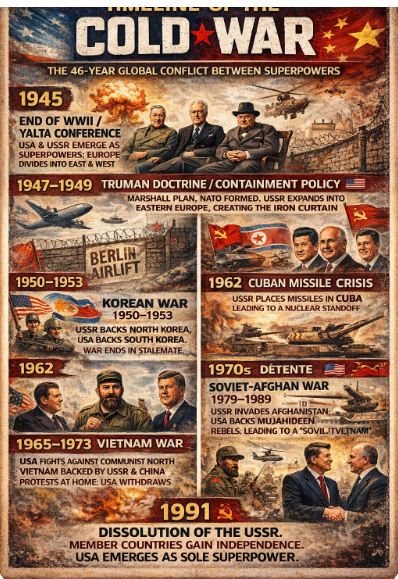
Cold War 2 (also called Cold War 2.0, Second Cold War, or New Cold War) refers to the heightened geopolitical rivalry in the 21st century, primarily between the United States (and its allies) on one side and China (often backed by Russia) on the other. Unlike the original Cold War (1947–1991), which was largely ideological (capitalism vs. communism) and bipolar with rigid blocs, this version is more multipolar, economically driven, and features competition in technology, trade, supply chains, and influence rather than direct military confrontation on a global scale.
As of early 2026, analysts widely describe the current era as a form of Cold War 2.0, intensified by events like the Russia-Ukraine war, US-China trade/tech decoupling, and China’s growing assertiveness in the Indo-Pacific. It is not identical to the first Cold War—there are no fully sealed ideological blocs, and many countries (including India) hedge and multi-align—but the structural rivalry shapes global affairs.
Key Dimensions of Cold War 2.0:
The competition spans multiple domains:
Geopolitical & Military — Arms build-ups, alliances (e.g., AUKUS, Quad vs. China’s claims in South China Sea), proxy conflicts, hybrid warfare, space/cyber domains, hypersonic weapons, and nuclear risks (e.g., New START expiration in February 2026 adds uncertainty).
Economic & Technological — Decoupling in supply chains, tech standards (5G/6G, AI, semiconductors), trade wars/tariffs, control over critical infrastructure (Belt and Road vs. alternatives like IMEC), and competition for centrality in global networks (production, finance, digital).
Ideological/Narrative — Democracy vs. authoritarian models; rules-based order vs. revisionist challenges; influence in Global South via debt, aid, and institutions.
Regional Flashpoints — Indo-Pacific (Taiwan, South China Sea), Europe (Ukraine), Middle East, Africa (influence competition), and emerging domains like Arctic and space.
It is characterized by contested multipolarity rather than strict bipolarity—countries like India, Brazil, Indonesia, and others act as swing states.
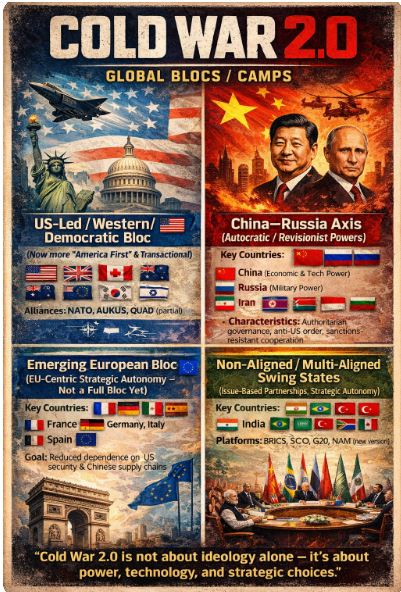
The “America First” Bloc:
- Led by the United States, this group focuses on transactional security. The US still leads major allies like Japan and Australia but now demands “membership fees” or higher defense spending from its partners. It uses aggressive tariffs and tech bans to contain China, making the alliance more about business deals than shared ideology.
The China-Russia Axis:
- This is the main rival to the US. China provides the economic and technological power, while Russia provides energy and military muscle. Together, they are expanding the BRICS group to create a global system that doesn’t rely on the US Dollar or Western rules.
The Independent Europe:
- Led by the EU (Germany, France, and Italy), this “Third Pole” is emerging because they no longer fully trust US security. They are drastically increasing their own military spending and making their own trade deals. They aren’t enemies of the US, but they are trying to stand on their own two feet to avoid being crushed in a US-China trade war.
The Global Swing States:
- Led by India, along with Brazil and Indonesia, these countries refuse to pick a side. They are the “Kingmakers” of 2026. They buy oil from Russia, tech from the US, and sell goods to Europe. By staying non-aligned, they get the best deals from everyone while increasing their own global influence.
No country is fully “blocked” like during the original Cold War—trade and diplomacy continue across lines—but pressures to choose sides are rising (e.g., secondary sanctions, tech restrictions).
India’s Role:
India is one of the most important swing states (or “fulcrums”) in this rivalry. It pursues strategic autonomy (Non-Alignment 2.0 / multi-alignment), refusing to fully join either bloc while deepening ties where it suits national interests.
With US/West — Strong convergence via Quad, defense deals (e.g., iCET for tech), Indo-Pacific focus to counter China. Benefits: technology, investment, maritime security.
With Russia — Long-standing defense/energy ties (S-400, oil imports), BRICS/SCO participation. Helps hedge against over-dependence on West.
With China — Tense (border issues, economic asymmetry), but pragmatic engagement continues (trade, diplomacy resets attempted).
Overall positioning — India promotes multipolarity, Global South voice, and avoids entrapment in US-China conflict. It gains leverage from rivalry (e.g., attracting FDI fleeing China, stronger Quad role).
Challenges for India:
China threat — Border standoffs, naval expansion in Indian Ocean, influence in neighbors (Pakistan, Sri Lanka, Maldives, Nepal).
Balancing act — US pressures (e.g., CAATSA risks, tariffs under Trump 2.0) vs. Russia ties; potential secondary sanctions if closer to China bloc.
Economic vulnerabilities — Supply chain disruptions, tech decoupling costs, higher borrowing costs due to geopolitical risk.
Two-front security — China-Pakistan axis, hybrid threats, need for massive military modernization (navy, cyber, space).
Global marginalization risk — If rigid blocs form (e.g., G2 US-China deal), India could lose influence unless it builds stronger independent capabilities.
Way Forward for India :
Strengthen deterrence — Accelerate military modernization (especially navy, cyber, space, hypersonics), indigenous defense production.
Deepen multi-alignment — Enhance Quad + Europe/Africa ties, push IMEC corridor, expand BRICS/SCO role without full alignment.
Economic hedging — Build resilient supply chains, attract FDI/tech from both sides, invest in semiconductors/AI domestically.
Diplomatic activism — Lead Global South (e.g., Africa outreach, climate finance), promote multipolar rules, avoid binary traps.
Strategic clarity — Prioritize capability over ambiguity; precise autonomy means diversified partnerships + self-reliance to reduce vulnerabilities.
In 2026, with ongoing wars, alliance shifts, and nuclear risks, India’s approach of multi-alignment with growing weight positions it well to benefit from rivalry without being forced into a camp—provided it invests heavily in hard power and economic resilience.
शीत युद्ध 2 (जिसे शीत युद्ध 2.0, द्वितीय शीत युद्ध अथवा नया शीत युद्ध भी कहा जाता है) 21वीं शताब्दी में उभरती हुई तीव्र भू-राजनीतिक प्रतिस्पर्धा को इंगित करता है। इसका मुख्य स्वरूप संयुक्त राज्य अमेरिका एवं उसके सहयोगियों के एक पक्ष तथा चीन (अक्सर रूस के समर्थन सहित) के दूसरे पक्ष के बीच देखा जाता है।
1947–1991 के मूल शीत युद्ध से भिन्न, जो मुख्यतः वैचारिक (पूँजीवाद बनाम साम्यवाद) एवं द्विध्रुवीय था, वर्तमान परिदृश्य बहुध्रुवीय, आर्थिक रूप से प्रेरित तथा तकनीक, व्यापार, आपूर्ति शृंखलाओं एवं प्रभाव-क्षेत्रों में प्रतिस्पर्धा पर आधारित है, न कि प्रत्यक्ष वैश्विक सैन्य टकराव पर।
वर्तमान स्थिति (2026) रूस-यूक्रेन युद्ध, अमेरिका-चीन व्यापार एवं तकनीकी पृथक्करण, तथा इंडो-पैसिफिक क्षेत्र में चीन की बढ़ती सक्रियता ने इस प्रतिस्पर्धा को और तीव्र बना दिया है। यद्यपि यह प्रथम शीत युद्ध की भाँति कठोर वैचारिक खेमों में विभाजित नहीं है, तथापि संरचनात्मक प्रतिद्वंद्विता वैश्विक व्यवस्था को प्रभावित कर रही है। अनेक देश (जैसे भारत) बहु-संरेखण एवं संतुलन की नीति अपनाकर लाभ प्राप्त कर रहे हैं।
शीत युद्ध 2.0 के प्रमुख आयाम:
भू-राजनीतिक एवं सैन्य आयाम — हथियारों का विस्तार, गठबंधन (AUKUS, क्वाड), प्रॉक्सी युद्ध, हाइब्रिड युद्ध, अंतरिक्ष एवं साइबर क्षेत्र, हाइपरसोनिक हथियार, तथा परमाणु जोखिम (जैसे New START संधि की समाप्ति, फरवरी 2026)।
आर्थिक एवं तकनीकी आयाम — आपूर्ति शृंखलाओं का पृथक्करण, तकनीकी मानक (5G/6G, कृत्रिम बुद्धिमत्ता, सेमीकंडक्टर), व्यापार युद्ध/शुल्क, महत्त्वपूर्ण अवसंरचना पर नियंत्रण (BRI बनाम IMEC), वैश्विक नेटवर्कों में केंद्रीयता हेतु प्रतिस्पर्धा।
वैचारिक एवं आख्यान आयाम — लोकतंत्र बनाम अधिनायकवाद, नियम-आधारित व्यवस्था बनाम संशोधनवादी चुनौतियाँ, ऋण, सहायता एवं संस्थागत प्रभाव के माध्यम से वैश्विक दक्षिण में पकड़।
क्षेत्रीय संवेदनशीलता — इंडो-पैसिफिक (ताइवान, दक्षिण चीन सागर), यूरोप (यूक्रेन), मध्य-पूर्व, अफ्रीका, तथा नए क्षेत्र जैसे आर्कटिक एवं अंतरिक्ष।
प्रमुख खेमे (2026):
अमेरिका-नेतृत्व वाला पश्चिमी/लोकतांत्रिक गुट — अमेरिका, चुनिंदा नाटो सहयोगी, जापान, ऑस्ट्रेलिया, दक्षिण कोरिया।
चीन-रूस अक्ष — चीन मुख्य चालक, रूस प्रमुख साझेदार; BRICS विस्तार, SCO, BRI, पश्चिम-विरोधी आख्यान।
यूरोपीय संघ-केंद्रित सामरिक स्वायत्तता — जर्मनी, फ्रांस, इटली आदि; रक्षा व्यय वृद्धि, कार्बन शुल्क, व्यापार विविधीकरण।
गैर-संरेखित/बहु-संरेखित देश — भारत, ब्राज़ील, इंडोनेशिया, दक्षिण अफ्रीका आदि; रणनीतिक स्वायत्तता, संतुलन, बहु-संरेखण।
भारत की भूमिका:
भारत इस प्रतिस्पर्धा में एक महत्त्वपूर्ण स्विंग स्टेट अथवा केंद्रबिंदु के रूप में उभर रहा है।
अमेरिका/पश्चिम के साथ — क्वाड, रक्षा समझौते, इंडो-पैसिफिक सहयोग; लाभ: तकनीक, निवेश, समुद्री सुरक्षा।
रूस के साथ — दीर्घकालिक रक्षा एवं ऊर्जा संबंध, BRICS/SCO सहभागिता।
चीन के साथ — सीमा विवाद एवं आर्थिक विषमता के बावजूद व्यवहारिक व्यापार एवं कूटनीतिक संवाद।
समग्र दृष्टिकोण — बहुध्रुवीयता को प्रोत्साहन, वैश्विक दक्षिण की आवाज़, तथा अमेरिका-चीन संघर्ष से बचाव।
भारत की चुनौतियाँ:
चीन का खतरा — सीमा विवाद, नौसैनिक विस्तार, पड़ोसी देशों में प्रभाव।
संतुलन की कठिनाई — अमेरिका का दबाव बनाम रूस संबंध; संभावित द्वितीयक प्रतिबंध।
आर्थिक संवेदनशीलता — आपूर्ति शृंखला व्यवधान, तकनीकी पृथक्करण, ऋण लागत में वृद्धि।
दो-मोर्चा सुरक्षा — चीन-पाकिस्तान अक्ष, हाइब्रिड खतरे; नौसेना, साइबर एवं अंतरिक्ष में आधुनिकीकरण की आवश्यकता।
वैश्विक हाशियाकरण का जोखिम — यदि कठोर खेमे बनते हैं तो भारत की स्वतंत्र भूमिका सीमित हो सकती है।
भारत के लिए आगे की राह:
निवारक शक्ति सुदृढ़ करना — सैन्य आधुनिकीकरण, स्वदेशी रक्षा उत्पादन।
बहु-संरेखण गहरा करना — क्वाड, यूरोप/अफ्रीका सहयोग, IMEC कॉरिडोर, BRICS/SCO में सक्रियता।
आर्थिक लचीलापन — आपूर्ति शृंखला सुदृढ़ करना, FDI आकर्षित करना, सेमीकंडक्टर/AI में निवेश।
कूटनीतिक सक्रियता — वैश्विक दक्षिण का नेतृत्व, जलवायु वित्त, बहुध्रुवीय नियमों का समर्थन।
रणनीतिक स्पष्टता — क्षमता-निर्माण को प्राथमिकता, विविधीकृत साझेदारी एवं आत्मनिर्भरता।
निष्कर्ष :
वर्ष 2026 में युद्धों, गठबंधन परिवर्तनों एवं परमाणु जोखिमों की पृष्ठभूमि में भारत की बहु-संरेखण नीति उसे प्रतिस्पर्धा से लाभ उठाने की स्थिति में रखती है—बशर्ते वह कठोर शक्ति एवं आर्थिक लचीलापन में पर्याप्त निवेश सुनिश्चित करे।

October 17, 2025
October 16, 2025
October 6, 2025
September 24, 2025

