August 7, 2026
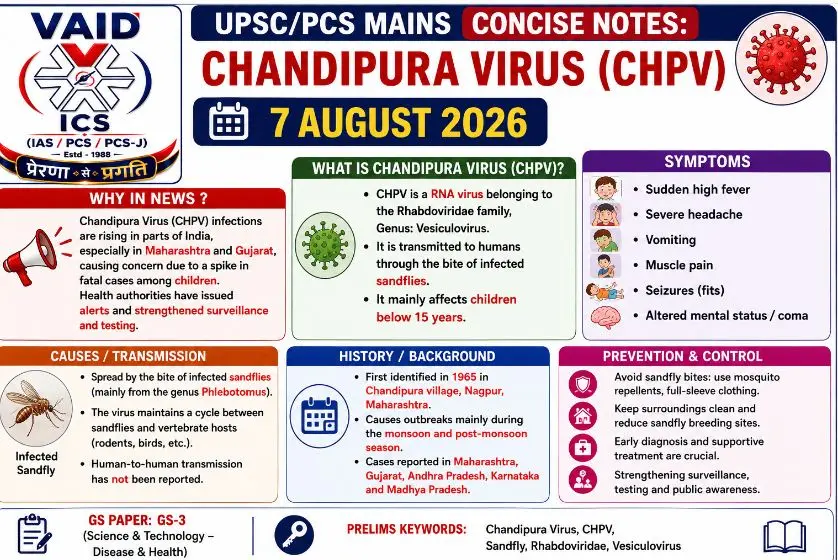
What is Chandipura Virus (CHPV)?
Why in news?:
A fresh outbreak of the Chandipura Virus Disease (CHPV) during the monsoon season in western India—particularly in Gujarat and Rajasthan—has claimed the lives of 22 children. This has prompted the Union Ministry of Health and Family Welfare to deploy the National Joint Outbreak Response Team (NJORT) to assist state health authorities with containment, epidemiological tracking, and clinical management.
What is Chandipura Virus (CHPV)?
-
Definition: A rare arbovirus belonging to the Vesiculovirus genus within the Rhabdoviridae family (the same family as the rabies virus, though it causes a completely different set of neurological symptoms).
-
Discovery: First identified in 1965 in Chandipura village, Maharashtra.
-
Target Demographic: Primarily affects children below 15 years of age, triggering rapid and severe brain inflammation.
-
No Specific Cure: There is currently no approved antiviral drug or vaccine; treatment relies solely on early supportive intensive care (managing fever, seizures, and respiratory support).
Why has the Centre deployed the National Joint Outbreak Response Team (NJORT)?
-
Objective: To supplement state-level machinery in controlling the current outbreak by coordinating field investigations, epidemiological assessments, and vector control measures.
-
Multi-Agency Collaboration: The team brings together top experts to review on-ground clinical protocols, reinforce laboratory diagnostics, and implement stringent public health barriers.
Role of NCDC, ICMR, and DAHD:
-
National Centre for Disease Control (NCDC): Coordinates nationwide disease surveillance through the Integrated Disease Surveillance Programme (IDSP) and provides technical guidance.
-
Indian Council of Medical Research (ICMR): Deploys premier research institutes—such as the ICMR-National Institute of Virology (NIV), Pune, and the National Institute of Epidemiology (NIE), Chennai—to run diagnostic assays and epidemiological investigations.
-
Department of Animal Husbandry & Dairying (DAHD): Manages animal surveillance by testing livestock and reservoir animals to study potential zoonotic links.
Integrated Disease Surveillance Programme (IDSP) & PHEOC:
-
IDSP: A decentralized, state-based surveillance system functioning under NCDC to detect early warning signals and track disease trends across districts.
-
Public Health Emergency Operations Centre (PHEOC): Functions as the central command hub for real-time monitoring, emergency response coordination, and resource allocation during outbreaks.
Clinical Syndromes: AES and AFI
-
Acute Encephalitis Syndrome (AES): Characterized by acute onset of fever and a change in mental status (such as confusion, disorientation, or coma) along with new-onset seizures. CHPV is a major contributor to AES outbreaks in India.
-
Acute Febrile Illness (AFI): Refers to any sudden onset of fever without a clearly localized source, which serves as the initial clinical presentation before neurological symptoms emerge.
Vectors, Animal Surveillance, and Whole Genome Sequencing (WGS):
-
Suspected Vectors: While sandflies are established vectors, scientific teams are also investigating whether mosquitoes, ticks, or mites play secondary roles in transmission during the monsoon.
-
Animal Surveillance: Blood and milk samples from cattle, buffaloes, and goats are being analyzed to check if domestic animals act as virus reservoirs.
-
Whole Genome Sequencing (WGS): Conducted at the Gujarat Biotechnology Research Centre (GBRC) in Gandhinagar to detect any minor genetic variations or mutations in the circulating virus strains.
One Health Approach & Lessons from 2024:
-
One Health Approach: Integrates human health, animal health, and environmental/vector surveillance into a unified framework to combat zoonotic threats effectively.
-
Lessons from 2024: Draws on experiences from the major 2024 outbreak (which recorded 245 AES cases and 82 deaths) to accelerate early hospitalization, intensive care unit (ICU) admissions, and community-level pesticide spraying

May 19, 2026
October 17, 2025
October 16, 2025
October 6, 2025

