June 23, 2026
What is Ancient DNA (aDNA)?
Rakhigarhi: Advanced Scientific Examination of Skeletal Remains
Why in News ?
The Archaeological Survey of India (ASI) has officially transferred human skeletal remains excavated from Rakhigarhi, Haryana, to the Anthropological Survey of India (AnSI), Kolkata, for advanced multidisciplinary scientific investigation. This initiative aims to deepen the understanding of the Indus-Saraswati Civilization (Harappan Civilization).
Key Points:
-
The Excavation: During the 2025–26 field season, ASI’s Excavation Branch-II uncovered eight burials at Mound No. 7, a site identified as an ancient cemetery.
-
Status of Remains: Three complete human skeletons, along with skeletal fragments from other burials, have been transferred to AnSI, Kolkata. The remaining materials are scheduled for transfer shortly.
-
Scientific Collaboration: The project involves a multidisciplinary approach, collaborating with leading institutions including the Birbal Sahni Institute of Palaeosciences (BSIP), Lucknow, and various genetic and archaeological research experts (e.g., CCMB Hyderabad, BHU).
-
Research Objectives:
-
Facial Reconstruction: To provide a scientifically accurate visual representation of Harappan individuals.
-
Genetic History: Using ancient DNA (aDNA) analysis to study ancestry, migration patterns, and genetic evolution.
-
Health and Lifestyle: Osteological and palaeopathological investigations to identify diseases, diet, cause of death, and biological adaptations to urban life.
-
Palaeo-environment: Understanding human-environment interactions during the Harappan period.
-
-
Contextual Significance:
-
Rakhigarhi is recognized as one of the largest Harappan settlements, spanning approximately 550 hectares.
-
Previous excavations have revealed a planned city with drainage systems, granaries, craft production units, and rich burial offerings (indicating social stratification).
-
This research builds upon the findings of nearly 70 skeletons recovered from the site in past excavations.
-
Key Related Terms:
-
Ancient DNA (aDNA): DNA extracted from biological remains (bones/teeth) used to reconstruct the biological and migratory history of ancient populations.
-
Palaeopathology: The study of ancient diseases and their effects on human remains to understand the health status and living conditions of past civilizations.
-
Craniofacial Reconstruction (CFR): A forensic and anatomical technique used to approximate the facial appearance of individuals based on skeletal remains.
-
Mound No. 7: Identified as the primary burial ground (cemetery) at the Rakhigarhi site, crucial for anthropological studies.
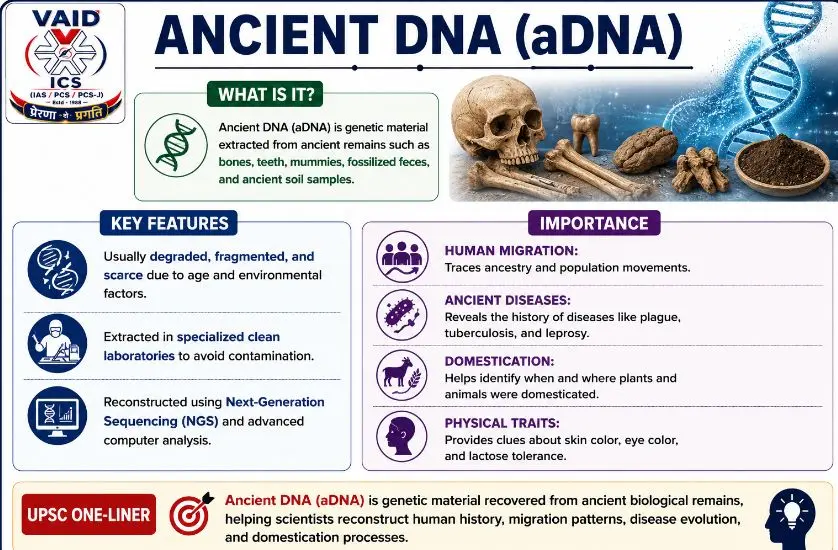
Ancient DNA (aDNA):
What is aDNA?
Ancient DNA (aDNA) refers to the DNA extracted from biological specimens that have been dead for a long period, such as skeletons, mummified tissues, coprolites (fossilized feces), or ancient soil samples. Unlike modern DNA, which is often found in high-quality, intact strands, aDNA is typically degraded, fragmented, and present in very small quantities.
How it works (Key Characteristics):
-
Degradation: Over time, DNA molecules break down due to environmental factors like heat, moisture, UV radiation, and microbial activity. The long double-helix structure gets chopped into tiny, random segments.
-
Extraction: Scientists use specialized “clean room” facilities to prevent contamination from modern human DNA. They use chemical processes to isolate the tiny, fragmented DNA strands from ancient bone (usually the dense petrous bone in the skull or teeth).
-
Sequencing & Reconstruction: Using “Next-Generation Sequencing” (NGS) technology, researchers read these millions of tiny fragments and use sophisticated computer algorithms to “stitch” them back together, comparing them to reference genomes to fill in the gaps.
Why is aDNA Important?
aDNA acts as a “time machine” for researchers, providing direct evidence of the past that artifacts alone cannot reveal:
-
Ancestry and Migration: It allows scientists to track how human populations moved across the globe, who they interbred with, and which modern-day groups are their direct descendants.
-
Palaeopathology (Ancient Diseases): By identifying traces of bacteria or viruses in ancient bones, researchers can trace the history of infectious diseases like tuberculosis, the plague, or leprosy to see how they evolved.
-
Domestication History: It helps scientists understand when and where humans domesticated plants and animals by tracking the genetic changes in their remains over thousands of years.
-
Physical Traits: It can reveal insights into non-fossilized traits, such as skin pigmentation, eye color, or the ability to digest certain foods (like lactose tolerance).
प्राचीन डीएनए (aDNA): एक अवलोकन
aDNA क्या है?
प्राचीन डीएनए (aDNA) उन जैविक नमूनों से निकाला गया डीएनए है जो बहुत लंबे समय से मृत हैं, जैसे कि कंकाल, ममीकृत ऊतक (mummified tissues), कोप्रोलाइट (जीवाश्म मल) या प्राचीन मिट्टी के नमूने। आधुनिक डीएनए के विपरीत, जो अक्सर उच्च गुणवत्ता और अखंड होता है, aDNA आमतौर पर क्षतिग्रस्त (degraded), छोटे टुकड़ों में विभाजित और बहुत कम मात्रा में होता है।
यह कैसे काम करता है? (मुख्य विशेषताएं)
-
क्षति (Degradation): समय के साथ, गर्मी, नमी, यूवी विकिरण और सूक्ष्मजीवों जैसे पर्यावरणीय कारकों के कारण डीएनए अणु टूट जाते हैं। यह लंबे दोहरे हेलिक्स (double-helix) के ढांचे को छोटे, यादृच्छिक खंडों में बदल देता है।
-
निष्कर्षण (Extraction): आधुनिक मानव डीएनए के संदूषण (contamination) को रोकने के लिए वैज्ञानिक विशेष “क्लीन रूम” सुविधाओं का उपयोग करते हैं। वे कंकाल के सबसे कठोर हिस्से (आमतौर पर खोपड़ी की पेट्रस हड्डी या दांतों) से डीएनए के इन नन्हे टुकड़ों को अलग करने के लिए रासायनिक प्रक्रियाओं का उपयोग करते हैं।
-
अनुक्रमण और पुनर्निर्माण: “नेक्स्ट-जेनरेशन सीक्वेंसिंग” (NGS) तकनीक का उपयोग करके, शोधकर्ता इन लाखों नन्हे टुकड़ों को पढ़ते हैं और उन्हें वापस जोड़ने के लिए जटिल कंप्यूटर एल्गोरिदम का उपयोग करते हैं।
aDNA क्यों महत्वपूर्ण है?
aDNA शोधकर्ताओं के लिए एक “टाइम मशीन” की तरह काम करता है, जो अतीत का ऐसा प्रत्यक्ष प्रमाण प्रदान करता है जो केवल कलाकृतियों से नहीं मिल सकता:
-
पूर्वज और प्रवास: यह वैज्ञानिकों को यह ट्रैक करने में मदद करता है कि मानव आबादी दुनिया भर में कैसे घूमी, उन्होंने किसके साथ प्रजनन किया, और आधुनिक समूहों में से कौन उनके सीधे वंशज हैं।
-
पैलियोपैथोलॉजी (प्राचीन बीमारियाँ): प्राचीन हड्डियों में बैक्टीरिया या वायरस के निशान खोजकर, शोधकर्ता तपेदिक (TB), प्लेग या कुष्ठ रोग जैसी संक्रामक बीमारियों के इतिहास का पता लगा सकते हैं।
-
पालतू बनाने का इतिहास: यह पौधों और जानवरों के डीएनए में हुए बदलावों को ट्रैक करके यह समझने में मदद करता है कि मनुष्यों ने उन्हें कब और कहाँ पालतू बनाया।
-
शारीरिक लक्षण: यह त्वचा का रंग, आंखों का रंग या भोजन पचाने की क्षमता (जैसे लैक्टोज सहनशीलता) जैसे लक्षणों के बारे में जानकारी दे सकता है।
aDNA अनुसंधान में चुनौतियाँ:
-
संदूषण (Contamination): चूंकि आधुनिक मानव डीएनए हर जगह मौजूद है, इसलिए सबसे बड़ी चुनौती यह सुनिश्चित करना है कि जो डीएनए अनुक्रमित (sequence) किया जा रहा है, वह वास्तव में प्राचीन है।
-
पर्यावरणीय सीमाएँ: गर्म और आर्द्र जलवायु (जैसे भारत का अधिकांश हिस्सा) में डीएनए बहुत तेजी से नष्ट हो जाता है। उष्णकटिबंधीय स्थलों से उपयोग योग्य डीएनए निकालना एक बड़ी वैज्ञानिक सफलता है।

May 19, 2026
October 17, 2025
October 16, 2025
October 6, 2025

