April 21, 2026
What are Non-Deliverable Forwards (NDF)?
Why in News ? The Reserve Bank of India’s (RBI) partial easing of curbs in the offshore non-deliverable forwards (NDF) market are not likely to change the central bank’s stance on the net open position for the Indian rupee (NOP-INR), according to market participants, as geopolitical uncertainties, along with persistently elevated Brent crude prices, do not look to taper down any time soon.
Non-Deliverable Forwards (NDF):
An NDF is a foreign exchange derivative contract used to hedge or speculate on currencies that are not freely convertible or have restricted offshore trading (like the Indian Rupee).
- How it Works: Unlike a standard “deliverable” forward, there is no physical exchange of the two currencies at maturity.
- The Settlement: Instead, the “net difference” between the contracted NDF rate and the prevailing spot rate is settled in a convertible currency (usually USD).
- Offshore vs. Onshore: NDFs traditionally trade in offshore hubs like Singapore, London, or Dubai. Because the RBI doesn’t control these offshore markets, a large “gap” often forms between offshore and onshore rupee rates, leading to arbitrage that can weaken the rupee domestically.
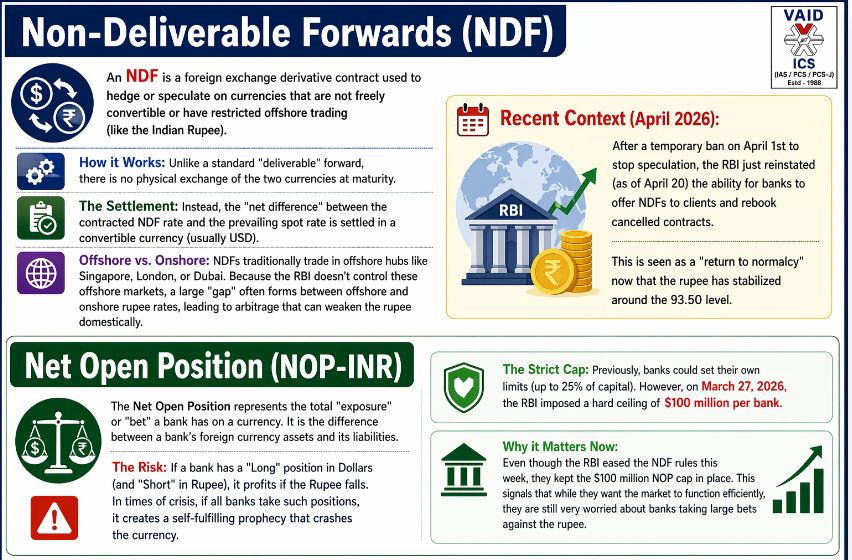
Recent Context (April 2026): After a temporary ban on April 1st to stop speculation, the RBI just reinstated (as of April 20) the ability for banks to offer NDFs to clients and rebook cancelled contracts. This is seen as a “return to normalcy” now that the rupee has stabilized around the 93.50 level.
Net Open Position (NOP-INR):
The Net Open Position represents the total “exposure” or “bet” a bank has on a currency. It is the difference between a bank’s foreign currency assets and its liabilities.
- The Risk: If a bank has a “Long” position in Dollars (and “Short” in Rupee), it profits if the Rupee falls. In times of crisis, if all banks take such positions, it creates a self-fulfilling prophecy that crashes the currency.
- The Strict Cap: Previously, banks could set their own limits (up to 25% of capital). However, on March 27, 2026, the RBI imposed a hard ceiling of $100 million per bank.
- Why it Matters Now: Even though the RBI eased the NDF rules this week, they kept the $100 million NOP cap in place. This signals that while they want the market to function efficiently, they are still very worried about banks taking large bets against the rupee.

May 19, 2026
October 17, 2025
October 16, 2025
October 6, 2025

