August 10, 2026
What are Invasive Species?
Why in news?:
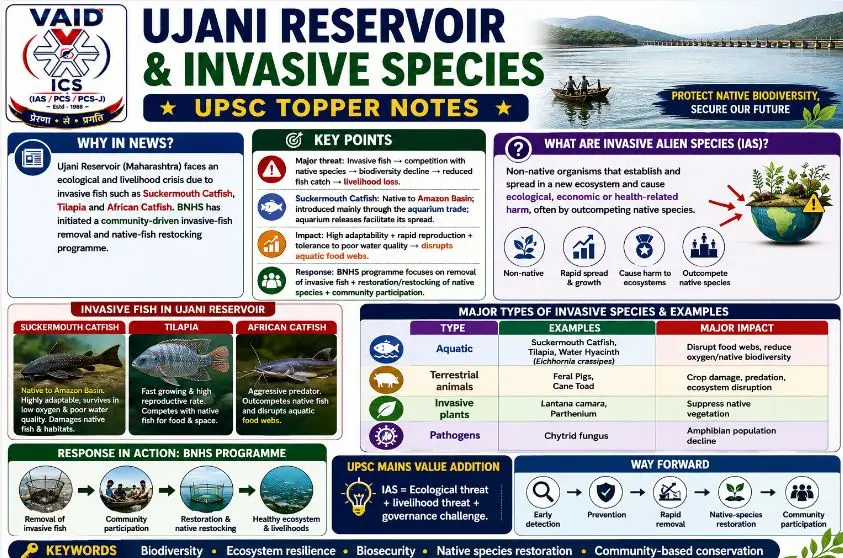
The Ujani reservoir is facing a severe ecological crisis due to invasive foreign fish species—such as the suckermouth catfish, Tilapia, and African catfish—which have collapsed local fish populations and threatened fishermen’s livelihoods, prompting the Bombay Natural History Society (BNHS) to launch India’s first community-driven removal and native-restocking programme.
Key Points:
-
Ecological Crisis at Ujani Reservoir: Once renowned for high-quality freshwater fish, the reservoir is now heavily impacted by invasive alien species that have decimated native biodiversity.
-
Target Invasive Species: Suckermouth catfish, Tilapia, and African catfish.
-
Pathway of Introduction: The suckermouth catfish, native to the Amazon River in South America, entered India primarily through the global aquarium trade.
-
Human Factor: Aquarium owners frequently dump these fish into local canals, streams, or rivers when they grow too large and aggressive for home tanks.
-
Conservation Response: The Bombay Natural History Society (BNHS), led by scientist Dr. Unmesh Katwate, has initiated India’s first active, community-driven removal and native-restocking programme.
What are Invasive Species?
Invasive species are non-native organisms (plants, animals, pathogens, or microbes) that are introduced either intentionally or accidentally into a new environment where they do not naturally occur. Once established, they adapt quickly, reproduce rapidly, and cause significant harm to local ecosystems, native biodiversity, the economy, or human health by outcompeting native species for resources like food, space, and light.
Types of Invasive Species & Examples:
1. Invasive Aquatic Species
-
Definition: Organisms that invade freshwater or marine ecosystems, aggressively altering aquatic food webs.
-
Examples: * Suckermouth Catfish & African Catfish: Outcompete native fish, destroy habitats, and survive in harsh, low-oxygen conditions.
-
Water Hyacinth (Eichhornia crassipes): A floating aquatic plant that chokes water bodies, blocks sunlight, depletes oxygen, and disrupts aquatic life.
-
2. Invasive Terrestrial Animals
-
Definition: Land-dwelling animals, insects, or birds that disrupt local fauna and agriculture.
-
Examples:
-
Feral Pigs / Wild Boars: Destroy crops, degrade soil, and prey on small native animals.
-
Spotted Lanternfly or Cane Toads: Rapidly multiply and lack natural predators in their introduced ranges, decimating native populations.
-
3. Invasive Plant Species (Weeds)
-
Definition: Aggressive terrestrial plants that smother native flora, alter soil chemistry, and reduce forest regeneration.
-
Examples:
-
Lantana camara: A toxic shrub that invades forests, prevents the growth of native understory plants, and increases wildfire risks.
-
Parthenium (Congress Grass): Causes severe allergic reactions in humans and livestock while destroying native vegetation.
-
4. Invasive Microbes & Pathogens
-
Definition: Fungi, bacteria, or viruses that decimate native wildlife or plant populations.
-
Examples:
-
Chytrid Fungus: Responsible for declining amphibian (frog and toad) populations globally.
-

May 19, 2026
October 17, 2025
October 16, 2025
October 6, 2025

