January 5, 2026
What are Graphite bombs?The Stealth “Corridor”
Why in News? The capture of Nicolás Maduro during Operation Absolute Resolve (January 3, 2026) is being studied by military analysts as a masterclass in “multi-domain” warfare. Despite Venezuela possessing a sophisticated, Russian-made Integrated Air Defense System (IADS) on paper, the U.S. successfully bypassed it through a combination of cyber-disruption and stealth technology.
Neutralizing the “High-Density” Defenses:
Venezuela’s defense network included long-range S-300VM missiles and Buk-M2 systems, designed to create a “no-fly zone.” The U.S. neutralized these through:
- Cyber & Space Command Intervention: Before any aircraft entered Venezuelan airspace, U.S. Cyber Command and Space Command “layered effects” to disable command-and-control nodes. This effectively “blinded” Venezuelan radar operators, leaving them unable to track incoming targets.
- Total Blackout: U.S. forces used specialized “expertise” (likely graphite bombs or cyber-attacks on the grid) to plunge Caracas into a total blackout. This removed the ability of ground forces to use visual tracking or communicate via landlines.
- Electronic Warfare (EW): EA-18G Growlers and F-35s utilized advanced jamming to saturate any remaining active radar frequencies, creating “electronic noise” that masked the approach of the extraction team.
The Stealth “Corridor”
Once the electronic defenses were suppressed, the U.S. used a high-low strategy to enter the capital:
- Stealth Escort: F-22 Raptors and F-35 Lightning IIs flew high-altitude “Combat Air Patrols” to secure the skies and destroy any Venezuelan jets or mobile missile launchers that attempted to activate.
- Low-Level Infiltration: While the fighters drew attention above, the 160th Special Operations Aviation Regiment (Night Stalkers) flew MH-47 Chinook and MH-60 Black Hawk helicopters at extremely low altitudes—roughly 100 feet above the water—to stay beneath the radar horizon until the last possible moment.
- Terrain Masking: Pilots used the mountains surrounding Caracas to hide in “radar clutter,” appearing on any surviving screens only seconds before touching down at the presidential compound.
Precision Execution at “The Fortress”:
The ground raid lasted less than 30 minutes:
- Delta Force Breach: Elite operators used massive blowtorches and explosives to cut through reinforced steel doors. They intercepted Maduro just as he was reaching a “fortress-like” safe room.
- Real-Time Intelligence: Throughout the raid, a small CIA team on the ground and overhead “stealth drones” (likely the secretive RQ-170 or RQ-180) provided live, room-by-room updates to the commandos.
- Suppressive Fire: During the exfiltration, U.S. helicopters came under fire from MANPADS (handheld missiles) and small arms. One helicopter was hit but remained flyable, supported by AH-64 Apache and AH-1Z Viper attack helicopters providing “suppressive fire” to clear the extraction zone.
What are Graphite boms?
Graphite bombs are non-lethal aerial munitions that disrupt electrical power grids by dispersing clouds of fine, conductive carbon filaments. These settle on high-voltage lines and transformers, causing short circuits without physical destruction.
The U.S. pioneered this with the BLU-114/B submunition in dispensers like the CBU-94, releasing chemically treated carbon-fiber filaments finer than early wire spools.
Operating Principle: Submunitions release coiled graphite-coated filaments (∼1.5 mm diameter, several meters long), forming clouds that bridge phases or ground lines, triggering arcs, overloads, and protective shutdowns. Cascading outages disable up to 85% of grids; effects are reversible via filament removal, though weather affects persistence.
Dispersal Cloud and Short Circuits:

Historical Development and Use:
Early concepts emerged in the Cold War; U.S. Navy’s Kit-2 used fiberglass wires in Tomahawk missiles during 1991 Gulf War, blacking out areas reversibly.
Refined BLU-114/B tested in mid-1990s for finer filaments.
First major combat: 1999 NATO Operation Allied Force (Yugoslavia) – disabled 70–80% of Serbia’s grid; restored in hours/days.
Also used in 2003 Iraq invasion via cruise missiles.
Historical Blackout Impacts:
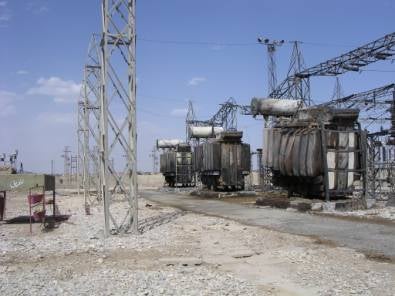
United States: Developed and deployed BLU-114/B in 1999 (Serbia: 70% blackout) and 2003 (Iraq); remains in inventory, no public use post-2003.
South Korea: ADD secured tech by 2017; developing gliding variant (completion targeted ~2024) for “Kill Chain” against North Korea; no deployments reported.
China: In June 2025, CCTV aired animation of new blackout bomb (90 submunitions, ~290 km range, 490 kg warhead), causing complete loss over ~10,000 m²; attributed to CASC, potentially integrates microwave tech.
Effectiveness and Outcomes:
1991 Gulf War: 85% Iraqi capacity disabled.
1999 Yugoslavia: 70–80% grid blackout; initial recovery 4–15 hours.
Temporary (hours–days); no permanent damage.
| Conflict | Peak Disruption | Duration |
|---|---|---|
| Gulf War (1991) | 85% capacity | Hours–days |
| Allied Force (1999) | 70–80% grid | 4–15 hours initial |
Vs. Conventional Munitions: Graphite causes temporary shorts (low collateral); conventional inflicts permanent destruction (high casualties/rebuild costs).
| Aspect | Graphite Bombs | Conventional |
|---|---|---|
| Effect | Temporary short-circuit | Permanent destruction |
| Collateral | Low | High |
| Recovery | Hours–days | Weeks–years |
Countermeasures and Vulnerabilities:
Immediate: Isolate segments, de-energize, remove filaments (brushing, air, dry ice); Serbia restored Belgrade in ~7 hours.
Hardening: Segmentation, automation, spares; insulation impractical for overhead lines.
Strategic Implications
Advantages: Non-kinetic denial of power-dependent systems; reversible, low escalation; supports precision electronic attacks.
Drawbacks: Temporary (quick recovery possible); weather-dependent; ineffective vs. insulated/underground lines; indirect civilian harm (e.g., hospitals, water). Criticized for disproportionate effects on dual-use infrastructure.

October 17, 2025
October 16, 2025
October 6, 2025
September 24, 2025

