June 12, 2026
What are GDDP and NDDP?
Why in News:?
The Ministry of Statistics and Programme Implementation (MoSPI) has released a uniform framework for compiling district-level economic output estimates. This move is aimed at improving the consistency and comparability of economic data across all States and Union Territories.
Key Points:
-
Revised Base Year: The framework sets 2022-23 as the new base year for these estimates, ensuring data reflects the current structure of the economy.
-
Standardized Guidelines: The finalized guidelines were released after incorporating feedback from various stakeholders, including State governments, academic institutions, and researchers.
-
Objective: The framework provides a comprehensive and standardized methodology for estimating Gross District Domestic Product (GDDP), Net District Domestic Product (NDDP), and per capita income at the district level.
-
Bottom-up Approach: The ministry primarily advocates for a bottom-up approach for preparing DDP estimates, wherever district-level data is available, as opposed to the traditional ‘top-down’ method (which often just allocates State-level data). This ensures a more accurate reflection of local economic activities.
-
Better Policy Formulation: More detailed and accurate district-level data will help governments identify backward districts, understand regional disparities, and implement targeted development schemes.
What are GDDP and NDDP?
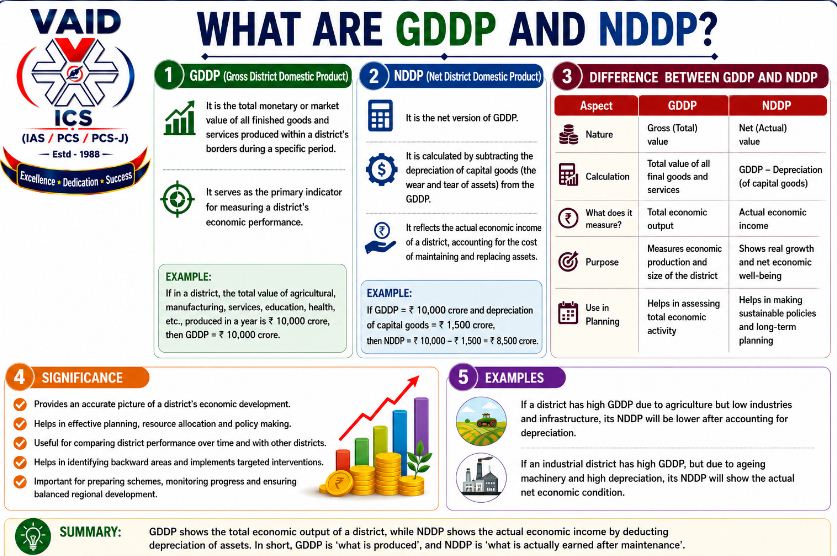
Gross District Domestic Product (GDDP):
-
It is the total monetary or market value of all finished goods and services produced within a district’s borders during a specific period.
-
It serves as the primary indicator for measuring a district’s economic performance.
Net District Domestic Product (NDDP):
-
It is the net version of GDDP.
-
It is calculated by subtracting the depreciation of capital goods (the wear and tear of assets) from the GDDP.
-
It reflects the actual economic income of a district, accounting for the cost of maintaining and replacing assets.
Significance of this Statistical Reform:
-
Identifying Regional Inequality: Often, ‘top-down’ estimates mask the true economic situation of individual districts. The new framework will better capture local economic shocks and the impact of the informal sector.
-
Precision in Resource Allocation: With more accurate data, central and state governments can better direct investment and support to the districts that need it most.
-
Harmonization: A uniform methodology across all States and UTs ensures that economic comparisons between districts and states are reliable and statistically sound.
चर्चा में क्यों?
सांख्यिकी और कार्यक्रम कार्यान्वयन मंत्रालय (MoSPI) ने जिला-स्तरीय आर्थिक उत्पादन (district-level economic output) के अनुमानों को संकलित करने के लिए एक समान ढांचा (uniform framework) जारी किया है। इसका मुख्य उद्देश्य राज्यों और केंद्र शासित प्रदेशों के बीच आर्थिक डेटा की संगति (consistency) और तुलनात्मकता (comparability) को सुधारना है।
प्रमुख बिंदु:
-
नया आधार वर्ष (Revised Base Year): इन अनुमानों के लिए 2022-23 को नया आधार वर्ष निर्धारित किया गया है, ताकि अर्थव्यवस्था की वर्तमान संरचना का सटीक चित्रण किया जा सके।
-
मानकीकृत दिशानिर्देश: MoSPI द्वारा जारी अंतिम दिशानिर्देश राज्यों, शैक्षणिक संस्थानों और शोधकर्ताओं से मिले फीडबैक पर आधारित हैं।
-
उद्देश्य: यह ढांचा सकल जिला घरेलू उत्पाद (GDDP), निवल जिला घरेलू उत्पाद (NDDP) और प्रति व्यक्ति आय के अनुमानों को संकलित करने के लिए एक व्यापक और मानकीकृत पद्धति प्रदान करता है।
-
बॉटम-अप दृष्टिकोण (Bottom-up Approach): मंत्रालय ने वर्तमान में प्रचलित ‘टॉप-डाउन’ (राज्य के जीडीपी का वितरण) के बजाय, जहाँ भी संभव हो, बॉटम-अप दृष्टिकोण अपनाने की वकालत की है। इससे जमीनी स्तर की आर्थिक गतिविधियों का अधिक सटीक डेटा मिल सकेगा।
-
बेहतर नीति निर्माण: अधिक विस्तृत और सटीक जिला-स्तरीय डेटा से सरकारों को पिछड़े जिलों की पहचान करने, क्षेत्रीय असमानताओं को समझने और लक्षित विकास योजनाएं बनाने में मदद मिलेगी।
GDDP और NDDP क्या हैं?
सकल जिला घरेलू उत्पाद (Gross District Domestic Product – GDDP):
-
यह एक जिले की सीमाओं के भीतर एक विशिष्ट समयावधि में उत्पादित सभी तैयार वस्तुओं और सेवाओं का कुल मौद्रिक या बाजार मूल्य है।
-
यह जिले के आर्थिक प्रदर्शन को मापने का प्राथमिक संकेतक है।
निवल जिला घरेलू उत्पाद (Net District Domestic Product – NDDP):
-
यह GDDP का शुद्ध रूप है।
-
इसे GDDP में से पूंजीगत वस्तुओं के मूल्यह्रास (depreciation) को घटाकर निकाला जाता है।
-
यह जिले की वास्तविक आर्थिक आय को दर्शाता है क्योंकि इसमें संपत्ति के उपयोग और टूट-फूट की लागत को शामिल किया जाता है।
सांख्यिकी में इस बदलाव का महत्व:
-
क्षेत्रीय असमानता को पहचानना: अक्सर टॉप-डाउन अनुमान जिलों की वास्तविक आर्थिक स्थिति को छिपा देते हैं। नया ढांचा जिला-स्तर पर स्थानीय आर्थिक झटकों और अनौपचारिक क्षेत्र के प्रभाव को बेहतर ढंग से कैप्चर करेगा।
-
सटीक संसाधन आवंटन: जब डेटा अधिक सटीक होता है, तो केंद्र और राज्य सरकारें उन जिलों में निवेश और सहायता को बेहतर तरीके से निर्देशित कर सकती हैं जहाँ इसकी वास्तव में आवश्यकता है।
-
मानकीकरण: सभी राज्यों और केंद्र शासित प्रदेशों में एक समान पद्धति होने से, अलग-अलग जिलों और राज्यों के बीच आर्थिक तुलना करना आसान और विश्वसनीय हो जाएगा।

May 19, 2026
October 17, 2025
October 16, 2025
October 6, 2025

