June 15, 2026
What are Flex-Fuel Vehicles (FFVs)/ E20
India has successfully established E20 (20% ethanol, 80% petrol) as a nationwide standard and is actively transitioning toward even higher blends. This transition is a cornerstone of India’s strategy to enhance energy security, reduce its massive crude oil import bill, and achieve environmental goals.
1. The Current Position in India:
-
Mandate Achievement: India achieved its nationwide E20 target, with the mandate in full effect as of April 1, 2026.
-
Moving Beyond E20: The government has recently notified technical standards for higher blends, specifically E22, E25, E27, and E30.
-
Infrastructure: There is an active push to upgrade fuel dispensing stations to handle multi-grade ethanol blends and to introduce E85/E100 fuel in specific areas to support flex-fuel vehicles.
-
Economic Impact: The ethanol blending program has already saved India over ₹1.40–1.65 lakh crore in foreign exchange by substituting imported crude oil with domestically produced ethanol.
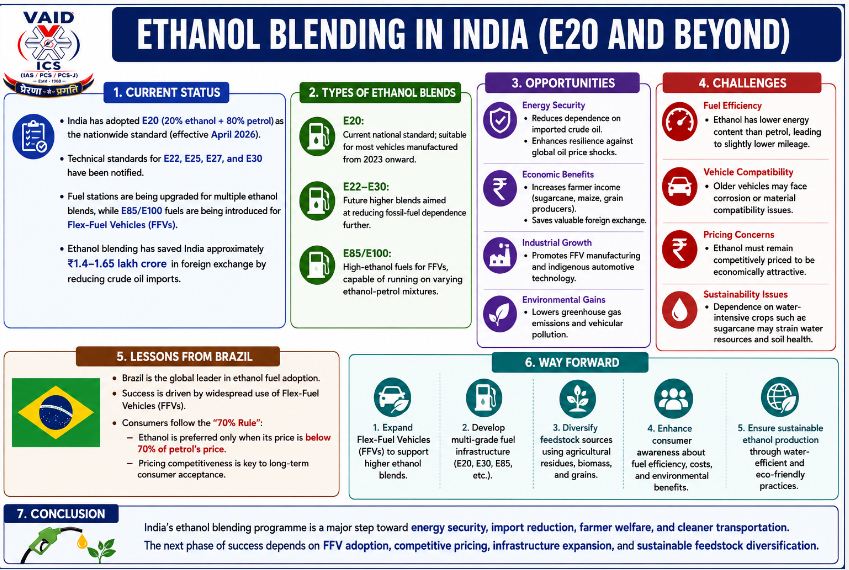
2. Types of Ethanol Blended Fuels:
India is moving toward a “supermarket-style” ecosystem where different blends will be available:
-
E20: The current standard; safe for most vehicles manufactured from 2023 onwards.
-
E22 to E30: Higher blends currently being standardized for future rollout to further reduce fossil fuel consumption.
-
E85/E100: High-concentration blends designed for Flex-Fuel Vehicles (FFVs), which are engineered to run on any mix of petrol and ethanol.
3. Opportunities and Challenges:
| Aspect | Opportunities | Challenges |
| Energy | Reduces reliance on volatile global oil markets and strengthens energy security. | Lower energy density of ethanol reduces fuel efficiency compared to pure petrol. |
| Economic | Boosts farmer incomes (sugarcane/maize); saves massive foreign exchange. | Pricing rigidity and the “70% rule” (ethanol must be significantly cheaper to be cost-effective per km). |
| Technical | Encourages domestic manufacturing of FFVs and advanced engine tech. | Compatibility issues for older (pre-2023) vehicles; risk of material corrosion (hoses, seals). |
| Environmental | Significantly lowers tailpipe emissions and carbon footprint. | High water consumption for ethanol feedstock (e.g., sugarcane) and potential soil nutrient depletion. |
4. Global Experience: Lessons from Brazil:
Brazil is the global leader in ethanol, with a multi-decade head start.
-
The “Flex” Advantage: Brazil’s success is built on widespread adoption of Flex-Fuel Vehicles. Consumers have the freedom to choose between pure ethanol (E100) and petrol/ethanol blends based on current market prices.
-
The Price Sensitivity Lesson: Brazilian consumers follow the “70% rule”: if ethanol is cheaper than 70% of the price of petrol, they buy ethanol; otherwise, they buy petrol. India’s success depends on achieving similar pricing competitiveness to ensure consumer adoption.
5. The Way Forward:
To sustain this transition, the following steps are critical:
-
Scaling Flex-Fuel Vehicles (FFVs): The ecosystem cannot move to high blends (like E85/E100) without a critical mass of vehicles designed to handle them. Promoting FFV adoption is the immediate priority.
-
Multi-Grade Infrastructure: Moving away from a “one-fuel-fits-all” approach to a multi-grade dispensing system (E20, E30, E85) at fuel pumps to accommodate different vehicle capabilities.
-
Feedstock Diversification: Reducing dependence on water-intensive crops (sugarcane) by expanding the use of agricultural waste, biomass, and grains to ensure long-term environmental sustainability.
-
Consumer Education: Transparent communication regarding fuel efficiency and cost-per-kilometer is essential to maintain public trust as higher blends are introduced.
भारत ने E20 (20% इथेनॉल, 80% पेट्रोल) को एक राष्ट्रव्यापी मानक के रूप में सफलतापूर्वक स्थापित कर लिया है और अब तेजी से उच्च मिश्रणों (Higher Blends) की ओर बढ़ रहा है। यह बदलाव भारत की ऊर्जा सुरक्षा बढ़ाने, कच्चे तेल के भारी आयात बिल को कम करने और पर्यावरणीय लक्ष्यों को प्राप्त करने की रणनीति का एक महत्वपूर्ण स्तंभ है।
1. भारत में वर्तमान स्थिति:
-
लक्ष्य प्राप्ति: भारत ने अपना राष्ट्रव्यापी E20 लक्ष्य प्राप्त कर लिया है और यह जनादेश 1 अप्रैल, 2026 से पूर्णतः प्रभावी है।
-
E20 से आगे: सरकार ने उच्च मिश्रणों, विशेष रूप से E22, E25, E27 और E30 के लिए तकनीकी मानक अधिसूचित किए हैं।
-
बुनियादी ढांचा: मल्टी-ग्रेड इथेनॉल मिश्रणों को संभालने के लिए फ्यूल डिस्पेंसिंग स्टेशनों को अपग्रेड करने और फ्लेक्स-फ्यूल वाहनों (FFVs) का समर्थन करने के लिए विशिष्ट क्षेत्रों में E85/E100 ईंधन पेश करने पर जोर दिया जा रहा है।
-
आर्थिक प्रभाव: इथेनॉल सम्मिश्रण कार्यक्रम ने आयातित कच्चे तेल को घरेलू रूप से उत्पादित इथेनॉल से प्रतिस्थापित करके भारत की ₹1.40–1.65 लाख करोड़ से अधिक की विदेशी मुद्रा बचाई है।
2. इथेनॉल मिश्रित ईंधन के प्रकार:
भारत एक “सुपरमार्केट-शैली” के इकोसिस्टम की ओर बढ़ रहा है जहाँ अलग-अलग मिश्रण उपलब्ध होंगे:
-
E20: वर्तमान मानक; 2023 के बाद निर्मित अधिकांश वाहनों के लिए सुरक्षित।
-
E22 से E30: उच्च मिश्रण, जिन्हें जीवाश्म ईंधन की खपत को और कम करने के लिए भविष्य में लागू किया जा रहा है।
-
E85/E100: उच्च-सांद्रता वाले मिश्रण, जिन्हें विशेष रूप से फ्लेक्स-फ्यूल वाहनों (FFVs) के लिए डिज़ाइन किया गया है, जो पेट्रोल और इथेनॉल के किसी भी मिश्रण पर चल सकते हैं।
3. अवसर और चुनौतियां:
| क्षेत्र | अवसर | चुनौतियां |
| ऊर्जा | वैश्विक तेल बाजारों पर निर्भरता कम होती है और ऊर्जा सुरक्षा मजबूत होती है। | इथेनॉल का ऊर्जा घनत्व कम होने से शुद्ध पेट्रोल की तुलना में माइलेज (Fuel Efficiency) कम हो सकती है। |
| आर्थिक | किसानों की आय (गन्ना/मक्का) में वृद्धि; भारी विदेशी मुद्रा की बचत। | मूल्य निर्धारण में कठोरता और “70% नियम” (प्रति किमी लागत प्रभावी होने के लिए इथेनॉल का पेट्रोल से काफी सस्ता होना जरूरी है)। |
| तकनीकी | FFVs के घरेलू विनिर्माण और उन्नत इंजन तकनीक को बढ़ावा। | पुराने वाहनों (2023 से पहले के) के साथ अनुकूलता की समस्या; सामग्री क्षरण (corrosion) का जोखिम। |
| पर्यावरण | कार्बन फुटप्रिंट और प्रदूषण उत्सर्जन में उल्लेखनीय कमी। | इथेनॉल फीडस्टॉक (जैसे गन्ना) के लिए पानी की अधिक खपत और मिट्टी के पोषक तत्वों में कमी का जोखिम। |
4. वैश्विक अनुभव: ब्राजील से सबक
ब्राजील इथेनॉल के क्षेत्र में वैश्विक नेता है।
-
“फ्लेक्स” लाभ: ब्राजील की सफलता फ्लेक्स-फ्यूल वाहनों को व्यापक रूप से अपनाने पर टिकी है। उपभोक्ताओं के पास बाजार की कीमतों के आधार पर शुद्ध इथेनॉल (E100) और पेट्रोल/इथेनॉल मिश्रण चुनने की स्वतंत्रता है।
-
मूल्य संवेदनशीलता का सबक: ब्राज़ीलियाई उपभोक्ता “70% नियम” का पालन करते हैं: यदि इथेनॉल की कीमत पेट्रोल की कीमत के 70% से कम है, तो वे इथेनॉल खरीदते हैं; अन्यथा वे पेट्रोल चुनते हैं। भारत की सफलता भी ऐसी ही मूल्य प्रतिस्पर्धा हासिल करने पर निर्भर करती है।
5. आगे की राह:
इस परिवर्तन को बनाए रखने के लिए निम्नलिखित कदम महत्वपूर्ण हैं:
-
फ्लेक्स-फ्यूल वाहनों (FFVs) का विस्तार: FFVs की एक बड़ी संख्या के बिना उच्च मिश्रण (जैसे E85/E100) की ओर बढ़ना संभव नहीं है।
-
मल्टी-ग्रेड बुनियादी ढांचा: फ्यूल पंपों पर “एक ईंधन, सभी के लिए” के बजाय मल्टी-ग्रेड डिस्पेंसिंग सिस्टम की आवश्यकता है।
-
फीडस्टॉक विविधीकरण: केवल गन्ने जैसे पानी की खपत करने वाली फसलों पर निर्भरता कम करना और कृषि अपशिष्ट, बायोमास और अनाज का उपयोग बढ़ाना।
-
उपभोक्ता शिक्षा: जैसे-जैसे उच्च मिश्रण पेश किए जा रहे हैं, ईंधन दक्षता और प्रति-किलोमीटर लागत के बारे में पारदर्शी संचार बहुत जरूरी है ताकि सार्वजनिक विश्वास बना रहे।

May 19, 2026
October 17, 2025
October 16, 2025
October 6, 2025

