February 7, 2026
What are Eco-Sensitive Zones (ESZ)?
Why in the News? The National Green Tribunal (NGT) recently took a stern stance against the National Mission for Clean Ganga (NMCG) and local authorities regarding environmental violations:
- Illegal Constructions: The NGT “slammed” authorities for allowing permanent structures and bridges in the Prayadhaj floodplain and sensitive Ganga zones without proper clearances.
- Accountability: The Tribunal emphasized that accountability must be fixed on high-ranking decision-makers, not just junior officials, for administrative lapses.
- The Varanasi ‘Tent City’ Dispute: Discussions continued regarding luxury tourism projects in Varanasi that overlap with the Kachhua (Turtle) Wildlife Sanctuary, raising concerns over habitat destruction.
- New Buffer Guidelines: State governments (especially Himalayan states) are pushing for site-specific buffer zone guidelines to ensure that vital infrastructure (roads/bridges) isn’t stalled by “blanket” 10km rules.
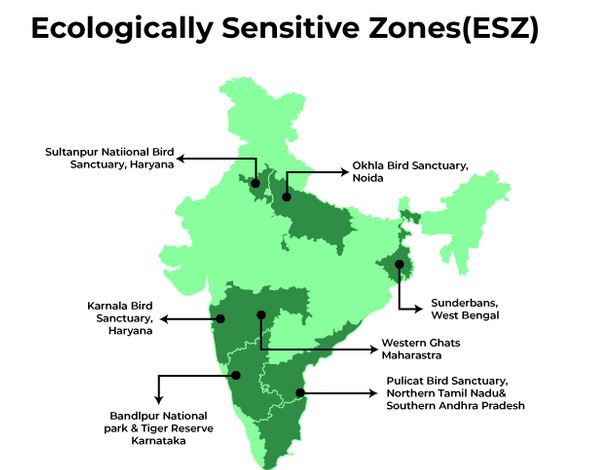
What are Eco-Sensitive Zones (ESZ)?
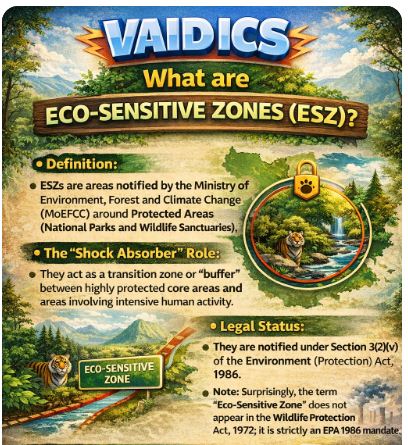
- Definition: ESZs are areas notified by the Ministry of Environment, Forest and Climate Change (MoEFCC) around Protected Areas (National Parks and Wildlife Sanctuaries).
- The “Shock Absorber” Role: They act as a transition zone or “buffer” between highly protected core areas and areas involving intensive human activity.
- Legal Status: They are notified under Section 3(2)(v) of the Environment (Protection) Act, 1986.
- Note: Surprisingly, the term “Eco-Sensitive Zone” does not appear in the Wildlife Protection Act, 1972; it is strictly an EPA 1986 mandate.
Regulatory Framework: What is allowed?
The activities in an ESZ are categorized into three types to manage the “degree of impact”:
| Prohibited Activities | Regulated Activities | Permitted Activities |
| Commercial Mining & Stone Quarrying. | Felling of trees (requires permit). | Ongoing Agriculture & Horticulture. |
| Setting up polluting industries. | Construction of hotels/resorts. | Rainwater Harvesting. |
| Major Hydroelectric projects. | Widening of roads. | Organic Farming. |
| Discharge of untreated effluents. | Small-scale cottage industries. | Use of Renewable Energy. |
Key Challenges & Criticisms :
- Impact on Livelihoods: Local communities often view ESZs as a “hurdle” because they restrict the conversion of agricultural land into commercial land, affecting local income.
- The 10km Uniformity Myth: While the general guideline is 10km, the SC and MoEFCC allow for flexibility. However, states argue that in ecologically dense regions (like the Western Ghats), this covers too much area, halting development.
- Implementation Gaps: As noted by the NGT in the Ganga case, even with ESZ status, “Administrative Apathy” often leads to illegal encroachments and sand mining.
The Way Forward:
- Zonal Master Plans (ZMP): Every ESZ must have a ZMP developed with the participation of local communities to ensure the “social license” to conserve.
- Site-Specific Sensitivity: Moving away from a “one-size-fits-all” 10km rule to a scientifically mapped boundary based on the specific species or terrain being protected.
- Digital Monitoring: Using GIS (Geographic Information Systems) and satellite monitoring to prevent the kind of “illegal construction” the NGT highlighted in 2026.
Conclusion: The NGT’s recent intervention serves as a reminder that Eco-Sensitive Zones are not merely “paper boundaries.” For India to meet its SDG 15 (Life on Land) goals, the state must balance infrastructure needs with the ecological integrity of river basins and forests.
Difference in ESA & ESZ:
- Eco-Sensitive Areas (ESAs) and Eco-Sensitive Zones (ESZs) are not the same, although both are conservation tools notified by the Ministry of Environment, Forest and Climate Change (MoEFCC) under the Environment (Protection) Act, 1986.
- ESZs serve as 10-km, regulatory, buffer zones around protected areas (national parks/sanctuaries), while ESAs are broader, often large-scale ecosystems (e.g., Western Ghats) needing protection.
Key Differences Between ESA and ESZ
- Scope and Size:ESZs are specific, smaller buffer areas surrounding a Protected Area (PA). ESAs are broader ecological zones, which may not always be directly adjacent to a national park or sanctuary.
- Purpose:ESZs act as “shock absorbers” that transition from high protection to lower protection zones. ESAs are designated for the conservation of unique biodiversity, ecosystems, and natural features.
- Origin:ESZs are typically 10-km buffers around PAs, while ESAs are defined based on ecological sensitivity regardless of surrounding PAs.
- Examples:ESZs are notified for specific parks (e.g., around Kaziranga National Park). Examples of ESAs include the Western Ghats, Doon Valley, and Mahabaleshwar-Panchgani.

Gist of daily Article /The Hindu 17oct 2025
October 17, 2025
Daily Gist of the Hindu/Indian Express : 16 Oct 2025
October 16, 2025
Daily Gist of The Hindu/Indian Express: 6 Oct 2025
October 6, 2025
Daily Gist of Article /The Hindu /Indian Express: 24 Sep 2025
September 24, 2025

