September 21, 2026
United Nations General Assembly (UNGA)/संयुक्त राष्ट्र महासभा (UNGA)
Why in News?
-
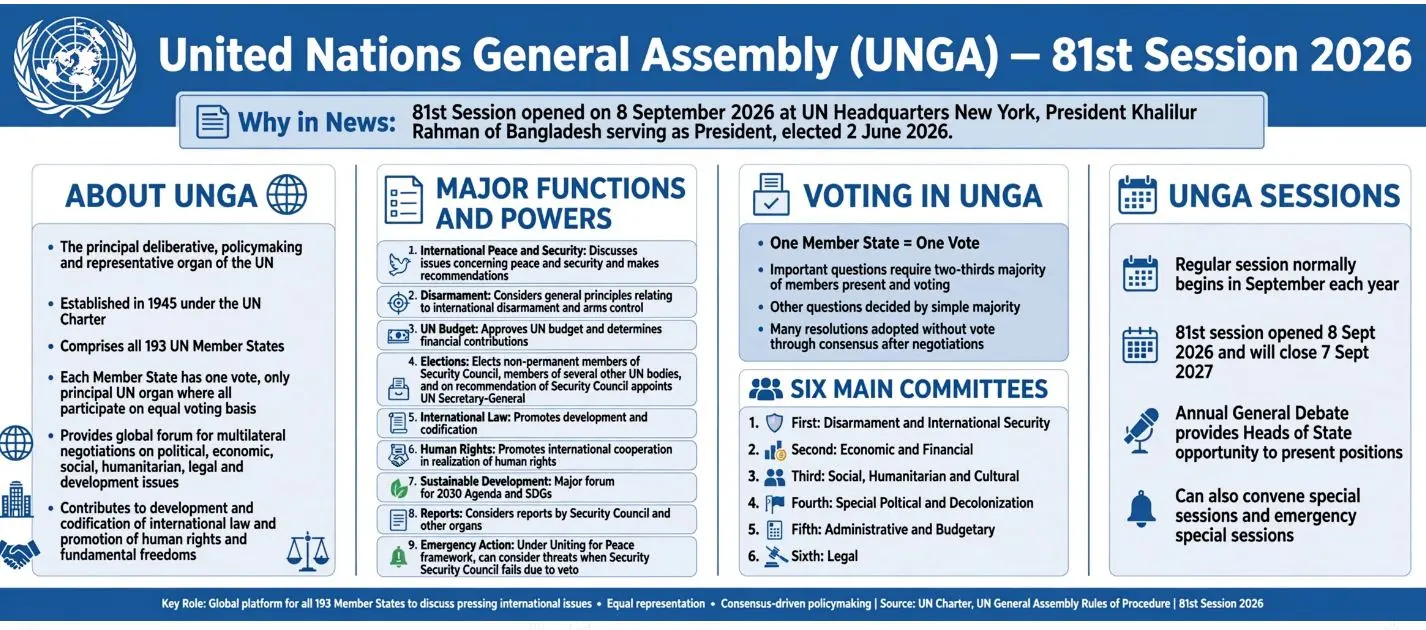
The 81st Session of the United Nations General Assembly (UNGA) began on 8 September 2026 at the UN Headquarters in New York.
-
Khalilur Rahman of Bangladesh is the President of the 81st Session.
-
India is participating in the session to discuss major global issues, including international peace and security, development, climate change and reform of multilateral institutions.
About the United Nations General Assembly:
-
The United Nations General Assembly (UNGA) is the principal deliberative, policymaking and representative organ of the United Nations.
-
It was established in 1945 under the UN Charter.
-
It consists of all 193 UN Member States.
-
Every Member State has one vote, irrespective of its population, economic strength or military power.
-
It provides the principal global forum for multilateral dialogue and negotiations.
Major Areas Discussed by UNGA:
-
International peace and security
-
Disarmament and arms control
-
Sustainable development and SDGs
-
Climate change and environmental protection
-
Human rights and humanitarian issues
-
International law
-
Economic and social development
-
Decolonisation
-
Global health and international cooperation
-
Reform of the UN system
Major Powers and Functions:
-
Discusses international issues: The UNGA can discuss matters within the scope of the UN Charter and make recommendations to Member States or the Security Council.
-
UN Budget: It approves the UN budget and determines the financial contributions of Member States.
-
Election of UN bodies: It elects the non-permanent members of the UN Security Council and members of several other UN organs.
-
Secretary-General: It appoints the UN Secretary-General on the recommendation of the Security Council.
-
International Law: Through its Sixth Committee, it contributes to the development and codification of international law.
-
Human Rights: It promotes international cooperation in the realization of human rights and fundamental freedoms.
-
Disarmament: It considers general principles of cooperation in maintaining international peace and security, including disarmament.
Voting System:
-
The basic principle is “one country, one vote.”
-
Important questions generally require a two-thirds majority of members present and voting.
-
Other questions are generally decided by a simple majority.
-
Many resolutions are adopted through consensus, without a formal vote.
Six Main Committees:
-
First Committee: Disarmament and International Security
-
Second Committee: Economic and Financial
-
Third Committee: Social, Humanitarian and Cultural
-
Fourth Committee: Special Political and Decolonization
-
Fifth Committee: Administrative and Budgetary
-
Sixth Committee: Legal
UNGA Sessions:
-
The regular session of the UNGA begins every year in September.
-
The General Debate is held at the beginning of the regular session, during which Heads of State, Heads of Government and other senior representatives present their countries’ positions on major global issues.
-
The UNGA may also convene Special Sessions and Emergency Special Sessions.
UNGA and UNSC: Key Difference:
-
UNGA: Broad representative body consisting of all 193 Member States; primarily deliberative and policymaking.
-
UNSC: Has 15 members, including 5 permanent members with veto power; has primary responsibility for international peace and security.
संयुक्त राष्ट्र महासभा (UNGA):
चर्चा में क्यों?
-
संयुक्त राष्ट्र महासभा (UNGA) के 81वें सत्र का प्रारंभ 8 सितंबर 2026 को संयुक्त राष्ट्र मुख्यालय, न्यूयॉर्क में हुआ।
-
बांग्लादेश के खलीलुर रहमान 81वें सत्र के अध्यक्ष हैं।
-
इस सत्र में भारत सहित सदस्य देश अंतरराष्ट्रीय शांति एवं सुरक्षा, सतत विकास, जलवायु परिवर्तन तथा बहुपक्षीय संस्थाओं में सुधार जैसे प्रमुख वैश्विक विषयों पर चर्चा कर रहे हैं।
संयुक्त राष्ट्र महासभा के बारे में:
-
संयुक्त राष्ट्र महासभा (UNGA) संयुक्त राष्ट्र का प्रमुख विचार-विमर्शकारी, नीतिनिर्माणकारी एवं प्रतिनिधिक अंग है।
-
इसकी स्थापना 1945 में संयुक्त राष्ट्र चार्टर के अंतर्गत हुई।
-
इसमें संयुक्त राष्ट्र के सभी 193 सदस्य राष्ट्र सम्मिलित हैं।
-
प्रत्येक सदस्य राष्ट्र को, उसकी जनसंख्या, आर्थिक क्षमता अथवा सैन्य शक्ति की परवाह किए बिना, एक मत प्राप्त है।
-
यह बहुपक्षीय संवाद एवं वार्ता के लिए संयुक्त राष्ट्र का प्रमुख वैश्विक मंच है।
महासभा में विचार किए जाने वाले प्रमुख विषय:
-
अंतरराष्ट्रीय शांति एवं सुरक्षा
-
निरस्त्रीकरण एवं शस्त्र नियंत्रण
-
सतत विकास एवं सतत विकास लक्ष्य (SDGs)
-
जलवायु परिवर्तन एवं पर्यावरण संरक्षण
-
मानवाधिकार एवं मानवीय मुद्दे
-
अंतरराष्ट्रीय विधि
-
आर्थिक एवं सामाजिक विकास
-
उपनिवेशवाद का उन्मूलन
-
वैश्विक स्वास्थ्य
-
अंतरराष्ट्रीय सहयोग
-
संयुक्त राष्ट्र प्रणाली में सुधार
प्रमुख शक्तियाँ एवं कार्य:
-
अंतरराष्ट्रीय विषयों पर विचार-विमर्श: महासभा संयुक्त राष्ट्र चार्टर के दायरे में आने वाले विषयों पर विचार कर सकती है तथा सदस्य राष्ट्रों अथवा सुरक्षा परिषद् को सिफारिशें कर सकती है।
-
संयुक्त राष्ट्र का बजट: यह संयुक्त राष्ट्र के बजट को अनुमोदित करती है तथा सदस्य राष्ट्रों के वित्तीय अंशदान का निर्धारण करती है।
-
विभिन्न निकायों का निर्वाचन: यह संयुक्त राष्ट्र सुरक्षा परिषद् के अस्थायी सदस्यों तथा विभिन्न अन्य संयुक्त राष्ट्र निकायों के सदस्यों का निर्वाचन करती है।
-
महासचिव की नियुक्ति: सुरक्षा परिषद् की सिफारिश पर संयुक्त राष्ट्र महासचिव की नियुक्ति महासभा द्वारा की जाती है।
-
अंतरराष्ट्रीय विधि: इसकी छठी समिति अंतरराष्ट्रीय विधि के विकास एवं संहिताकरण से संबंधित कार्य करती है।
-
मानवाधिकार: यह मानवाधिकारों तथा मौलिक स्वतंत्रताओं की प्राप्ति के लिए अंतरराष्ट्रीय सहयोग को बढ़ावा देती है।
-
निरस्त्रीकरण: अंतरराष्ट्रीय शांति एवं सुरक्षा बनाए रखने तथा निरस्त्रीकरण से संबंधित सामान्य सिद्धांतों पर विचार करती है।
मतदान व्यवस्था:
-
मूल सिद्धांत है — “एक सदस्य राष्ट्र, एक मत”।
-
महत्त्वपूर्ण प्रश्नों पर सामान्यतः उपस्थित एवं मतदान करने वाले सदस्यों के दो-तिहाई बहुमत की आवश्यकता होती है।
-
अन्य प्रश्नों पर सामान्यतः साधारण बहुमत से निर्णय लिया जाता है।
-
अनेक प्रस्ताव औपचारिक मतदान के बिना सर्वसम्मति से भी स्वीकार किए जाते हैं।
महासभा की छह मुख्य समितियाँ:
-
प्रथम समिति: निरस्त्रीकरण एवं अंतरराष्ट्रीय सुरक्षा
-
द्वितीय समिति: आर्थिक एवं वित्तीय
-
तृतीय समिति: सामाजिक, मानवीय एवं सांस्कृतिक
-
चतुर्थ समिति: विशेष राजनीतिक एवं उपनिवेशवाद उन्मूलन
-
पंचम समिति: प्रशासनिक एवं बजटीय
-
षष्ठ समिति: विधिक
महासभा के सत्र:
-
महासभा का नियमित सत्र प्रत्येक वर्ष सितंबर में प्रारंभ होता है।
-
नियमित सत्र के प्रारंभ में सामान्य वाद-विवाद (General Debate) आयोजित किया जाता है, जिसमें राष्ट्राध्यक्ष, शासनाध्यक्ष तथा अन्य वरिष्ठ प्रतिनिधि वैश्विक मुद्दों पर अपने देशों के दृष्टिकोण प्रस्तुत करते हैं।
-
आवश्यकता पड़ने पर महासभा विशेष सत्र तथा आपातकालीन विशेष सत्र भी आयोजित कर सकती है।
UNGA और UNSC में अंतर:
-
UNGA: संयुक्त राष्ट्र के सभी 193 सदस्य राष्ट्रों का प्रतिनिधिक निकाय; इसका प्रमुख स्वरूप विचार-विमर्शकारी एवं नीतिनिर्माणकारी है।
-
UNSC: 15 सदस्यों वाला निकाय; इसमें 5 स्थायी सदस्य हैं, जिन्हें वीटो का अधिकार प्राप्त है। यह अंतरराष्ट्रीय शांति एवं सुरक्षा के लिए प्राथमिक उत्तरदायित्व रखता है।
-
UNGA में वीटो की व्यवस्था नहीं है।
81वें सत्र से संबंधित प्रमुख तथ्य:
-
सत्र: संयुक्त राष्ट्र महासभा का 81वाँ सत्र
-
अध्यक्ष: खलीलुर रहमान
-
देश: बांग्लादेश
-
अध्यक्ष के रूप में निर्वाचन: 2 जून 2026
-
सत्र का प्रारंभ: 8 सितंबर 2026
-
स्थान: संयुक्त राष्ट्र मुख्यालय, न्यूयॉर्क
-
संयुक्त राष्ट्र के सदस्य राष्ट्र: 193
-
मतदान का सिद्धांत: एक सदस्य राष्ट्र, एक मत
-
नियमित सत्र: प्रत्येक वर्ष
-
मुख्य समितियाँ: 6

May 19, 2026
October 17, 2025
October 16, 2025
October 6, 2025

