December 22, 2025
The Tribal Council of Little and Great Nicobar Islands/UPSC Current 22 Dec 2025
Why in News ? The Tribal Council of Little and Great Nicobar Islands recently wrote to the), flagging “unanswered” grievances over the project’s impact on tribal lands, forest rights, and ancestral villages. This follows a November 2025 NCST interview where its chairperson claimed no such representations were received, prompting the council to resubmit old complaints. The project involves diverting ~130 sq km of forest land and denotifying tribal reserves, raising fears of displacement for Nicobarese and Shompen tribes.
Key Points:
Tribal Concerns:
-
- Affected Groups: Nicobarese (Scheduled Tribe) and Shompen (Particularly Vulnerable Tribal Group, ~200-300 people).
- Issues: Potential displacement from ancestral lands (including pre-2004 tsunami villages), loss of forest rights, lack of informed consent, and violation of Forest Rights Act (FRA), 2006.
- Council Actions: Withdrew No-Objection Certificate (NOC) in November 2022; reiterated in July 2025 and December 2025 letters that they oppose project in tribal reserves or Shompen areas.
- Allegations: Earlier consent was obtained under misinformation; forest rights not properly settled before diversion.
About Tribal Council of Little and Great Nicobar Islands:
The Tribal Council of Little and Great Nicobar Islands is a statutory body established under the Andaman and Nicobar Islands (Tribal Councils) Regulation, 2009. It represents the indigenous tribal communities in the southern Nicobar group, primarily the Nicobarese (a Scheduled Tribe) and the Shompen (a Particularly Vulnerable Tribal Group, or PVTG, with a population of ~200–300).
Structure & Role:
-
- Comprises elected or appointed representatives (e.g., captains from village councils).
- Has limited advisory and executive powers focused on tribal welfare, land rights, cultural preservation, and local governance.
- Unlike Sixth Schedule autonomous councils, it lacks legislative or judicial authority but plays a key role in consultations for development projects affecting tribal areas.
Leadership:
-
- Chairman: Barnabas Manju (long-serving leader, based in Campbell Bay, Great Nicobar).
- He has been vocal about tribal rights since at least 2021.
Key Stance on Great Nicobar Project:
-
- The council opposes aspects of the Rs 81,000 crore mega-infrastructure project (transshipment port, airport, township, power plant) due to potential displacement, forest diversion (~130 sq km), and denotification of tribal reserves (~84 sq km).
- Issued a No-Objection Certificate (NOC) in August 2022 but withdrew it in November 2022, alleging misinformation and lack of informed consent.
- Demands return to pre-2004 tsunami ancestral villages and protection under the Forest Rights Act (FRA), 2006.
- Recent actions: Wrote to NCST on December 6, 2025, highlighting “unanswered” grievances; also complained to Union Tribal Affairs Minister in July 2025.
Broader Context
-
- Operates in a highly restricted tribal reserve area (under the 1956 Protection of Aboriginal Tribes Regulation).
- Focuses on protecting Shompen (semi-nomadic foragers) and Nicobarese (settled with plantations and fishing) from external impacts.
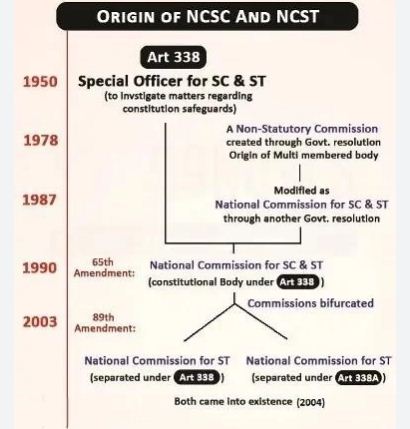
About National Commission for Scheduled Tribes (NCST):
The National Commission for Scheduled Tribes (NCST) is a constitutional body established under Article 338A of the Indian Constitution (inserted via the 89th Amendment Act, 2003). It was carved out from the earlier combined SC/ST Commission to focus exclusively on tribal issues.
- Composition
-
- Chairperson: Antar Singh Arya (current as of 2025).
- Vice-Chairperson + 3 Members (including one woman).
- Appointed by the President for a 3-year term; Chairperson has Cabinet Minister rank, others have senior bureaucratic status.
- Functions & Powers
-
- Investigate and monitor safeguards for Scheduled Tribes under the Constitution, laws, or government orders.
- Evaluate socio-economic development progress and advise on planning.
- Inquire into complaints, summon witnesses, and have civil court-like powers.
- Submit annual reports to the President (laid before Parliament).
- Consulted on major policy matters affecting STs.
About Particularly Vulnerable Tribal Groups (PVTGs) in India:
Particularly Vulnerable Tribal Groups (PVTGs) are a special sub-category of Scheduled Tribes (STs) in India, identified as the most disadvantaged and vulnerable among tribal communities. They face extreme socio-economic challenges and require targeted protection and development interventions. The term was changed from Primitive Tribal Groups (PTGs) in 2006 to avoid derogatory connotations and emphasize vulnerability.
Identification Criteria:
PVTGs are recognized based on the following key characteristics (as per Ministry of Tribal Affairs guidelines):
- Pre-agricultural level of technology (e.g., reliance on hunting, gathering, shifting cultivation).
- Low or stagnant/declining population.
- Extremely low literacy rates.
- Subsistence-level economy.
- Geographical isolation and limited contact with mainstream society.
These criteria were first outlined in the Dhebar Commission report (1973) and formalized in the Fifth Five-Year Plan (1974–79).
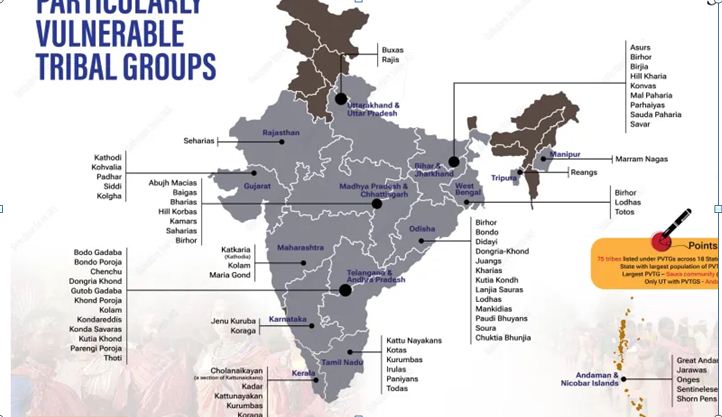
Number and Distribution:
- There are 75 PVTGs across 18 states and 1 Union Territory (Andaman & Nicobar Islands).
- Highest numbers: Odisha (13 PVTGs), followed by Andhra Pradesh (12).
- Estimated population: Around 47–48 lakh (as per recent habitation surveys; 2011 Census figures were lower).
- They inhabit remote, often forested or hilly areas, with many groups facing habitat threats from development projects.
Government Initiatives:
- Development of PVTGs Scheme (Ministry of Tribal Affairs): Provides 100% central funding for habitat-level plans focusing on housing, education, health, livelihoods, and cultural preservation.
- Pradhan Mantri Janjati Adivasi Nyay Maha Abhiyan (PM-JANMAN): Aims to saturate PVTG habitations with basic facilities (e.g., roads, housing, water, electricity).
- Habitat Rights Recognition: Granted to some groups (e.g., in Odisha, Madhya Pradesh, Chhattisgarh) under the Forest Rights Act, 2006, to protect traditional territories.
- Emphasis on Conservation-cum-Development (CCD) plans to balance development with cultural integrity.

October 17, 2025
October 16, 2025
October 6, 2025
September 24, 2025

