June 1, 2026
The Shangri-La Dialogue:
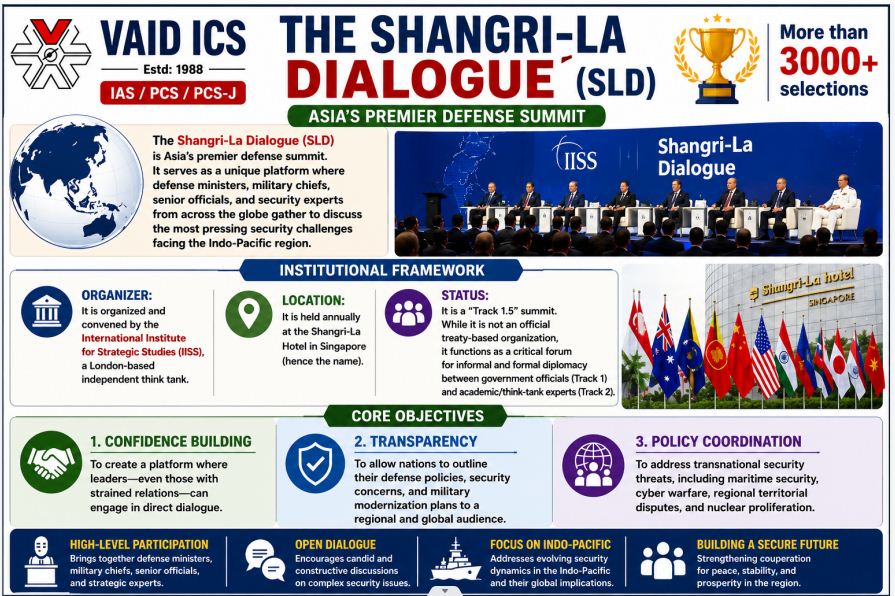
The Shangri-La Dialogue (SLD) is Asia’s premier defense summit. It serves as a unique platform where defense ministers, military chiefs, senior officials, and security experts from across the globe gather to discuss the most pressing security challenges facing the Indo-Pacific region.
Institutional Framework;
-
Organizer: It is organized and convened by the International Institute for Strategic Studies (IISS), a London-based independent think tank.
-
Location: It is held annually at the Shangri-La Hotel in Singapore (hence the name).
-
Status: It is a “Track 1.5” summit. While it is not an official treaty-based organization, it functions as a critical forum for informal and formal diplomacy between government officials (Track 1) and academic/think-tank experts (Track 2).
Core Objectives:
-
Confidence Building: To create a platform where leaders—even those with strained relations—can engage in direct dialogue.
-
Transparency: To allow nations to outline their defense policies, security concerns, and military modernization plans to a regional and global audience.
-
Policy Coordination: To address transnational security threats, including maritime security, cyber warfare, regional territorial disputes, and nuclear proliferation.
Key Characteristics:
-
Multilateral Engagement: Unlike many alliances (like NATO) that are exclusionary, the SLD encourages participation from a wide spectrum of nations, including non-aligned countries.
-
High-Level Representation: It regularly hosts the US Secretary of Defense, senior Chinese military officials, and ministers from ASEAN, Japan, Australia, India, and European nations.
-
The “Hegseth Effect” (Current Context): As seen in the recent 2026 session, the summit is frequently used as a stage for major policy announcements or “warning shots” regarding shifts in global military strategy.
Importance for India:
For India, the Shangri-La Dialogue is a crucial component of its “Act East” Policy:
-
Regional Integration: It allows India to signal its commitment to a “Free, Open, and Inclusive Indo-Pacific.”
-
Security Diplomacy: It provides a venue to engage with ASEAN partners and major powers (like the US, Japan, and France) on issues such as freedom of navigation and combating maritime piracy.
-
Addressing the China Factor: It serves as a key monitoring post to assess China’s evolving military posture and regional strategies, which directly impacts India’s strategic interests in the Indian Ocean Region (IOR).
Why is it “Track 1.5”?
In international relations, diplomacy operates on different “tracks”:
-
Track 1: Official government-to-government communication.
-
Track 2: Unofficial dialogue between academics, retired officials, and researchers.
-
Track 1.5: A hybrid model where government officials attend and participate in a non-governmental (think-tank) environment. This allows for “frank and open” discussions that might be impossible in strictly formal, televised inter-governmental negotiations.

May 19, 2026
October 17, 2025
October 16, 2025
October 6, 2025

