January 28, 2026
The India-EU Strategic Agenda 2030
Why in News ? On January 27, 2026, India and the European Union (EU) transitioned from a trade-focused relationship to a deep strategic and military alliance. At the 16th India-EU Summit in New Delhi, the two entities signed a series of landmark agreements that redefine their cooperation for the next decade.
The India-EU Strategic Agenda 2030:
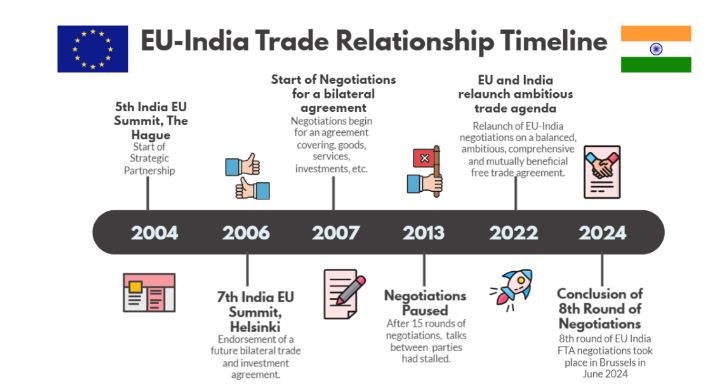
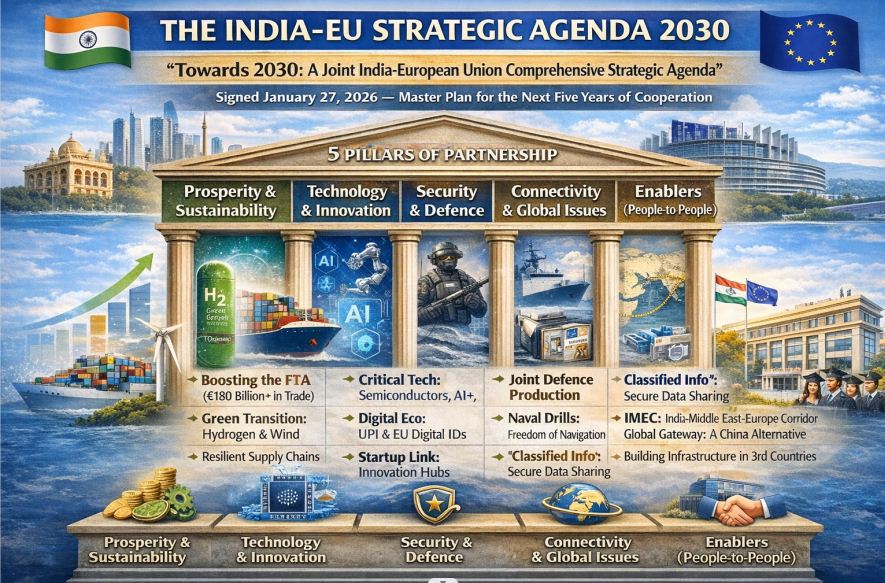
This roadmap, titled “Towards 2030: A Joint India-EU Comprehensive Strategic Agenda,” serves as the master architecture for bilateral relations, replacing the previous 2025 roadmap. It is built upon five core pillars:
- Prosperity & Sustainability: Centered on the historic Free Trade Agreement (FTA) to boost a €180-billion trade relationship.
- Technology & Innovation: Focused on AI, semiconductors, and Quantum Computing via the Trade and Technology Council (TTC).
- Security & Defence: Expanding from maritime drills to joint military production and intelligence sharing.
- Connectivity: Prioritizing the IMEC corridor and Global Gateway projects in Africa and Central Asia.
- Enablers (People-to-People): Facilitating skilled migration through the new European Legal Gateway Office in India.
Security and Defence Partnership (SDP):
The SDP marks the first overarching defence framework between India and the EU. It shifts the dynamic from a “buyer-seller” relationship to one of co-development and co-production.
- Defence Industry & Technology: Indian firms are now integrated into Europe’s “Rearm Initiative,” helping replenish stockpiles and modernize military capacity.
- Maritime Security: Increased cooperation in the Indo-Pacific, including the permanent placement of a Liaison Officer at the Indian Navy’s Information Fusion Centre (IFC-IOR) in Gurugram.
- The “Legal Enabler”: Launch of negotiations for a Security of Information Agreement, which will allow the exchange of classified intelligence and military data.
- Counter-Terrorism: Strengthened CBI-Europol cooperation to combat cross-border terrorism and radicalization.
The “Mother of All Trade Deals” (FTA):
The conclusion of the India-EU FTA is a seismic shift in global trade, creating a combined market of nearly 2 billion people.
- Tariff Elimination: The EU will drop tariffs on 99.5% of Indian exports, while India has granted significant concessions on 97.5% of traded value.
- Key Sectors: Significant duty cuts on European cars (down to as low as 10%), wines, and spirits, while Indian textiles, leather, and pharmaceuticals gain duty-free access to Europe.
- Supply Chain Resilience: Access for Indian companies to the EU’s €150-billion SAFE program for joint R&D and secure procurement.
The Blue-Raman Digital Backbone:
The Blue-Raman submarine cable system is the digital layer of the India-Middle East-Europe Economic Corridor (IMEC), designed to end the “Suez bottleneck.”
| Feature | Details |
| Route | Blue Segment: Italy to Israel; Raman Segment: Israel to India via Jordan/Saudi Arabia. |
| Capacity | 16 fiber pairs providing 218 Tbps (upgradable to 400 Tbps). |
| Strategic Goal | Bypasses the Red Sea chokepoint via a terrestrial land link across Israel. |
| Research Link | Connects 10,000 European and 3,700 Indian research institutions for real-time AI and climate study. |
Energy and Connectivity (IMEC):
The summit reaffirmed the commitment to the India-Middle East-Europe Economic Corridor (IMEC) as a secure alternative to China’s Belt and Road Initiative.
- Green Hydrogen Task Force: A new joint body to lead the transition to sustainable fuels.
- Digital Corridors: Integration of Indian and European Digital Public Infrastructure (DPI) to make systems like UPI and digital IDs interoperable across borders.

October 17, 2025
October 16, 2025
October 6, 2025
September 24, 2025

