January 24, 2026
The Greater Hesaraghatta Grassland Conservation Reserve (GHGCR)
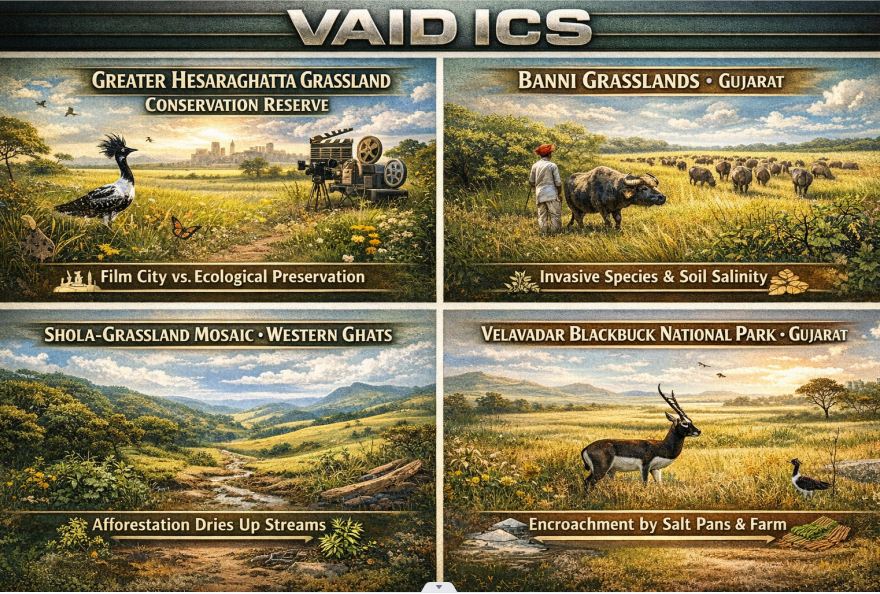
The Greater Hesaraghatta Grassland Conservation Reserve (GHGCR) has been a focal point of environmental tension in Karnataka for decades. The “news” surrounding it stems from a long-standing battle between industrial development (specifically a proposed “Film City”) and ecological preservation.
Key Issues Surrounding Hesaraghatta (GHGCR):
The struggle for Hesaraghatta highlights several systemic issues in how we treat “wastelands”:
- Development vs. Conservation: For years, the government viewed these 5,000+ acres as “prime real estate” for a film city, theme park, or veterinary infrastructure, rather than a living ecosystem.
- The “Wasteland” Myth: Historically, Indian land records often classify grasslands as “wastelands” because they don’t produce timber or high agricultural tax revenue. This makes them vulnerable to being diverted for industrial use.
- Unscientific Afforestation: As noted in your text, people often try to “fix” grasslands by planting trees. This is actually harmful; planting “scrawny old saplings” in a grassland destroys the habitat for sun-loving species and can deplete groundwater.
- Recreational Misuse: Without formal protection, the area became a hub for “beer parties,” littering, and disruptive pre-wedding shoots, which stress the local wildlife like the Black Naped Hare and migratory raptors.
- Water Security: The area is the catchment for the Arkavathy River and Hesaraghatta Lake. Protecting the grass is essential for the soil to absorb rainwater and recharge the aquifers that help supply Bengaluru.
Other Important Grasslands in India:
Grasslands are arguably India’s most misunderstood and threatened landscapes. Here are a few other critical examples:
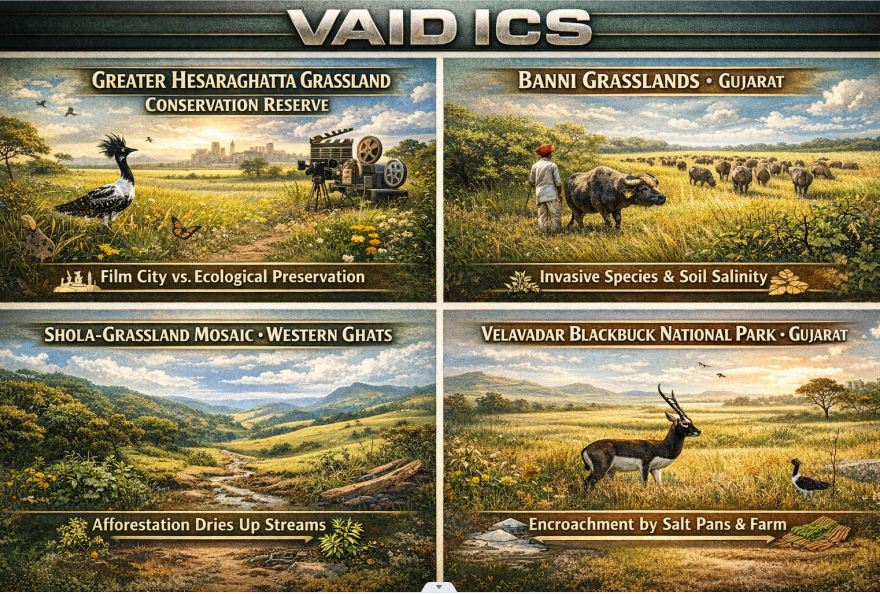
Banni Grasslands (Gujarat):
- Significance: One of the largest semi-arid grasslands in Asia. It is home to the nomadic Maldhari community and the unique Banni buffalo.
- Key Issue: Invasive species (Prosopis juliflora) and increasing soil salinity are choking out the native grasses.
Shola-Grassland Mosaic (Western Ghats):
- Significance: A unique high-altitude ecosystem where stunted evergreen forests (Sholas) exist alongside vast rolling grasslands.
- Key Issue: These were historically destroyed by “afforestation” drives during the British era, where invasive eucalyptus and wattle were planted, drying up the streams that feed South Indian rivers.
Velavadar Blackbuck National Park (Gujarat):
- Significance: A specialized savanna ecosystem designed to protect the Blackbuck and the Lesser Florican (the same rare bird mentioned in the Hesaraghatta notification).
- Key Issue: Encroachment by salt pans and agriculture.
Why Grasslands Matter (The “Carbon Sink”)?
Contrary to popular belief, grasslands are often more stable carbon sinks than forests in a warming world.
- Forest Carbon: Stored mostly in leaves and woody biomass (above ground). If a forest burns, that carbon is released instantly.
- Grassland Carbon: Stored mostly underground in deep, complex root systems. Even if a fire sweeps across the surface, the carbon remains sequestered in the soil.
- Status of the GHGCR (January 2025 Update)
The recent approval of the 5,678-acre Conservation Reserve is a massive win for activists. It legally recognizes that:
- Grasslands = Forests: They are equal in ecological value.
- Wildlife Refuge: It protects the habitat for the Lesser Florican (critically endangered) and the Slender Loris.
- Legal Barrier: The “status quo” is now permanent, effectively ending the threat of the Film City project.

October 17, 2025
October 16, 2025
October 6, 2025
September 24, 2025

