July 8, 2026
The G2 Strategy
The term “G2” refers to a proposed strategic and economic partnership between the United States and China. The concept envisions the world’s two largest economies working in tandem to address global economic challenges and ensure stability.
Origin and Historical Context:
-
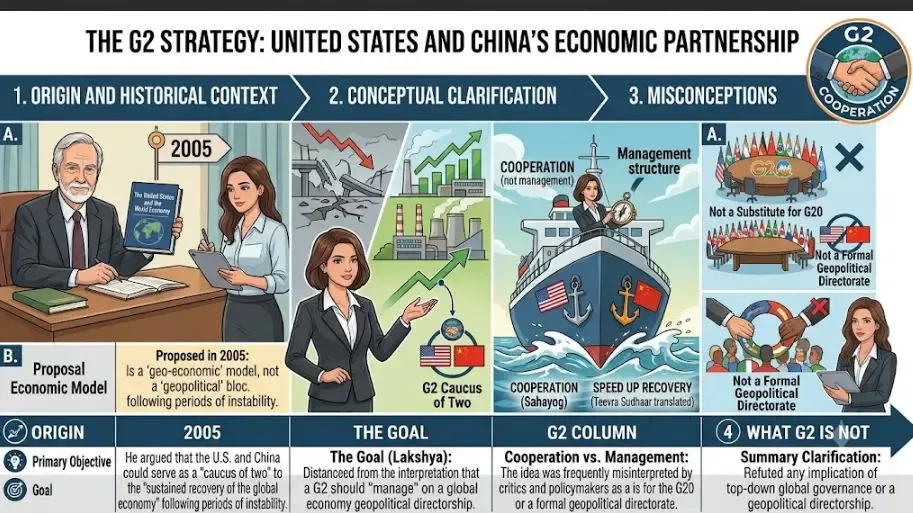
The Proposal: American economist C. Fred Bergsten first proposed the idea in his 2005 book, The United States and the World Economy.
-
Primary Objective: Bergsten introduced the G2 not as a “geopolitical” bloc, but as a “geo-economic” model.
-
The Goal: He argued that the U.S. and China could serve as a “caucus of two” to ensure the “sustained recovery of the global economy” following periods of instability.
Conceptual Clarification:
-
Cooperation vs. Management: Bergsten explicitly distanced himself from the interpretation that a G2 should “manage” the world economy. He emphasized that it was meant to be a vehicle for cooperation to speed up global recovery, rather than a top-down governing body.
-
Misconceptions: The idea was frequently misinterpreted by critics and policymakers as a potential substitute for the G20 or a formal geopolitical directorate, an implication that Bergsten continuously refuted.
Geo-economic vs. Geopolitical Dimensions:
-
Geo-economic Focus: Historically, the focus was on trade harmonization, financial stability, supply chain synchronization, and addressing global imbalances.
-
Geopolitical Shift: Recent rhetoric, including statements from U.S. leadership, has framed the “G2” in more overt power-political terms. It now signals a shift toward a bipolar global order, moving away from Bergsten’s original, narrow economic focus toward a broader struggle for influence.
Contemporary Relevance and Critiques:
-
Power Shift: The mention of a “G2” in contemporary discourse signals a significant transition in global power, reflecting the reality that U.S.-China dynamics now dictate the trajectory of international affairs.
-
Criticism: The G2 model faces strong opposition from other major powers and emerging economies. Critics argue that it undermines multilateralism and neglects the interests and voices of the rest of the world (including the EU, India, and the Global South).
Key Takeaways:
While Fred Bergsten’s original vision was a pragmatic, narrow economic partnership aimed at recovery, the “G2” has evolved into a symbol of modern bipolarity. It represents a fundamental tension between the need for cooperation among the top two powers and the global desire for a multipolar, inclusive world order.
जी-2 (G2) का परिचय:
जी-2 शब्द मुख्य रूप से संयुक्त राज्य अमेरिका और चीन के बीच एक विशेष आर्थिक और रणनीतिक साझेदारी को संदर्भित करता है। यह विचार दुनिया की दो सबसे बड़ी अर्थव्यवस्थाओं को एक साथ लाकर वैश्विक आर्थिक स्थिरता सुनिश्चित करने की परिकल्पना करता है।
उत्पत्ति और ऐतिहासिक संदर्भ:
-
प्रस्तावना: अमेरिकी अर्थशास्त्री फ्रेड बर्गस्टेन (Fred Bergsten) ने 2005 में अपनी पुस्तक ‘द यूनाइटेड स्टेट्स एंड द वर्ल्ड इकोनॉमी’ में पहली बार इस विचार को प्रस्तावित किया था।
-
मूल उद्देश्य: बर्गस्टेन का उद्देश्य इसे एक ‘भू-राजनीतिक’ (Geopolitical) अवधारणा के बजाय एक ‘भू-आर्थिक’ (Geo-economic) मॉडल के रूप में देखना था।
-
सहयोग की आवश्यकता: उनका तर्क था कि अमेरिका और चीन का एक ‘दो का समूह’ (Caucus of two) मिलकर वैश्विक अर्थव्यवस्था को एक स्थायी सुधार की ओर ले जा सकता है।
वैचारिक स्पष्टीकरण:
-
सहयोग बनाम प्रबंधन: बर्गस्टेन ने स्पष्ट किया कि जी-2 का उद्देश्य वैश्विक अर्थव्यवस्था का “प्रबंधन” करना नहीं है, बल्कि एक “सहयोगात्मक मंच” के रूप में कार्य करना है ताकि वैश्विक आर्थिक रिकवरी की गति को बढ़ाया जा सके।
-
भ्रम और गलतफहमी: इस विचार को अक्सर गलत समझा गया। कई आलोचकों और टिप्पणीकारों ने इसे जी-20 (G20) के विकल्प के रूप में देखना शुरू कर दिया, जबकि मूल अवधारणा का ऐसा कोई इरादा नहीं था।
भू-आर्थिक बनाम भू-राजनीतिक आयाम:
-
भू-आर्थिक (Geo-economic): यह मॉडल मुख्य रूप से व्यापारिक साझेदारी, वित्तीय स्थिरता, आपूर्ति श्रृंखला और वैश्विक आर्थिक विकास दर को नियंत्रित करने पर केंद्रित था।
-
भू-राजनीतिक (Geopolitical): हाल के वर्षों में, जैसे कि अमेरिकी राष्ट्रपति के बयानों में देखा गया है, जी-2 की अवधारणा अधिक राजनीतिक शक्ति के हस्तांतरण की ओर झुकी है, जो वैश्विक नेतृत्व में द्विध्रुवीयता (Bipolarity) को दर्शाती है।
वर्तमान प्रासंगिकता और चुनौतियां:
-
शक्तियों का हस्तांतरण: वर्तमान में, जी-2 शब्द का प्रयोग उस शक्ति संतुलन को दर्शाने के लिए किया जा रहा है जहाँ दुनिया की दो महाशक्तियाँ अपने एजेंडे को वैश्विक स्तर पर लागू कर रही हैं।
-
आलोचना: जी-2 मॉडल की आलोचना इस आधार पर की जाती है कि यह अन्य देशों (जैसे भारत, यूरोपीय संघ और उभरती अर्थव्यवस्थाओं) की भूमिका को गौण कर देता है और बहुपक्षवाद (Multilateralism) के महत्व को कम करता है।
मुख्य निष्कर्ष:
फ्रेड बर्गस्टेन की मूल दृष्टि एक “आर्थिक सुधार” के लिए गठबंधन की थी, लेकिन आज के परिदृश्य में यह एक शक्ति के समीकरण (Power shift) के रूप में विकसित हो गई है। यह दुनिया के वैश्विक आर्थिक और राजनीतिक भविष्य के लिए एक महत्वपूर्ण बहस का विषय बनी हुई है।

May 19, 2026
October 17, 2025
October 16, 2025
October 6, 2025

