April 21, 2026
The Evolving Role of Civil Services in Digital India
1. Historical Context & Significance:
-
Origin: Commemorates April 21, 1947, when Sardar Vallabhbhai Patel addressed the first batch of IAS officers at Metcalfe House, Delhi.
-
The “Steel Frame”: Patel famously dubbed civil servants the “steel frame of India,” essential for maintaining unity and integrity post-independence.
-
Official Recognition: Government of India began formally observing Civil Services Day on April 21, 2006.
2. Shift in Governance Paradigm: “Policy to Implementation”:
-
Shift to Saturation: Moving beyond mere policy launching to 100% implementation (Saturation).
-
Goal: No citizen left behind in healthcare, education, housing, or essential services.
-
Viksit Bharat @ 2047: Alignment with the vision of a fully developed India by the centenary of independence.
-
Last-Mile Delivery: Civil servants act as the bridge between political vision and actionable programs at the grassroots level.
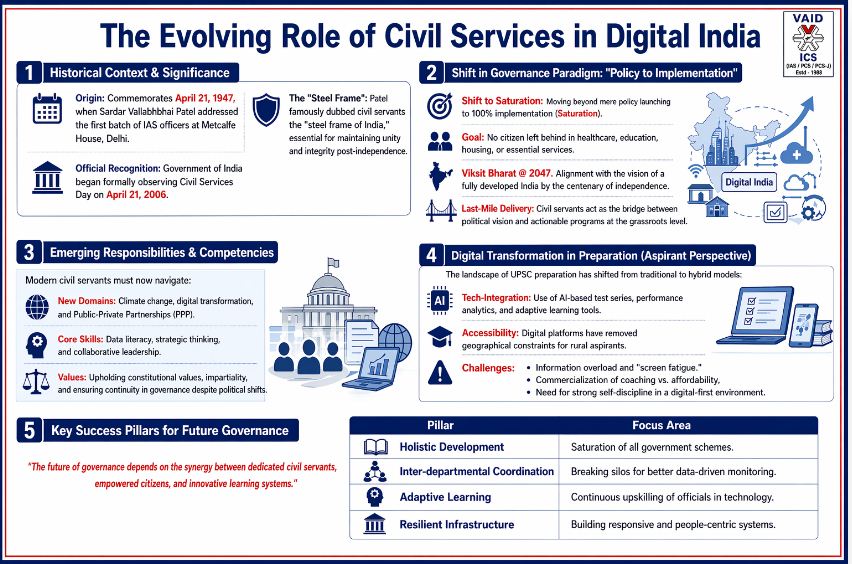
3. Emerging Responsibilities & Competencies:
Modern civil servants must now navigate:
-
New Domains: Climate change, digital transformation, and Public-Private Partnerships (PPP).
-
Core Skills: Data literacy, strategic thinking, and collaborative leadership.
-
Values: Upholding constitutional values, impartiality, and ensuring continuity in governance despite political shifts.
4. Digital Transformation in Preparation (Aspirant Perspective):
The landscape of UPSC preparation has shifted from traditional to hybrid models:
-
Tech-Integration: Use of AI-based test series, performance analytics, and adaptive learning tools.
-
Accessibility: Digital platforms have removed geographical constraints for rural aspirants.
-
Challenges: * Information overload and “screen fatigue.”
-
Commercialization of coaching vs. affordability.
-
Need for strong self-discipline in a digital-first environment.
-
5. Key Success Pillars for Future Governance:
“The future of governance depends on the synergy between dedicated civil servants, empowered citizens, and innovative learning systems.”
| Pillar | Focus Area |
| Holistic Development | Saturation of all government schemes. |
| Inter-departmental Coordination | Breaking silos for better data-driven monitoring. |
| Adaptive Learning | Continuous upskilling of officials in technology. |
| Resilient Infrastructure | Building responsive and people-centric systems. |

October 17, 2025
October 16, 2025
October 6, 2025
September 24, 2025

