March 25, 2026
The Constitution (Scheduled Castes) Order, 1950
The Constitution (Scheduled Castes) Order, 1950 is a Presidential Order issued under the authority of Article 341(1) of the Indian Constitution. It is the foundational legal document that defines who qualifies for “Scheduled Caste” status in India, thereby determining eligibility for reservation in legislatures, government jobs, and educational institutions.
1. Constitutional Basis (Article 341):
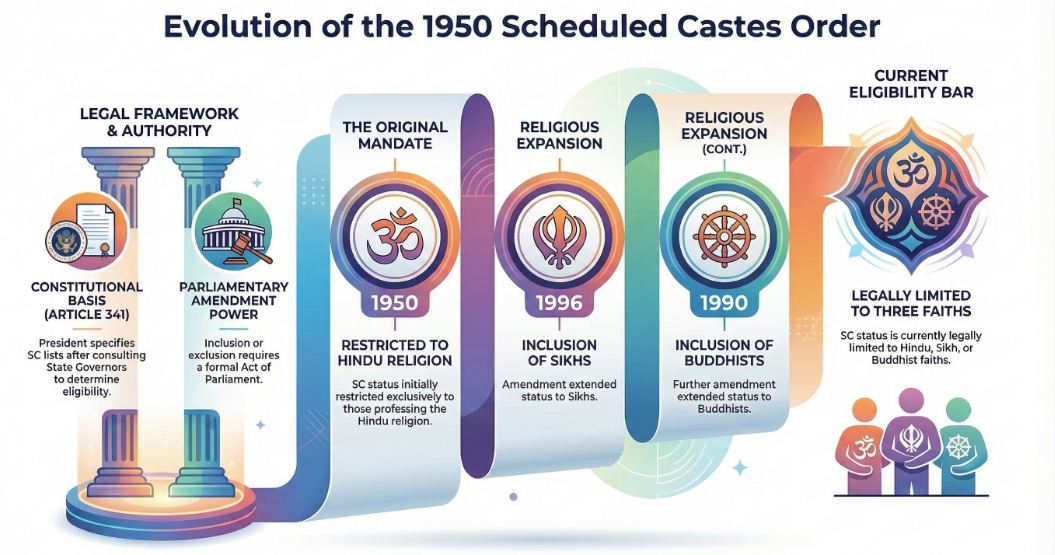
Under Article 341, the President of India, after consultation with the Governor of a State, specifies the castes, races, or tribes which are deemed to be Scheduled Castes.
-
Once the initial list is notified via the 1950 Order, any inclusion or exclusion from this list can only be done by an Act of Parliament (Article 341(2)).
2. The Religious Requirement (Clause 3):
The most defining and debated feature of the 1950 Order is Clause 3, which creates a religious “bar” for SC status.
-
The Original Mandate (1950): Initially, the order stated that “no person who professes a religion different from the Hindu religion shall be deemed to be a member of a Scheduled Caste.”
-
Expansion to Sikhs (1956): Following demands that the Sikh community faced similar social disabilities, the Order was amended to include those professing the Sikh religion.
-
Expansion to Buddhists (1990): The Order was again amended to include “Nav-Buddhists” (those who converted to Buddhism, often following Dr. B.R. Ambedkar), recognizing that their social and economic backwardness persisted after conversion.
Current Status: Currently, only individuals belonging to Hindu, Sikh, or Buddhist faiths can legally be recognized as Scheduled Castes.
3. Key Legal Principles:
The “Social Disability” Rationale:
The exclusion of Christianity and Islam from the SC Order is based on the legal argument that Scheduled Caste status is intended to remediate the specific social malady of untouchability, which is historically rooted in the structure of Hindu society. Since Christianity and Islam are theologically egalitarian (do not recognize caste), the state’s position has been that the “disability” of untouchability ceases to exist upon conversion to these faiths.
The Distinction from Scheduled Tribes (ST):
Unlike the SC Order, the Constitution (Scheduled Tribes) Order, 1950 is religion-neutral. A member of a Scheduled Tribe retains their status regardless of whether they convert to Christianity, Islam, or any other faith, as tribal identity is seen as an ethnic/cultural marker rather than one defined by social hierarchy within a specific religion.
4. Current Legal Challenges & Commissions:
The validity of Clause 3 is frequently challenged in the Supreme Court by Dalit Christians and Dalit Muslims who argue that social discrimination persists even after conversion.
-
Justice Ranganath Misra Commission (2007): Recommended that SC status should be completely de-linked from religion and made religion-neutral like ST status.
-
Justice K.G. Balakrishnan Commission (Ongoing): In 2022, the Central Government appointed a new commission to examine the matter of granting SC status to new persons who have historically belonged to the Scheduled Castes but have converted to religions other than Hinduism, Buddhism, or Sikhism.

October 17, 2025
October 16, 2025
October 6, 2025
September 24, 2025

