August 6, 2026
The 16th Finance Commission and India’s Fiscal Federalism/16वां वित्त आयोग और भारत का राजकोषीय संघवाद :
Context and Core Premise:
-
Institutional Role: The Finance Commission was designed under India’s constitutional framework not as a routine fund allocator, but as a core pillar of the fiscal federal compact and a corrective institution.
-
Objective: To mediate the asymmetry between a fiscally dominant Union and structurally constrained States, while addressing deep-rooted horizontal inequalities.
-
The Turning Point: The report of the 16th Finance Commission (FC-16), chaired by Arvind Panagariya (covering 2026–31), marks a decisive shift by re-engineering fiscal transfers—particularly grants-in-aid—to prioritize efficiency and performance, raising debates over equity and constitutional intent.
Constitutional Architecture and Original Intent:
-
Balancing Fiscal Asymmetry: The Union possesses major revenue-raising powers (tax dominance), while States bear primary responsibility for welfare, infrastructure, and public goods (expenditure burden).
-
Corrective Mechanism: The Commission was envisioned to correct vertical imbalances (Union vs. States) and horizontal imbalances (disparities among States caused by history, geography, and capacity).
-
Preserving the Compact: By safeguarding State interests, the Commission ensures the integrity of a strong federal Union.
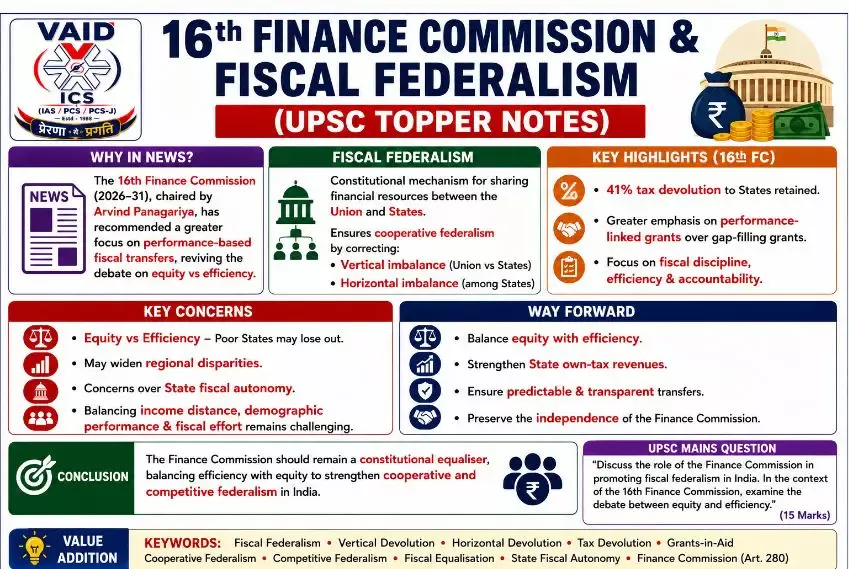
Key Highlights of the 16th Finance Commission (FC-16):
-
Vertical Devolution: Retains the share of central taxes transferred to the States at 41%, matching the recommendation of the 15th Finance Commission.
-
Re-engineering Grants-in-Aid: Moves away from conventional, blanket gap-filling grants toward performance-linked and efficiency-driven frameworks.
-
The Central Debate: While efficiency rewards growth and fiscal prudence, critics argue it may penalize less-developed States that structurally require greater equalizing support.
Major Concerns and Structural Dilemmas:
-
The Shift from Equity to Efficiency: Prioritizing performance can widen the gap between economically progressive States and lagging States.
-
Union Fiscal Primacy: Questions are raised whether modern fiscal shifts inadvertently protect the Union’s fiscal space at the cost of State autonomy.
-
Balancing Past and Present: Reconciling demographic performance, income distance, and fiscal effort remains a complex tightrope walk for successive Commissions.
Way Forward:
-
Harmonizing Equity and Efficiency: Performance-based incentives must be paired with foundational support for lower-capacity States to prevent developmental divergence.
-
Strengthening State-Level Fiscal Autonomy: Enhancing their own-source revenue mobilization (GST rationalization, property tax reforms) alongside predictable central transfers.
-
Preserving Federal Trust: Ensuring the Finance Commission remains an independent, objective arbiter of India’s fiscal federalism.
Conclusion:
The 16th Finance Commission report underscores the evolving dynamics of India’s cooperative federalism. While efficiency and performance are vital for a modernizing economy, the Commission’s historic and constitutional mandate of equalization and federal equity must remain paramount to sustain a balanced and resilient Union.
16वां वित्त आयोग और भारत का राजकोषीय संघवाद :
संदर्भ और मुख्य आधार:
-
संस्थागत भूमिका: भारत के संवैधानिक ढांचे के तहत वित्त आयोग को केवल धन का आवंटन करने वाली एक नियमित संस्था के रूप में नहीं, बल्कि राजकोषीय संघवाद (Fiscal Federal Compact) के एक केंद्रीय स्तंभ और एक सुधारात्मक संस्था के रूप में परिकल्पित किया गया था।
-
उद्देश्य: राजकोषीय रूप से शक्तिशाली केंद्र और संरचनात्मक रूप से विवश राज्यों के बीच निहित असंतुलन को पाटना, तथा इतिहास, भूगोल और संस्थागत क्षमता से उत्पन्न होने वाली गहरी क्षैतिज असमानताओं को दूर करना।
-
एक निर्णायक मोड़: अरविंद पनगढ़िया की अध्यक्षता में 16वें वित्त आयोग (FC-16) (अवधि 2026-31) की हाल ही में सौंपी गई रिपोर्ट ने राजकोषीय हस्तांतरण—विशेषकर सहायता अनुदान (Grants-in-aid)—की संरचना को नए सिरे से तैयार करके एक निर्णायक मोड़ ला दिया है, जिससे दक्षता और प्रदर्शन को प्राथमिकता दी गई है, लेकिन साथ ही समानता और संवैधानिक मंशा पर गंभीर चिंताएं भी खड़ी हो गई हैं।
1. संवैधानिक वास्तुकला और मूल उद्देश्य:
-
राजकोषीय असंतुलन को संतुलित करना: केंद्र के पास राजस्व जुटाने की बड़ी शक्तियाँ (कर प्रभुत्व) हैं, जबकि राज्य कल्याण, बुनियादी ढांचा और सार्वजनिक वस्तुओं (व्यय भार) की प्राथमिक जिम्मेदारी संभालते हैं।
-
सुधारात्मक तंत्र: आयोग की कल्पना ऊर्ध्वाधर असंतुलन (केंद्र बनाम राज्यों) और क्षैतिज असंतुलन (इतिहास, भूगोल और क्षमता के कारण राज्यों के बीच असमानताओं) को सुधारने के लिए की गई थी।
-
संघीय समझौते की रक्षा करना: राज्यों के हितों की रक्षा करके, आयोग एक मजबूत संघीय संघ की अखंडता को बनाए रखता है।
2. 16वें वित्त आयोग की मुख्य बातें:
-
ऊर्ध्वाधर हस्तांतरण (Vertical Devolution): केंद्रीय करों में राज्यों का हिस्सा 41% पर बरकरार रखा गया है, जो 15वें वित्त आयोग की सिफारिश के अनुरूप है।
-
सहायता अनुदान की पुनर्रचना: यह पारंपरिक और सामान्य अंतर-पाने वाले अनुदानों से हटकर प्रदर्शन-आधारित और दक्षता-संचालित ढांचों की ओर बढ़ता है।
-
केंद्रीय बहस: हालांकि दक्षता से विकास और राजकोषीय विवेक को प्रोत्साहन मिलता है, लेकिन आलोचकों का तर्क है कि इससे कम विकसित राज्यों को नुकसान हो सकता है जिन्हें संरचनात्मक रूप से अधिक समकारी समर्थन की आवश्यकता होती है।
3. प्रमुख चिंताएं और संरचनात्मक दुविधाएं:
-
समानता से दक्षता की ओर बदलाव: प्रदर्शन को प्राथमिकता देने से आर्थिक रूप से प्रगतिशील राज्यों और पिछड़ रहे राज्यों के बीच की खाई और चौड़ी हो सकती है।
-
केंद्र का राजकोषीय वर्चस्व: यह सवाल उठाया जा रहा है कि क्या आधुनिक राजकोषीय बदलाव अनजाने में राज्यों की स्वायत्तता की कीमत पर केंद्र के राजकोषीय दायरे की रक्षा कर रहे हैं।
-
अतीत और वर्तमान का संतुलन: जनसांख्यिकीय प्रदर्शन, आय की दूरी और राजकोषीय प्रयास में तालमेल बिठाना क्रमिक आयोगों के लिए एक जटिल चुनौती बना हुआ है।
4. आगे की राह:
-
समानता और दक्षता में तालमेल: विकासात्मक विचलन को रोकने के लिए प्रदर्शन-आधारित प्रोत्साहनों को कम क्षमता वाले राज्यों के लिए बुनियादी समर्थन के साथ जोड़ा जाना चाहिए।
-
राज्य-स्तरीय राजकोषीय स्वायत्तता को मजबूत करना: अनुमानित केंद्रीय हस्तांतरण के साथ-साथ राज्यों की अपनी आय जुटाने की क्षमता (जीएसटी सुसंगतता, संपत्ति कर सुधार) को बढ़ाना।
-
संघीय विश्वास को बनाए रखना: यह सुनिश्चित करना कि वित्त आयोग भारत के राजकोषीय संघवाद का एक स्वतंत्र, निष्पक्ष मध्यस्थ बना रहे।
निष्कर्ष:
16वें वित्त आयोग की रिपोर्ट भारत के सहयोगात्मक संघवाद की बदलती गतिशीलता को रेखांकित करती है। हालांकि आधुनिकीकरण अर्थव्यवस्था के लिए दक्षता और प्रदर्शन महत्वपूर्ण हैं, लेकिन संतुलित और लचीले संघ को बनाए रखने के लिए आयोग का समानता और संघीय न्याय का ऐतिहासिक और संवैधानिक जनादेश सर्वोपरि रहना चाहिए।

May 19, 2026
October 17, 2025
October 16, 2025
October 6, 2025

