February 12, 2026
Tamil-Brahmi inscriptions
In a groundbreaking announcement at an international Tamil epigraphy conference in Chennai (February 2026), Swiss and French scholars revealed the discovery of 2,000-year-old Tamil-Brahmi inscriptions deep inside the Valley of the Kings in Egypt.
This discovery is historic because it marks the first time physical evidence of ancient Tamil presence has been found in the interior of Egypt—the sacred burial grounds of the Pharaohs—rather than just at coastal trading ports.
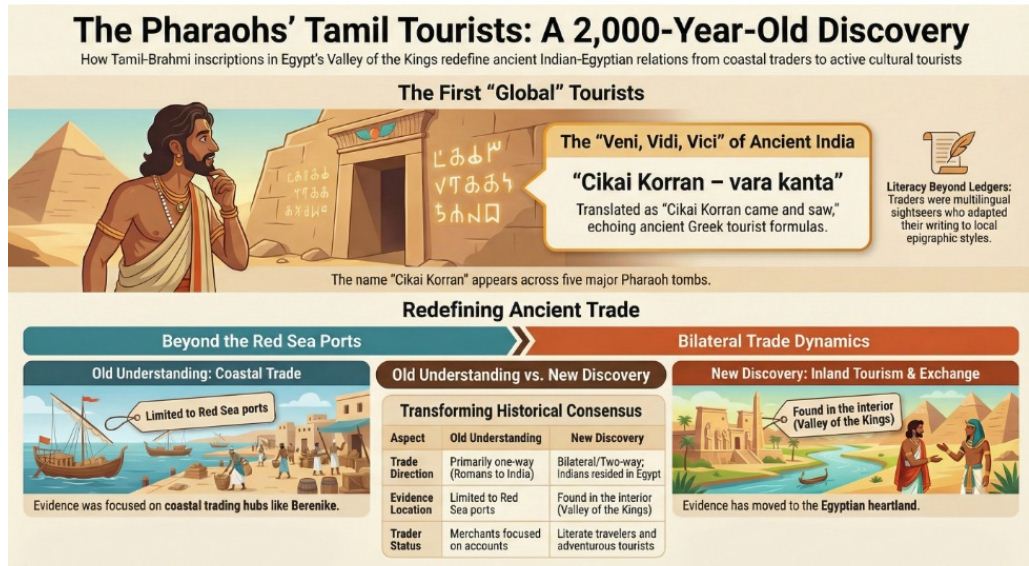
Key Points of the Discovery
1. The “Cikai Korran” Graffiti
The most prominent name found is “Cikai Korran”, scratched in eight different places across five of the six major tombs.
- Meaning: “Cikai” refers to a tuft of hair or a crown (derived from Sanskrit Sikha), and “Korran” means leader or victor—a name associated with the warrior goddess Korravai of the Chera kingdom.
- The “Veni, Vidi, Vici” Moment: One specific inscription reads “Cikai Korran – vara kanta”, which translates to “Cikai Korran came and saw.” Scholars believe he was imitating a common Greek formula found in the same tombs, suggesting he was a literate, multilingual traveler who “sight-saw” the tombs just as modern tourists do.
2. Evidence of “Two-Way” Trade
Historically, it was believed that Roman traders primarily came to India. However, these inscriptions (dating from the 1st to 3rd Century CE) prove that Indian merchants were not just sailors waiting at ports; they were wealthy, mobile, and adventurous enough to travel deep into the Nile Valley.
- Other Names Found: Kopan (“Kopan came and saw”) and Catan, both names frequently found in Sangam-era Tamil Nadu.
- North-West Links: Out of 30 inscriptions, 10 are in Sanskrit, Prakrit, and Gandhari-Kharoshi, including a mention of an envoy from the Kshaharata dynasty (Western India).
Significance to History:
| Aspect | Old Understanding | New Discovery |
| Trade Direction | Primarily one-way (Romans coming to India). | Bilateral/Two-way; Indian traders resided in and explored Egypt. |
| Location | Evidence limited to Red Sea ports like Berenike. | Evidence found in the interior heartland (Thebes/Valley of Kings). |
| Literacy | Traders used scripts for accounts only. | Traders were literate travelers who adapted to Greek epigraphic styles. |

May 19, 2026
October 17, 2025
October 16, 2025
October 6, 2025

