May 6, 2026
Supreme Court of India: Composition, Appointment, and Recent Reforms :
Composition and Strength:
- Historical Growth: The Supreme Court (SC) began in 1950 with eight judges. Parliament has periodically increased this number to manage rising caseloads.
- Current Sanctioned Strength: As of early 2026, the strength is 34 judges (1 Chief Justice of India (CJI) and 33 others).
- 2026 Expansion: Following a request from CJI Surya Kant to address over 92,000 pending cases, the Union Cabinet approved increasing the sanctioned strength to 37 judges (excluding the CJI). This requires an amendment to the Supreme Court (Number of Judges) Act, 1956.
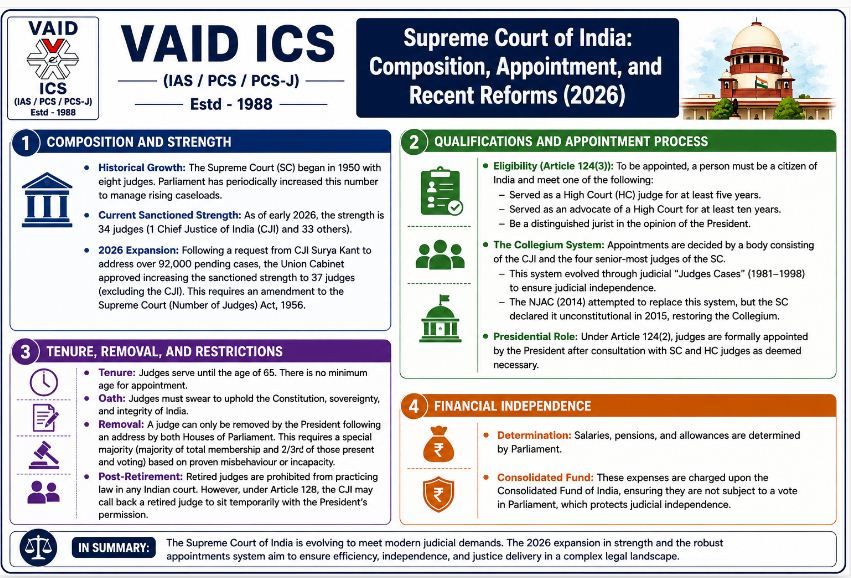
Qualifications and Appointment Process:
- Eligibility (Article 124(3)): To be appointed, a person must be a citizen of India and meet one of the following:
- Served as a High Court (HC) judge for at least five years.
- Served as an advocate of a High Court for at least ten years.
- Be a distinguished jurist in the opinion of the President.
- The Collegium System: Appointments are decided by a body consisting of the CJI and the four senior-most judges of the SC.
- This system evolved through judicial “Judges Cases” (1981–1998) to ensure judicial independence.
- The NJAC (2014) attempted to replace this system, but the SC declared it unconstitutional in 2015, restoring the Collegium.
- Presidential Role: Under Article 124(2), judges are formally appointed by the President after consultation with SC and HC judges as deemed necessary.
Tenure, Removal, and Restrictions:
- Tenure: Judges serve until the age of 65. There is no minimum age for appointment.
- Oath: Judges must swear to uphold the Constitution, sovereignty, and integrity of India.
- Removal: A judge can only be removed by the President following an address by both Houses of Parliament. This requires a special majority (majority of total membership and 2/3rd of those present and voting) based on proven misbehaviour or incapacity.
- Post-Retirement: Retired judges are prohibited from practicing law in any Indian court. However, under Article 128, the CJI may call back a retired judge to sit temporarily with the President’s permission.
Financial Independence:
- Determination: Salaries, pensions, and allowances are determined by Parliament.
- Consolidated Fund: These expenses are charged upon the Consolidated Fund of India, ensuring they are not subject to a vote in Parliament, which protects judicial independence.
The Supreme Court (Number of Judges) Act, 1956 is the legislative instrument used by the Indian Parliament to fulfill its constitutional duty under Article 124(1) to determine the strength of the nation’s highest court.
Core Provisions & Legal Basis:
-
Constitutional Mandate: Article 124(1) provides for a Chief Justice of India and leaves it to Parliament to increase the number of judges through legislation.
-
Purpose: The Act provides a formal mechanism to align judicial capacity with the growing docket and complexity of legal questions.
-
Amendment Mechanism: Every time the sanctioned strength needs to be raised, Parliament must pass an Amendment Bill to this specific Act.
Historical Evolution of Judicial Strength:
Since its inception, the sanctioned strength of the Supreme Court has grown significantly to combat mounting pendency:
| Year | Sanctioned Strength (Excluding CJI) | Total Strength |
| 1950 | 7 (Original Constitutional limit) | 8 |
| 1956 | 10 (First Act passed) | 11 |
| 1960 | 13 | 14 |
| 1977 | 17 | 18 |
| 1986 | 25 | 26 |
| 2008 | 30 | 31 |
| 2019 | 33 | 34 |
| 2026 (Proposed) | 37 | 38 |

October 17, 2025
October 16, 2025
October 6, 2025
September 24, 2025

