May 4, 2026
Space Warfare: The Silent Frontier of Modern Conflict
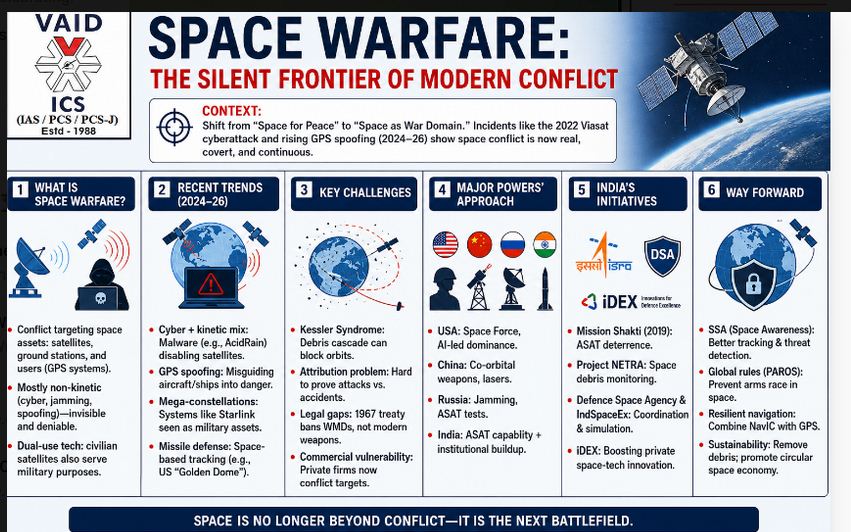
Context: Recent years have seen a paradigm shift from “Space for Peace” to “Space as a Warfighting Domain.” The 2022 Viasat cyber-attack during the Russia-Ukraine conflict and the 2024–2026 surge in GPS spoofing across the Baltic and Mediterranean Seas have proven that space warfare is no longer a sci-fi concept but a present-day reality.
What is Space Warfare?
Space warfare involves combat that takes place in outer space or targets space-based assets. Unlike traditional kinetic warfare (explosions), modern space conflict is often non-kinetic, invisible, and deniable.
- Targeting: It targets the “space segment” (satellites), the “ground segment” (control stations), and the “user segment” (GPS receivers in phones/planes).
- Dual-Use Nature: Most space technology is dual-use; a satellite meant for weather tracking can also be used for military reconnaissance.
Recent Developments (2024–2026):
- Cyber-Kinetic Hybridization: The use of malware like “AcidRain” to wipe satellite modems (Viasat Hack).
- Weaponization of Safety Logic: GPS spoofing (sending false signals) is being used to trick aircraft and ships into “thinking” they are off-course, potentially luring them into hostile territory or causing crashes.
- Proliferation of Mega-Constellations: The rise of Starlink and similar networks has forced rivals (like China) to develop “anti-Starlink” strategies, viewing these commercial constellations as military intelligence tools.
- Missile Defense Expansion: The Pentagon’s 2025 “Golden Dome” initiative aims for a four-layer space-based sensor system to intercept hypersonic missiles.
Key Challenges:
- The Kessler Syndrome: A single collision in space can create a “cascade” of debris, making certain orbits unusable for centuries.
- Attribution Dilemma: It is extremely difficult to prove if a satellite failed due to a solar flare, a technical glitch, or a stealthy “dazzling” (blinding by laser) from a rival nation.
- Legal Lacuna: The Outer Space Treaty (1967) prohibits Weapons of Mass Destruction (WMDs) in space but is silent on conventional missiles, lasers, or cyber-attacks.
- Commercial Risk: Private companies like SpaceX and Maxar are now front-line actors, making them targets in state-led conflicts.
Global Trends & State Actors:
| Country | Major Strategy/Development |
| USA | Focused on Space Superiority through the Space Force; AI-driven “2025 Data Strategic Plan.” |
| China | Developing “co-orbital” robots (satellites with arms to grab other satellites) and ground-based lasers. |
| Russia | Heavy reliance on electronic warfare (EW) and jamming; demonstrated kinetic ASAT capabilities in 2021. |
| India | Mission Shakti (2019): Demonstrated kinetic kill capability. Recently established the Defence Space Agency (DSA) and conducted IndSpaceEx (space warfare simulations). |
Steps Taken by India:
- Mission Shakti: Positioned India as the 4th nation with ASAT (Anti-Satellite) capability, ensuring “Strategic Deterrence.”
- Project NETRA: An early warning system in space to detect debris and hazards to Indian satellites.
- IDEX (Innovations for Defence Excellence): Encouraging startups to build “Space-Tech” solutions for the military (e.g., secure communications, small-sat launchers).
- Integrated Space Cell: A tri-service command to coordinate space assets between the Army, Navy, and Air Force.
Way Forward
- Space Situational Awareness (SSA): Developing better tracking systems to differentiate between natural accidents and deliberate attacks.
- International Law (PAROS): Pushing for the Prevention of an Arms Race in Outer Space (PAROS) treaty at the UN to create binding rules for behavior in orbit.
- Resilient PNT: Moving away from sole reliance on GPS/GNSS by using “Multi-constellation” receivers (like combining NavIC with GPS) to mitigate spoofing.
- Space Sustainability: Adopting “Circular Space Economy” principles—removing old debris to prevent the Kessler Syndrome.

October 17, 2025
October 16, 2025
October 6, 2025
September 24, 2025

