July 4, 2026
Skyroot Vikram-1: Mission Aagaman
Why in News?
Skyroot Aerospace is set to make history with Mission Aagaman, the maiden orbital launch of Vikram-1. This mission signifies a monumental shift in India’s space sector, as it marks the first time a private Indian company will launch an orbital-class rocket, effectively demonstrating the maturity and capability of the country’s private space ecosystem.
Skyroot Vikram-1: Mission Aagaman
- India’s private space sector is on the brink of a historic milestone. Mission Aagaman (The Arrival), the inaugural flight of the Vikram-1 rocket, is scheduled to launch from the Satish Dhawan Space Centre (SDSC), Sriharikota, between 12 July and 4 August 2026. This mission confirms that private Indian firms can now independently develop and launch satellites into orbit.
What is Vikram-1?
- Vikram-1 is India’s first privately developed orbital launch vehicle, designed by the Hyderabad-based startup Skyroot Aerospace. Named in honor of Dr. Vikram Sarabhai, the father of the Indian space program, this rocket is built to provide cost-effective, reliable, and on-demand launch services for the global small-satellite market. Unlike the sub-orbital Vikram-S (tested in 2022), Vikram-1 is a full-fledged orbital vehicle.
Mission Aagaman: Objectives
The primary goal of this maiden flight is to collect critical flight data that cannot be simulated on the ground. Key areas of focus include:
- Performance Metrics: Assessing stage separation and propulsion efficiency.
- Structural Integrity: Monitoring acoustic vibrations and thermal stress during supersonic flight.
- Flight Dynamics: Validating vehicle stability and the autonomous Guidance, Navigation, and Control (GNC) systems.
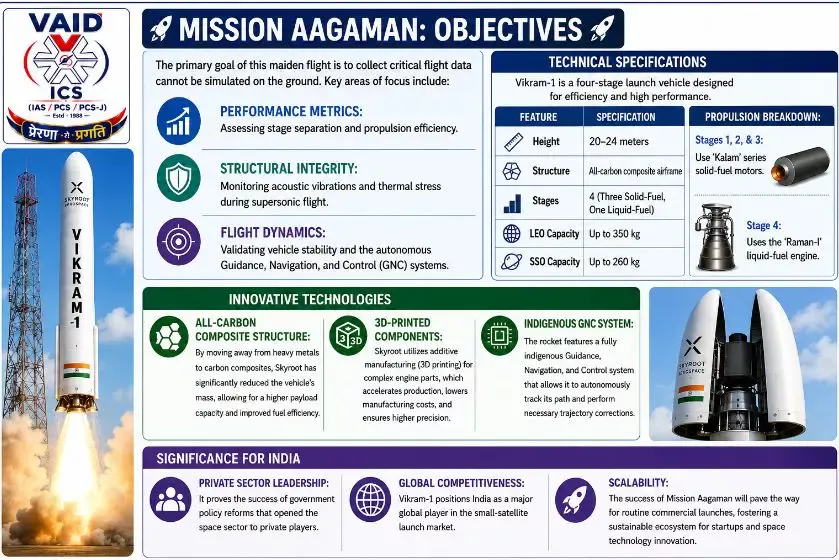
Technical Specifications:
Vikram-1 is a four-stage launch vehicle designed for efficiency and high performance.
Propulsion Breakdown:
- Stages 1, 2, & 3: Use ‘Kalam’ series solid-fuel motors.
- Stage 4: Uses the ‘Raman-I’ liquid-fuel engine.
Innovative Technologies:
- All-Carbon Composite Structure: By moving away from heavy metals to carbon composites, Skyroot has significantly reduced the vehicle’s mass, allowing for a higher payload capacity and improved fuel efficiency.
- 3D-Printed Components: Skyroot utilizes additive manufacturing (3D printing) for complex engine parts, which accelerates production, lowers manufacturing costs, and ensures higher precision.
- Indigenous GNC System: The rocket features a fully indigenous Guidance, Navigation, and Control system that allows it to autonomously track its path and perform necessary trajectory corrections.
Significance for India:
- Private Sector Leadership: It proves the success of government policy reforms that opened the space sector to private players.
- Global Competitiveness: Vikram-1 positions India as a major global player in the small-satellite launch market.
- Scalability: The success of Mission Aagaman will pave the way for routine commercial launches, fostering a sustainable ecosystem for startups and space technology innovation.
Vikram-S vs. Vikram-1
| Feature | Vikram-S (2022) | Vikram-1 (2026) |
| Mission Type | Sub-orbital | Orbital |
| Purpose | Technology Demonstrator | Commercial Launch |
| Satellite Deployment | No | Yes |
| Operational Status | Experimental | Full Commercial |
‘मिशन आगमन’ (Mission Aagaman : विक्रम-1 (Vikram-1
यह चर्चा में क्यों है?
स्काईरूट एयरोस्पेस (Skyroot Aerospace) अपने ‘मिशन आगमन’ (Mission Aagaman) के साथ इतिहास रचने के लिए तैयार है, जो विक्रम-1 (Vikram-1) रॉकेट की पहली कक्षीय (orbital) उड़ान होगी। यह मिशन भारत के अंतरिक्ष क्षेत्र में एक महत्वपूर्ण बदलाव का प्रतीक है, क्योंकि यह पहली बार है जब कोई निजी भारतीय कंपनी कक्षीय श्रेणी का रॉकेट लॉन्च करेगी, जो देश के निजी अंतरिक्ष इकोसिस्टम की परिपक्वता और क्षमता को सिद्ध करेगा।
स्काईरूट विक्रम-1: मिशन आगमन की पूरी जानकारी
भारत का निजी अंतरिक्ष क्षेत्र एक ऐतिहासिक पड़ाव पर है। ‘मिशन आगमन’, विक्रम-1 रॉकेट की पहली उड़ान है, जो 12 जुलाई से 4 अगस्त 2026 के बीच सतीश धवन अंतरिक्ष केंद्र (SDSC), श्रीहरिकोटा से लॉन्च की जाएगी। यह मिशन यह पुष्टि करता है कि भारतीय निजी कंपनियां अब स्वतंत्र रूप से उपग्रहों को अंतरिक्ष की कक्षा में स्थापित करने में सक्षम हैं।
विक्रम-1 क्या है?
- विक्रम-1 भारत का पहला निजी तौर पर विकसित कक्षीय प्रक्षेपण यान (orbital launch vehicle) है, जिसे हैदराबाद स्थित स्टार्टअप स्काईरूट एयरोस्पेस ने तैयार किया है। भारतीय अंतरिक्ष कार्यक्रम के जनक डॉ. विक्रम साराभाई के नाम पर रखा गया यह रॉकेट वैश्विक लघु-उपग्रह (small-satellite) बाजार के लिए किफायती, विश्वसनीय और मांग के अनुसार लॉन्च सेवाएं प्रदान करने के लिए बनाया गया है। 2022 में परीक्षण किए गए सब-ऑर्बिटल ‘विक्रम-S’ के विपरीत, विक्रम-1 एक पूर्ण कक्षीय यान है।
मिशन आगमन: उद्देश्य
इस पहली उड़ान का प्राथमिक लक्ष्य महत्वपूर्ण उड़ान डेटा एकत्र करना है, जिसे जमीन पर सिमुलेट नहीं किया जा सकता। इसके प्रमुख उद्देश्यों में शामिल हैं:
- प्रदर्शन मापदंड: स्टेज सेपरेशन और प्रोपल्शन (प्रणोदन) दक्षता का आकलन करना।
- संरचनात्मक अखंडता: सुपरसोनिक उड़ान के दौरान ध्वनि कंपन (acoustic vibrations) और थर्मल दबाव की निगरानी करना।
- उड़ान गतिशीलता: वाहन की स्थिरता और स्वदेशी मार्गदर्शन, नेविगेशन और नियंत्रण (GNC) प्रणालियों को मान्य करना।
तकनीकी विशेषताएँ
विक्रम-1 एक चार-चरणीय (four-stage) प्रक्षेपण यान है जिसे दक्षता और उच्च प्रदर्शन के लिए डिज़ाइन किया गया है।
| विशेषता | विवरण |
| ऊंचाई | लगभग 20–24 मीटर |
| संरचना | ऑल-कार्बन कम्पोजिट एयरफ्रेम |
| चरण | 4 (तीन ठोस ईंधन, एक तरल ईंधन) |
| LEO क्षमता | 350 किलोग्राम तक |
| SSO क्षमता | 260 किलोग्राम तक |
प्रोपल्शन (प्रणोदन) प्रणाली:
- चरण 1, 2, और 3: ‘कलाम’ (Kalam) श्रृंखला के ठोस ईंधन मोटर्स का उपयोग करते हैं।
- चरण 4: ‘रमन-I’ (Raman-I) तरल ईंधन इंजन का उपयोग करता है।
उपयोग की गई उन्नत तकनीकें
- ऑल-कार्बन कम्पोजिट स्ट्रक्चर: पारंपरिक धातुओं के बजाय कार्बन कम्पोजिट का उपयोग करने से रॉकेट का वजन काफी कम हो गया है, जिससे इसकी पेलोड क्षमता और ईंधन दक्षता बढ़ गई है।
- 3D-प्रिंटेड इंजन: स्काईरूट इंजन के पुर्जों के लिए 3D प्रिंटिंग का उपयोग करता है, जिससे उत्पादन तेज होता है, निर्माण लागत कम होती है और सटीकता बढ़ती है।
- स्वदेशी GNC सिस्टम: रॉकेट में पूरी तरह से स्वदेशी मार्गदर्शन, नेविगेशन और नियंत्रण प्रणाली है जो स्वायत्त रूप से उड़ान पथ को ट्रैक करती है और सुधार करती है।
भारत के लिए इसका महत्व
- निजी क्षेत्र का नेतृत्व: यह सरकारी नीतिगत सुधारों की सफलता को दर्शाता है जिन्होंने अंतरिक्ष क्षेत्र को निजी कंपनियों के लिए खोल दिया है।
- वैश्विक प्रतिस्पर्धा: विक्रम-1 भारत को वैश्विक लघु-उपग्रह लॉन्च बाजार में एक प्रमुख खिलाड़ी के रूप में स्थापित करता है।
- नवाचार को बढ़ावा: ‘मिशन आगमन’ की सफलता नियमित वाणिज्यिक लॉन्च का मार्ग प्रशस्त करेगी, जिससे स्टार्टअप्स और अंतरिक्ष प्रौद्योगिकी नवाचार के लिए एक स्थायी इकोसिस्टम बनेगा।
तुलना: विक्रम-S बनाम विक्रम-1
| विशेषता | विक्रम-S (2022) | विक्रम-1 (2026) |
| मिशन का प्रकार | सब-ऑर्बिटल | कक्षीय (ऑर्बिटल) |
| उद्देश्य | तकनीकी प्रदर्शन | व्यावसायिक लॉन्च |
| उपग्रह तैनाती | नहीं | हाँ |
| परिचालन स्थिति | प्रायोगिक | पूर्ण वाणिज्यिक |

May 19, 2026
October 17, 2025
October 16, 2025
October 6, 2025

