December 13, 2025
SHANTI Bill, 2025 (Atomic Energy Bill, 2025)
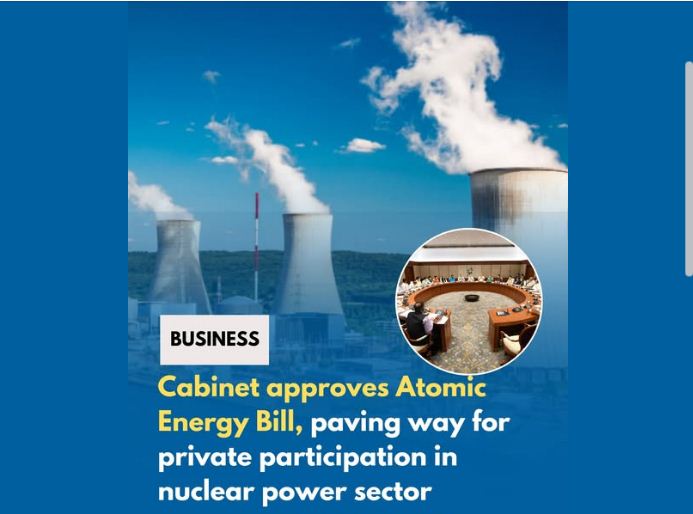
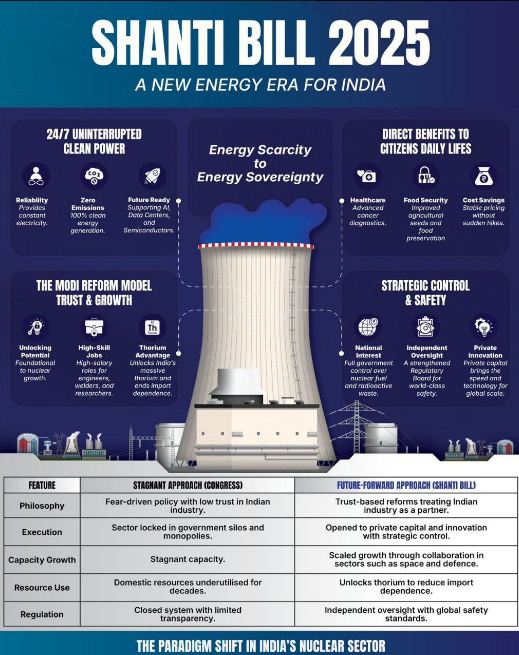
The Sustainable Harnessing and Advancement of Nuclear Energy for Transforming India (SHANTI) Bill, 2025, represents the most significant legislative reform in India’s nuclear sector since the 1960s. Its core objective is to open the tightly restricted civil nuclear power sector to private and foreign participation to achieve ambitious energy targets.
The bill is designed to replace or significantly amend the restrictive Atomic Energy Act, 1962 and the contentious Civil Liability for Nuclear Damage (CLND) Act, 2010.
Core Objectives :
- Open the state-controlled civil nuclear power sector to private companies and global investors.
- National Target Accelerate nuclear power capacity addition to 100 Gigawatts (GW) by 2047, up from the current level of around 8.8 GW.
- Need To secure base-load power to complement intermittent renewable energy and meet India’s 2070 Net-Zero emissions commitment.
Key Provisions and Reforms
The SHANTI Bill focuses on comprehensive legal, financial, and regulatory reforms:
1. Private Sector Entry and Investment
- Expansion of Participation: The bill allows private players to enter various parts of the nuclear value chain, including:
- Exploration and mining of atomic minerals.
- Fuel fabrication and equipment manufacturing.
- Setting up and potentially operating nuclear power plants (under government oversight).
- Foreign Investment: It proposes allowing up to 49% Foreign Direct Investment (FDI) in the sector to attract global technology providers and capital.
- Retained State Control: The Department of Atomic Energy (DAE) will retain strategic control over core, sensitive functions such as production of nuclear material, heavy water, and handling/segregation of nuclear waste.
2. Nuclear Liability Reform
- Addressing CLND Act Issues: The bill seeks to amend the CLND Act, 2010, whose stringent and ambiguous liability clauses have deterred foreign technology suppliers and private domestic investors.
- Capping Supplier Liability: It aims to cap and clearly define the financial liability of equipment suppliers, aligning India’s liability framework with international standards (like the IAEA-backed Convention on Supplementary Compensation).
- Operator Insurance: It redesigns the operator’s insurance cover, potentially setting it at a ceiling (e.g., 1,500 crore per incident) under the Indian Nuclear Insurance Pool, with the Government providing backstopping beyond a threshold.
3. Institutional Modernization
- Unified Legal Framework: The bill seeks to consolidate and modernise fragmented, decades-old laws into a single, comprehensive legal framework for the sector.
- Independent Regulator: Proposes the creation of an Independent Nuclear Safety Authority to ensure stringent safety oversight, in line with international best practices and the IAEA.
- Dispute Resolution: Proposes a dedicated, specialised Nuclear Tribunal to handle disputes related to nuclear energy, particularly liability and contractual issues, ensuring efficient resolution.
- SMR Focus: It supports the development and deployment of Small Modular Reactors (SMRs), which are crucial for industrial decarbonisation and providing flexible base-load power.
➡ Significance of the Bill
The SHANTI Bill is a crucial step for India’s energy future, aiming to:
- Boost Energy Security: Nuclear power provides stable, non-intermittent (base-load) electricity, complementing solar and wind power, thereby strengthening grid stability.
- Meet Climate Targets: Accelerating nuclear capacity is essential for India to achieve its Net-Zero goal by 2070.
- Mobilize Capital: The public sector cannot fund the projected $200+ billion required to hit the 2047 capacity target; private capital and efficiency are mandatory.
- Promote Technology: Attracting foreign investment and allowing private R&D will boost innovation in advanced reactor technologies like SMRs.
About the Atomic Energy Act, 1962 :
The AEA, 1962, is the parent law that established the government’s monopoly and absolute control over all aspects of atomic energy in India.
Features and Provisions:
- Establishment of Monopoly: The Act grants the Central Government (specifically the Department of Atomic Energy or DAE) the exclusive power to develop, control, and use atomic energy for the welfare of the people of India and for other peaceful purposes.
- Definition of Atomic Energy: The Act broadly defines ‘atomic energy’ and ‘prescribed substances’ (like uranium, thorium, and heavy water) and grants the government control over their exploration, mining, processing, and disposal.
- Licensing and Regulation: It mandates that no person or entity other than the Central Government (or its authorized agencies like the Nuclear Power Corporation of India Ltd. – NPCIL) can produce, possess, use, transfer, or dispose of prescribed substances or operate atomic reactors without a license.
Civil Liability for Nuclear Damage (CLND) Act, 2010:
The CLND Act, 2010, was enacted to create a liability regime for nuclear damage, mainly to implement the 2008 civil nuclear deal with the US and to permit India to join the Convention on Supplementary Compensation for Nuclear Damage (CSC).
Core Features and Controversy
A. Strict and No-Fault Liability
- Principle: The Act establishes strict and no-fault liability on the nuclear plant Operator (e.g., NPCIL) for any nuclear damage, regardless of negligence or intent.
Financial Cap: It fixes the maximum amount of liability for nuclear damage that the Operator must bear (currently around Rs 1,500 crore). The Central Government covers any amount exceeding this cap, up to the total liability as defined by the CSC.B. The Controversial Clause 17(b) – Supplier Recourse
This clause is the most controversial feature and the main reason for international and domestic resistance:
- Right of Recourse: The Act grants the Operator (NPCIL) the Right of Recourse (the right to claim damages) against the nuclear Supplier (the company that provided the reactor or equipment) in three scenarios:
- If the recourse right is expressly provided for in a written contract.
- If the damage is caused by the supplier’s willful act or gross negligence.
- If the damage is caused by the supplier providing equipment or services that include latent or patent defects, or substandard services. (This is Clause 17(b)).

October 17, 2025
October 16, 2025
October 6, 2025
September 24, 2025

