June 8, 2026
Section 301 (Trade Act of 1974)
Why in the news ?
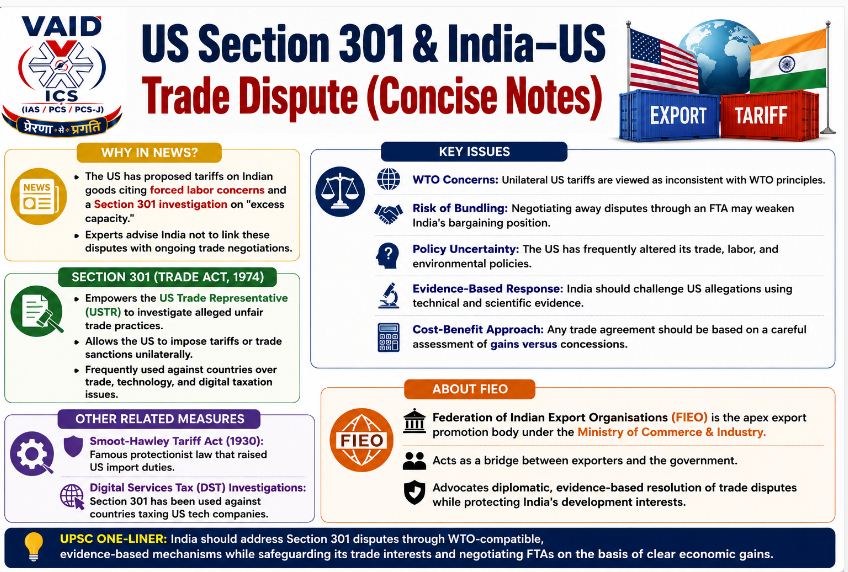
Trade tensions between India and the United States are escalating. The U.S. has proposed a 12.5% tariff on Indian goods based on allegations of “forced labor” and is conducting a Section 301 investigation regarding “excess capacity.” Experts are urging the Indian government not to bundle these legal disputes into ongoing trade negotiations, as doing so may undermine India’s bargaining power and validate Washington’s unilateral, non-WTO-compliant actions.
Key points:
-
Opposition to Unilateralism: Experts argue that U.S. unilateral tariff measures violate WTO rules. They suggest these should be challenged independently in the WTO rather than being negotiated away through concessions in a trade deal.
-
Risks of Bundling: Trade analysts warn that relying on a bilateral trade pact as a shield is risky. There is no guarantee that the U.S. will adhere to commitments, as Washington has a history of changing policies on labor and environmental issues.
-
Illogical Tariff Rates: Given that the U.S. Supreme Court invalidated 25% reciprocal tariffs and temporary 10% global tariffs are set to expire, experts see no reason for India to agree to an additional 18% tariff framework.
-
Strategic Defense: Instead of yielding to demands, India should use an empirical defense—challenging the authenticity of U.S. claims with technical and scientific evidence.
-
Cost-Benefit Analysis: Before signing any Free Trade Agreement (FTA), India must conduct a cold calculation of interests, comparing the losses from potential U.S. tariffs against the value of the concessions Washington is demanding.
Other similar laws:
-
Section 301 (Trade Act of 1974): A primary tool used by the U.S. Trade Representative (USTR) to investigate and impose sanctions on countries that the U.S. deems to be engaging in “unjustifiable” or “unreasonable” trade practices.
-
Smoot-Hawley Tariff Act: Historically the most famous example of protectionist trade legislation in the U.S., which significantly raised import duties to protect domestic industries, often leading to global trade retaliation.
-
Digital Services Tax (DST) Investigations: The U.S. frequently uses Section 301 to investigate and threaten retaliatory tariffs against countries that implement taxes on U.S.-based digital and tech giants.
About FIEO:
-
Overview: The Federation of Indian Export Organisations (FIEO) is the apex body of all export promotion organizations in India. It functions under the aegis of the Ministry of Commerce and Industry.
-
Objective: Its primary role is to serve as a bridge between the government and the exporter community, providing policy inputs, promoting Indian products in international markets, and representing the interests of exporters.
-
Role in Current Crisis: FIEO emphasizes that disputes arising from Section 301 should be resolved through diplomatic, evidence-based dialogue. Their priority is to ensure stability for businesses and prevent supply chain disruptions while safeguarding India’s developmental priorities.
न्यूज़ में क्यों है:
भारत और अमेरिका के बीच व्यापार संबंधों में तनाव बढ़ रहा है। अमेरिका द्वारा ‘जबरन श्रम’ (forced labour) के आरोपों के आधार पर भारतीय वस्तुओं पर 12.5% अतिरिक्त टैरिफ लगाने का प्रस्ताव है, साथ ही ‘धारा 301’ (Section 301) के तहत जांच भी चल रही है। विशेषज्ञ चिंता जता रहे हैं कि भारत को इन विवादों को व्यापक व्यापार समझौतों (FTA) के साथ नहीं जोड़ना चाहिए, क्योंकि यह भारत की सौदेबाजी की शक्ति को कमजोर कर सकता है।
मुख्य बिंदु:
-
एकतरफा कार्रवाई का विरोध: विशेषज्ञ मानते हैं कि अमेरिका के एकतरफा टैरिफ उपाय WTO (विश्व व्यापार संगठन) के नियमों का उल्लंघन हैं। इन्हें व्यापार समझौते के जरिए हल करने के बजाय WTO मंच पर चुनौती दी जानी चाहिए।
-
समझौते का जोखिम: व्यापार विशेषज्ञों का मानना है कि अमेरिका के साथ किसी भी व्यापार सौदे में शामिल होना भविष्य में टैरिफ की सुरक्षा की गारंटी नहीं देता, क्योंकि अमेरिका श्रम और पर्यावरण जैसे मुद्दों पर कभी भी नीति बदल सकता है।
-
तर्कहीन दरें: लेख के अनुसार, जब अमेरिका के 25% और 10% के वैश्विक टैरिफ रद्द या समाप्त हो रहे हैं, तो भारत का 18% अतिरिक्त टैरिफ स्वीकार करना तर्कहीन है।
-
रणनीतिक विकल्प: सुझाव दिया गया है कि भारत को अमेरिकी दावों को वैज्ञानिक और तकनीकी साक्ष्यों (empirical defense) के साथ चुनौती देनी चाहिए। साथ ही, व्यापार समझौते के लाभ और संभावित टैरिफ नुकसान का गहन विश्लेषण (Cost-Benefit Analysis) करना आवश्यक है।
अन्य समान कानून (अमेरिकी कानून):
-
धारा 301 (Section 301): यह अमेरिकी व्यापार अधिनियम 1974 का हिस्सा है, जो अमेरिका को उन देशों के खिलाफ जवाबी कार्रवाई करने की अनुमति देता है जो अनुचित व्यापार प्रथाओं में लिप्त हैं। यह अक्सर एकतरफा व्यापार प्रतिबंधों के लिए उपयोग किया जाता है।
-
स्मूट-हॉली टैरिफ एक्ट (Smoot-Hawley Tariff Act): ऐतिहासिक रूप से यह उच्च टैरिफ नीतियों का उदाहरण रहा है, जो वैश्विक व्यापार में संरक्षणवाद को दर्शाता है।
-
डिजिटल सेवा कर (DST) जांच: अमेरिका अक्सर अन्य देशों द्वारा अपनी टेक कंपनियों पर लगाए गए डिजिटल टैक्स के जवाब में धारा 301 का उपयोग करता है।
FIEO के बारे में (Federation of Indian Export Organisations):
-
परिचय: FIEO भारत के निर्यात संवर्धन संगठनों का शीर्ष निकाय है। यह वाणिज्य और उद्योग मंत्रालय के तत्वावधान में स्थापित किया गया था।
-
उद्देश्य: इसका मुख्य कार्य भारतीय निर्यातकों के लिए एक मंच प्रदान करना, व्यापार नीतियों पर सरकार को सलाह देना और अंतरराष्ट्रीय बाजारों में भारतीय उत्पादों को बढ़ावा देना है।
-
भूमिका: यह सरकार और निर्यातकों के बीच एक सेतु की तरह कार्य करता है। वर्तमान संकट में, FIEO का जोर इस बात पर है कि विवादों को ‘साक्ष्य-आधारित चर्चा’ (evidence-based discussion) और कूटनीति के माध्यम से हल किया जाए ताकि आपूर्ति श्रृंखला (supply chain) बाधित न हो।

May 19, 2026
October 17, 2025
October 16, 2025
October 6, 2025

