November 14, 2026
SCO CIVILISATIONAL DIALOGUE FORUM
Why in News? India is hosting the first-ever SCO Civilisational Dialogue Forum in New Delhi from 20–22 November 2026 to promote cultural cooperation and civilisational understanding among countries associated with the Shanghai Cooperation Organisation (SCO).
- 15 out of 25 invited countries have confirmed their participation, including China, Saudi Arabia, Türkiye and Iran.
- Pakistan has not yet confirmed its participation, despite receiving an invitation for its national heritage expert, Minister Aurangzeb Alamgir.
- The forum will be organised at Purana Qila, New Delhi, to showcase India’s rich civilisational heritage.
- Prime Minister Narendra Modi is scheduled to inaugurate the forum.
- Union Ministers Kishan Reddy and Gajendra Singh Shekhawat have highlighted India’s ancient civilisational heritage in the context of discussions surrounding the Indus Valley Civilisation.
About SCO Civilisational Dialogue Forum:
- Nature: An international platform for cultural and civilisational dialogue associated with the SCO.
- Organisers: Ministry of Culture and Ministry of External Affairs.
- Venue: Purana Qila, New Delhi.
- Objective: To promote cultural exchange, mutual understanding and cooperation among SCO member states, observer states and dialogue partners.
- Significance: To highlight India’s historical contributions, cultural heritage and civilisational links with other countries.
Importance of the Forum for India:
- Cultural Diplomacy: Strengthens India’s cultural relations with Eurasian and other participating countries.
- Civilisational Identity: Highlights India’s contribution to ancient knowledge, philosophy, art, architecture and traditions.
- Soft Power: Uses India’s rich cultural heritage as an instrument of international influence.
- Regional Cooperation: Encourages dialogue and mutual understanding among SCO countries.
- Historical Recognition: Provides an international platform to highlight India’s contribution to ancient civilisations.
- People-to-People Relations: Encourages academic, cultural and heritage-related exchanges.
Purana Qila (Old Fort):
- Location: New Delhi, India.
- Historical Significance: Traditionally associated with the ancient city of Indraprastha, mentioned in the Mahabharata.
- Construction: Its present fortifications were developed during the reigns of Mughal Emperor Humayun and Sher Shah Suri in the 16th century.
- Architecture: Reflects medieval Indian fort architecture with Mughal and Afghan influences.
- Archaeological Importance: Excavations have revealed evidence of human occupation at the site extending back to ancient periods.
- Significance: Represents India’s historical and cultural heritage.
Indus Valley Civilisation (IVC):
- Period: Mature Harappan phase approximately 2600–1900 BCE.
- Nature: One of the world’s earliest urban civilisations.
- Geographical Extent: Spread across present-day India, Pakistan and parts of Afghanistan.
- Major Sites: Harappa, Mohenjo-daro, Dholavira, Rakhigarhi, Lothal and Kalibangan.
Major Features:
- Urban Planning: Well-planned cities with grid-pattern streets and organised residential areas.
- Drainage System: Advanced covered drainage and sanitation facilities.
- Economy: Agriculture, craft production and long-distance trade.
- Trade: Commercial contacts with Mesopotamia.
- Script: Harappan script remains undeciphered.
- Architecture: Use of standardised baked bricks and sophisticated water-management structures.
- Craftsmanship: Production of seals, pottery, ornaments and metal objects.
Indus Waters Treaty (IWT), 1960:
- Signed: 19 September 1960.
- Parties: India and Pakistan.
- Broker: World Bank.
- Objective: Regulates the sharing of waters of the Indus River system between India and Pakistan.
Distribution of Rivers:
- Eastern Rivers: Ravi, Beas and Sutlej — allocated primarily for India’s unrestricted use.
- Western Rivers: Indus, Jhelum and Chenab — allocated primarily to Pakistan, subject to specified uses permitted to India under the treaty.
Recent Context:
- Following the Pahalgam terrorist attack in April 2025, India announced that the Indus Waters Treaty would be held in abeyance.
- The treaty became a major subject of diplomatic discussion between India and Pakistan.
India-Pakistan Relations: Diplomatic Context
- Pulwama Attack (2019): A terrorist attack on 14 February 2019 in Jammu and Kashmir killed 40 Indian CRPF personnel and significantly affected bilateral relations.
- Pahalgam Attack (2025): The terrorist attack further intensified tensions between the two countries.
- Cultural Diplomacy: India’s invitation to a Pakistani heritage expert represents an effort to maintain cultural engagement despite strained political relations.
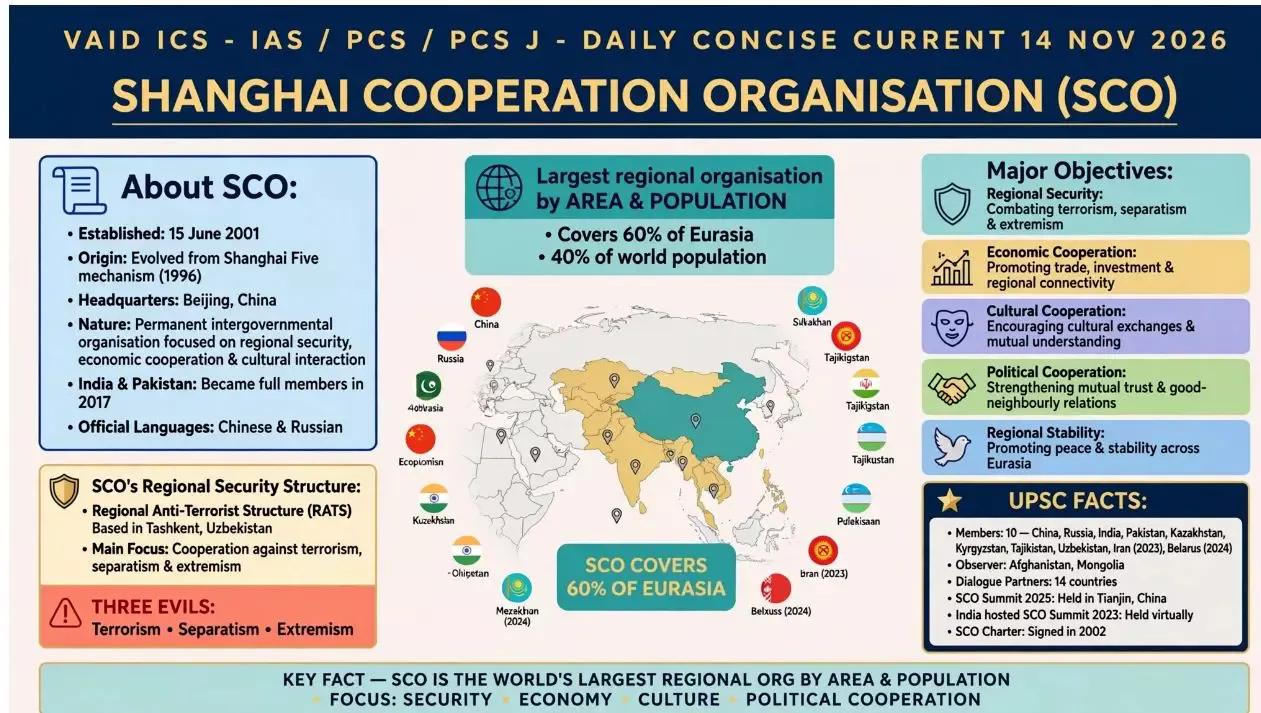
Shanghai Cooperation Organisation (SCO):
About SCO:
- Established: 15 June 2001.
- Origin: Evolved from the Shanghai Five mechanism established in 1996.
- Headquarters: Beijing, China.
- Nature: A permanent intergovernmental organisation focusing on regional security, economic cooperation and cultural interaction.
- India and Pakistan: Both became full members in 2017.
- Official Languages: Chinese and Russian.
Major Objectives:
- Regional Security: Combating terrorism, separatism and extremism.
- Economic Cooperation: Promoting trade, investment and regional connectivity.
- Cultural Cooperation: Encouraging cultural exchanges and mutual understanding.
- Political Cooperation: Strengthening mutual trust and good-neighbourly relations.
- Regional Stability: Promoting peace and stability across Eurasia.
Regional Anti-Terrorist Structure (RATS):
- Full Name: Regional Anti-Terrorist Structure.
- Headquarters: Tashkent, Uzbekistan.
- Objective: To facilitate cooperation among SCO members against terrorism, separatism and extremism.
Significance of SCO for India:
- Central Asian Connectivity: Provides India with a platform to strengthen relations with Central Asian countries.
- Energy Security: Facilitates engagement with resource-rich countries of Central Asia and Eurasia.
- Counterterrorism: Promotes regional cooperation against terrorism and extremism.
- Strategic Engagement: Provides a platform for dialogue with China, Russia and other regional powers.
- Economic Opportunities: Encourages trade, investment and connectivity.
- Cultural Relations: Strengthens historical and civilisational connections with Eurasian countries.
Challenges for India in SCO:
- India-China Tensions: Border disputes and strategic competition affect cooperation.
- India-Pakistan Relations: Cross-border terrorism and political tensions limit bilateral engagement.
- Connectivity Issues: Regional geopolitical tensions restrict India’s direct connectivity with Central Asia.
- Divergent Interests: Different strategic priorities among member countries make consensus difficult.
- China’s Influence: China’s economic and strategic influence creates challenges for India’s regional interests.
Conclusion:
The SCO Civilisational Dialogue Forum provides India with an opportunity to strengthen its cultural diplomacy and soft power. By highlighting its ancient civilisational heritage and encouraging dialogue among participating countries, India can promote regional understanding beyond conventional political and security cooperation.

May 19, 2026
October 17, 2025
October 16, 2025
October 6, 2025

