December 31, 2025
Saudi -UAE Conflict/ What is Southern Transitional Council (STC)?
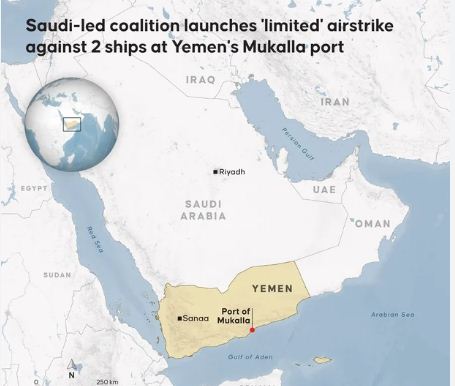
Why in the News? Saudi Airstrikes on Mukalla: Saudi warplanes targeted Yemen’s southern port city following the unauthorized arrival of vessels from a UAE port.
- Coalition Rupture: The incident exposed a public and sharp division between Saudi Arabia and the UAE, who previously led the coalition against the Iran-aligned Houthi movement.
- Open Confrontation: Riyadh has labeled UAE-backed movements as an “imminent threat” to its national security, moving the conflict from a proxy dispute to an open confrontation.
Key Points of the Conflict
The Mukalla Port Incident:
- Weapon Shipments: Saudi Arabia accused two ships from the UAE port of Fujairah of disabling tracking systems to unload weapons and armored vehicles for separatist forces.
- Military Action: The Saudi-led coalition conducted a “limited airstrike” at the port to neutralize what it deemed a threat to regional peace and stability.
- Damage Reported: While Saudi state media reported no casualties, local residents noted damage to nearby homes, and Yemeni media showed footage of burned vehicles.
The Role of the Southern Transitional Council (STC):
- Separatist Movement: The STC, formed in 2017, seeks the independence of South Yemen, which was a separate state until 1990.
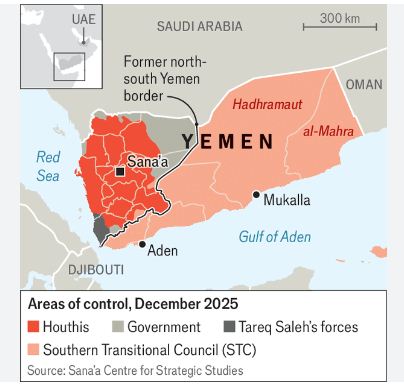
- UAE Support: Backed by the UAE, the STC commands the Southern Armed Forces and controls strategic territory, including the city of Aden.
- Political Defiance: Despite being part of Yemen’s Presidential Leadership Council, the STC has seized territory from Saudi-backed units and rejected orders from the central government.
The “Red Line” for Saudi Arabia:
- Border Security: Riyadh fears that instability in eastern provinces like Hadramout and al-Mahra will spill over into its own borders.
- Eastern Interests: These provinces are vital because they border Saudi Arabia, house key land routes to Oman, and contain significant oil reserves.
- Warning to Partners: Saudi Arabia has declared any threat to its national security a “red line” and warned that it will act to prevent any power shift along its southern frontier.
The UAE and Yemen Government Response:
- UAE Denial: The UAE rejected accusations of directing STC military operations and claimed the intercepted shipments were intended for its own counterterrorism teams.
- Military Withdrawal: Following the tensions, the UAE Ministry of Defence announced the termination and withdrawal of its remaining counterterrorism teams from Yemen.
- Government Escalation: Rashad al-Alimi, head of Yemen’s Presidential Leadership Council, canceled a defense pact with the UAE and ordered their forces to leave within 24 hours.
- Blockade: Al-Alimi imposed a temporary no-fly zone and a sea and ground blockade on ports to reassert state authority.
Regional Implications:
- Divided Anti-Houthi Front: The escalation creates a new front where former allies are fighting each other while the Houthi movement remains firmly entrenched in the north.
- Humanitarian Crisis: A new wave of internal conflict threatens to worsen what is already one of the world’s most severe humanitarian crises, with over 150,000 people killed in a decade of war.
History of Conflict:
The Two Yemens (1967–1990):
For much of the 20th century, Yemen was not one country.
- North Yemen: A conservative republic with close ties to Saudi Arabia.
- South Yemen: After British withdrawal in 1967, it became the People’s Democratic Republic of Yemen (PDRY)—the only Marxist-Leninist state in the Arab world.
- Legacy: Southerners maintained a distinct identity, a secular tradition, and a sophisticated civil service. This “Southern Identity” is what the STC seeks to restore today.
The Failed Union and Civil War (1990–1994):
In 1990, the two sides unified to form the Republic of Yemen. However, the marriage was short-lived:
- Marginalization: Southerners felt they were being “colonized” by the North. Their military officers were fired, and their land was seized by northern elites.
- 1994 Civil War: The South attempted to secede but was brutally crushed by Northern President Ali Abdullah Saleh. This defeat created a deep-seated “victim narrative” in the south that fueled the Al-Hirak (Southern Movement) from 2007 onwards.
The Current Civil War & the Coalition Rupture (2014–Present):
The current conflict began in 2014 when Houthi rebels (backed by Iran) seized the capital, Sanaa. In 2015, Saudi Arabia and the UAE formed a coalition to fight them.
The Rise of the STC (2017):
The UAE realized that the “official” Yemeni government was weak and influenced by the Muslim Brotherhood (which the UAE hates). Instead, they began training and funding local southern militias. In 2017, these factions formed the Southern Transitional Council (STC).
The 2025 “Seismic Shift”:
By late 2025, the silent rivalry between the coalition partners turned into an open war:
- The UAE Goal: Creating a “Maritime Empire.” By backing the STC, the UAE secures control over strategic ports (Aden, Mukalla) and the Bab el-Mandeb shipping lane.
- The Saudi Goal: Border Security. Saudi Arabia wants a unified Yemen. They fear that an independent South Yemen (backed by the UAE) would leave Saudi Arabia’s southern border unstable and under Emirati influence.
- The December 2025 Offensive: In a surprise move, STC forces swept through the eastern provinces of Hadramout and Al-Mahra. These areas are the “red line” for Saudi Arabia because they border the Kingdom and contain Yemen’s oil wealth

October 17, 2025
October 16, 2025
October 6, 2025
September 24, 2025
