March 12, 2026
Right to Die with Dignity/Active vs. Passive Euthanasia
Core Concept: Right to Die with Dignity
The Right to Die with Dignity is recognized as a fundamental right under Article 21 (Right to Life and Personal Liberty). The judiciary maintains that “Right to Life” includes the right to a dignified exit when life is reduced to mere biological existence without quality.
Active vs. Passive Euthanasia (The 2026 Clarification)
Justice J.B. Pardiwala’s 2026 judgment redefined the distinction, moving beyond the simple “act vs. omission” debate to focus on the Source of Harm.
Active Euthanasia (Illegal):
It is a positive, overt act designed to curtail the natural lifespan.
-
Mechanism: A direct act, such as administering a lethal injection.
-
Source of Harm: Death is caused by a new external intervention.
-
Causality: The doctor’s intervention is the cause of death, not the disease itself.
-
Legal Status: It remains a criminal offense in India (Homicide).
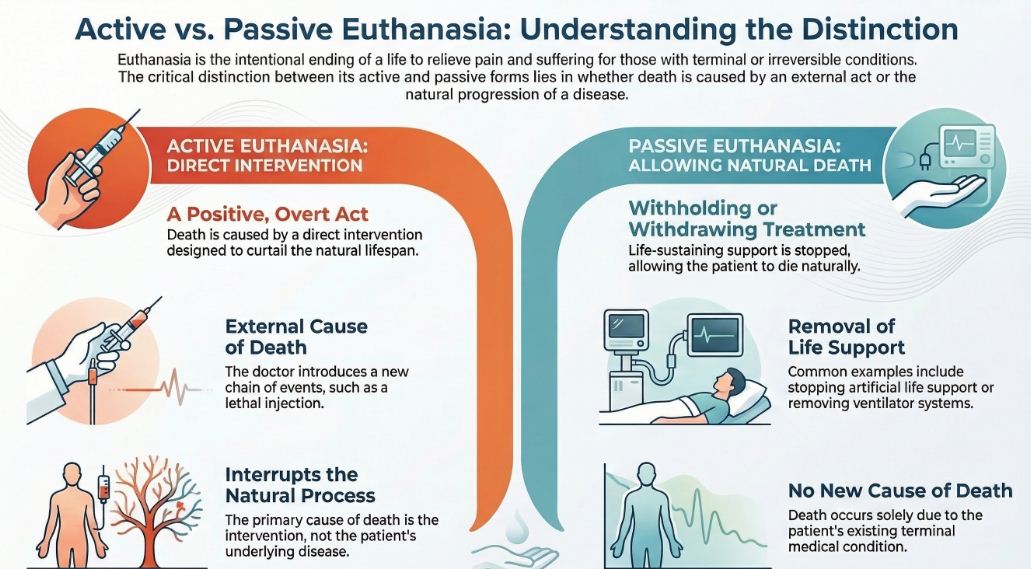
Passive Euthanasia (Legal):
It means allowing death to occur naturally by not interfering with the inevitable process.
-
Mechanism: Withdrawing (removing) or withholding (not starting) life-sustaining treatment (e.g., ventilators, feeding tubes).
-
Source of Harm: Death results from the patient’s underlying illness.
-
Causality: The doctor merely removes the artificial barrier; the disease takes its natural course.
-
Legal Status: Legal under strict guidelines established by the Supreme Court.
Key Judicial Evolution (Case Laws)
| Case | Year | Impact on “Right to Die” |
| P. Rathinam v. Union of India | 1994 | SC held Right to Life includes Right to Die (Later Overruled). |
| Gian Kaur v. State of Punjab | 1996 | Ruled Art. 21 does not include Right to Die, but recognized Right to Die with Dignity. |
| Aruna Shanbaug Case | 2011 | Permitted Passive Euthanasia for the first time under strict High Court monitoring. |
| Common Cause v. UoI | 2018 | Landmark ruling legalizing Living Wills (Advance Directives) for passive euthanasia. |
| Harish Rana Case | 2026 | First practical application; classified feeding tubes as medical treatment that can be withdrawn. |
Vital Legal Instruments:
-
Advance Directive (Living Will): A document where a person specifies in advance that they should not be kept on life support if they become terminally ill or enter a vegetative state.
-
Duty of Care: Even during the withdrawal of treatment, doctors must ensure Palliative Care (pain management) to maintain the patient’s dignity until the end.
-
Medical Boards: The process requires a Primary Medical Board (hospital) and a Secondary Medical Board (including an external expert) to certify that the condition is irreversible.
Present Legal Position:
-
Passive Euthanasia is a fundamental right under Article 21.
-
Living Wills are legally valid and enforceable.
-
Active Euthanasia is strictly prohibited.
-
The focus is on the “Best Interest” of the patient, ensuring they are not subjected to “futile” medical suffering.

October 17, 2025
October 16, 2025
October 6, 2025
September 24, 2025

