March 11, 2026
Removal process of Election Commission of India (ECI):
Constitutional Foundation (Article 324):
The ECI is a permanent, independent Constitutional Body established under Part XV of the Constitution to ensure free and fair elections.
- Article 324(1): Vests the “superintendence, direction, and control” of elections to Parliament, State Legislatures, and the offices of the President and Vice-President in the ECI.
- Composition (Article 324(2)): Consists of the Chief Election Commissioner (CEC) and such number of other Election Commissioners (ECs) as the President may fix.
- Current Structure: A multi-member body comprising 1 CEC and 2 ECs. Decisions are made by majority vote, and all three enjoy equal power, salary, and status.
Landmark Case Law: The Shift in Appointment:
Historically, appointments were made by the President on the advice of the Executive (Council of Ministers). This was challenged for lacking transparency.
Anoop Baranwal v. Union of India (2023)
- The Ruling: The Supreme Court (SC) noted a “constitutional vacuum” in the appointment process. It ruled that until Parliament enacts a law, the CEC and ECs should be appointed by the President on the advice of a three-member committee:
- The Prime Minister (PM)
- The Leader of Opposition (LoO) in Lok Sabha
- The Chief Justice of India (CJI)
- Rationale: To insulate the ECI from political and executive interference, ensuring the purity of the electoral process.
The 2023 Legislation: Current Appointment Process
In response to the SC judgment, Parliament enacted the CEC and Other ECs (Appointment, Conditions of Service and Term of Office) Act, 2023.
- The Selection Committee: Replaced the CJI with a Union Cabinet Minister nominated by the PM.
- Members: PM (Chair), LoO, and a Union Cabinet Minister.
- Search Committee: Headed by the Cabinet Secretary, it prepares a panel of five names for the Selection Committee’s consideration.
- Salary & Status: The salary and service conditions are now equivalent to that of the Cabinet Secretary (previously equivalent to a Supreme Court Judge).
Key Challenges & Concerns
- Executive Dominance: The 2023 Act gives the Executive a 2:1 majority in the Selection Committee, potentially compromising the “perceived independence” of the ECI.
- Security of Tenure (Parity Issue): While the CEC can only be removed like a SC Judge (Impeachment), the ECs can be removed by the President simply on the recommendation of the CEC. This “differential protection” creates a hierarchy that may affect independent functioning.
- Administrative Dependence: The ECI depends on the government for financial allocations (its budget is not “charged” on the Consolidated Fund of India) and for staff during elections.
Way Forward: Necessary Reforms
To bolster public trust and institutional autonomy, the following reforms are often suggested by the Law Commission and former CECs:
- Constitutional Parity: Amend Article 324(5) to provide the same removal protection to ECs as the CEC.
- Independent Secretariat: An independent cadre of officers specifically for the ECI to reduce dependence on central/state deputations.
- Charged Expenditure: Making the ECI’s administrative expenses a “Charged” expenditure on the Consolidated Fund of India to ensure financial autonomy.
- Selection Balance: Re-evaluating the selection committee to include judicial or independent oversight to ensure a “neutral” appointment.
Conclusion:
The Election Commission is the “bulwark of Indian democracy.” While the 2023 Act fulfills the constitutional requirement for a parliamentary law under Article 324(2), the debate over “substantive independence” versus “executive discretion” remains. For a vibrant democracy, the ECI must not only be independent but must also appear to be independent of the government of the day.
Election Commission: Removal Process:
According to the Constitution, there are significant differences between the removal process for the Chief Election Commissioner (CEC) and other Election Commissioners (ECs). It is important to understand this in detail for the UPSC Mains exam:
Election Commission: Removal Process:
Removal of the Chief Election Commissioner (CEC):
The Chief Election Commissioner is provided constitutional protection to enable him to function without political pressure.
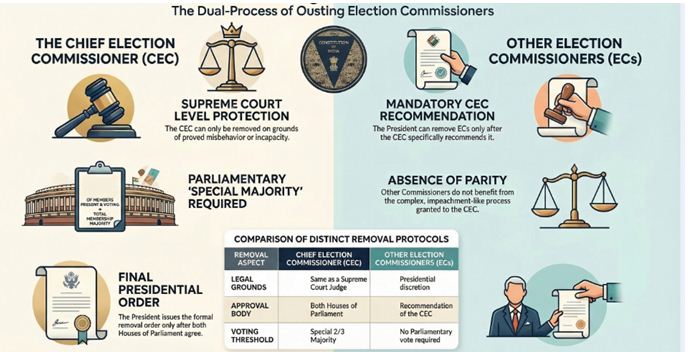
Article 324(5): According to this, the CEC can be removed from his office only in the same manner and on the same grounds as the removal of a Supreme Court judge.
Grounds for Removal:
- Proved Misbehavior
- Incapacity
- Parliamentary Process:
- Removal requires a resolution passed by both Houses of Parliament (Lok Sabha and Rajya Sabha) with a special majority.
- Special majority means: a majority of the total membership of the House + a majority of at least two-thirds (2/3) of the members present and voting.
- After this process, the President issues the order of removal.
Removal of Other Election Commissioners (ECs):
Other Election Commissioners and Regional Commissioners do not enjoy the same constitutional protections as the CEC.
Procedure: They can be removed by the President, but the recommendation of the Chief Election Commissioner (CEC) is mandatory.
- The Parity Issue: Article 324(5) of the Constitution states that ECs cannot be removed without the recommendation of the CEC, but this does not guarantee a complex “impeachment-like process” like the CEC.
Relevant Case Law:
T.N. Seshan v. Union of India (1995):
Supreme Court ruling: The Court clarified that although the CEC and ECs have similar powers and salaries, the CEC’s position is distinct when it comes to removal. The CEC’s recommendation for the removal of ECs acts as a “safeguard” to prevent arbitrary removal.
Anup Baranwal v. Union of India (2023):
In this case, it was also argued that to maintain the independence of the Election Commission, ECs should also have the same protection from removal as the CEC, so that they do not feel “subservient” to the CEC.

October 17, 2025
October 16, 2025
October 6, 2025
September 24, 2025

