March 21, 2026
RBI’s Liquidity Management Framework (LMF): What is Variable Rate Repo (VRR)?
Why in News? On March 20, 2026, the RBI injected ₹25,101 crore into the banking system via a 3-day Variable Rate Repo (VRR) auction.
- The Mismatch: While the RBI notified ₹75,000 crore, banks only took ~₹25k crore. Simultaneously, some banks parked excess funds in the SDF (Standing Deposit Facility).
- The Context: Liquidity tightened recently due to advance tax outflows (corporates moving cash to the government) and GST payments, ending the typical surplus seen in early March.
Variable Rate Repo (VRR):
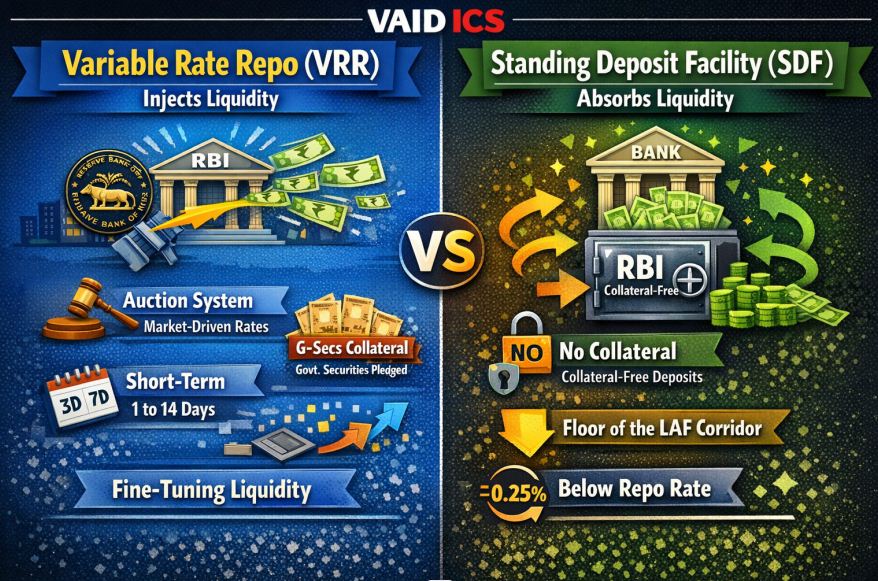
The VRR is a fine-tuning operation used by the RBI to inject liquidity into the system.
- Mechanism: It is an auction-based system where banks bid for funds. Unlike the “Fixed Repo Rate,” the interest rate here is determined by the market (though the RBI sets a cut-off).
- Purpose: To manage transient (short-term) liquidity shortages.
- Collateral: Like a regular Repo, banks must provide Government Securities (G-Secs) as collateral.
- Tenor: Usually ranges from overnight to 14 days (currently, 7-day and 3-day auctions are most frequent).
Standing Deposit Facility (SDF):
Introduced in April 2022 (based on the Urjit Patel Committee recommendation), the SDF is the primary tool for absorbing liquidity.
- The “Collateral-Free” Factor: Unlike the Reverse Repo, the RBI does not give G-Secs to banks in exchange for their deposits. This allows the RBI to absorb infinite liquidity without being limited by its own stock of securities.
- Position in the Corridor: It acts as the floor (lower bound) of the Liquidity Adjustment Facility (LAF) corridor.
- Rate: It is typically pegged at 25 bps (0.25%) below the Policy Repo Rate.
- Discretion: It is a “standing” facility, meaning banks can use it at their own discretion to park overnight surplus.
Comparative Analysis: VRR vs. SDF:
| Feature | Variable Rate Repo (VRR) | Standing Deposit Facility (SDF) |
| Objective | Inject liquidity (Lending to banks) | Absorb liquidity (Taking deposits) |
| Collateral | Required (Banks give G-Secs to RBI) | No Collateral (RBI gives nothing) |
| Interest Rate | Auction-determined (Variable) | Fixed (Repo Rate – 25 bps) |
| LAF Corridor | Acts as a tool within the corridor | Acts as the Floor of the corridor |
| Duration | 3, 7, or 14 days (Transient) | Usually Overnight |
Key Concepts for Exams:
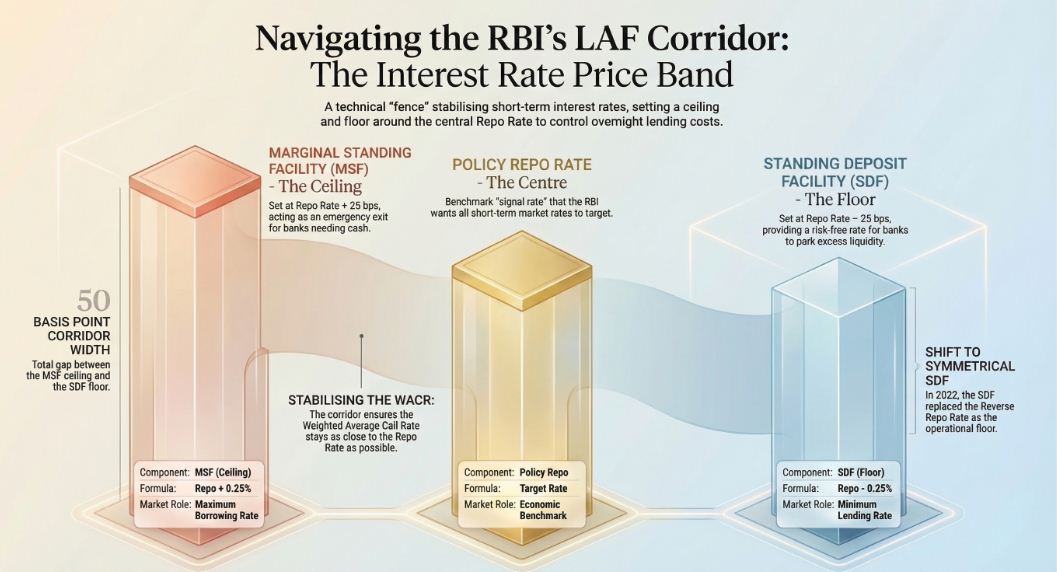
- The LAF Corridor: This is the range between the MSF (Marginal Standing Facility – the ceiling) and the SDF (the floor). The Repo Rate sits in the middle. The goal of the RBI is to keep the WACR (Weighted Average Call Rate) within this corridor.
- Liquidity Fragmentation: The current situation in March 2026—where some banks are borrowing (VRR) while others are depositing (SDF)—indicates that money is not flowing efficiently between banks in the inter-bank market.
- Durable vs. Transient: VRR/SDF are for transient (short-term) mismatches. For durable (long-term) liquidity, the RBI uses Open Market Operations (OMOs) or Forex Swaps.

Gist of daily Article /The Hindu 17oct 2025
October 17, 2025
Daily Gist of the Hindu/Indian Express : 16 Oct 2025
October 16, 2025
Daily Gist of The Hindu/Indian Express: 6 Oct 2025
October 6, 2025
Daily Gist of Article /The Hindu /Indian Express: 24 Sep 2025
September 24, 2025

