May 13, 2026
Public Examinations (Prevention of Unfair Means) Act, 2024:
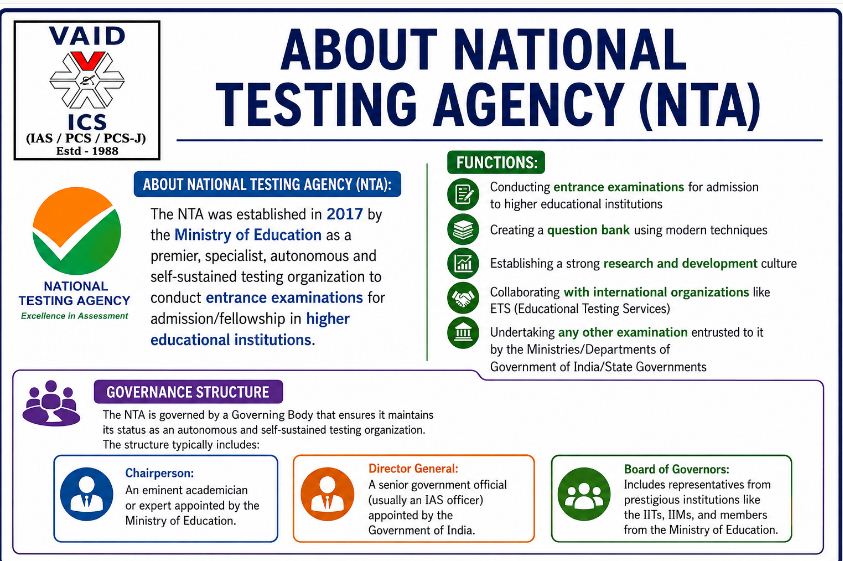
About National Testing Agency (NTA):
- The NTA was established in 2017 by the Ministry of Educationas a premier, specialist, autonomous and self-sustained testing organization to conduct entrance examinations for admission/fellowship in higher educational institutions.
Functions:
- Conducting entranceexaminations for admission to higher educational institutions
- Creating a question bankusing modern techniques
- Establishing a strong research and development culture
- Collaborating with international organizationslike ETS (Educational Testing Services)
- Undertaking any other examination entrusted to it by the Ministries/Departments of Government of India/State Governments
Governance Structure:
The NTA is governed by a Governing Body that ensures it maintains its status as an autonomous and self-sustained testing organization. The structure typically includes:
- Chairperson: An eminent academician or expert appointed by the Ministry of Education.
- Director General: A senior government official (usually an IAS officer) appointed by the Government of India.
- Board of Governors: Includes representatives from prestigious institutions like the IITs, IIMs, and members from the Ministry of Education.
About The Public Examinations (Prevention of Unfair Means) Act, 2024:
It is a central legislation aimed at curbing malpractices and ensuring transparency in high-stakes competitive exams conducted across India. Given your expertise in guiding civil services aspirants, this is a critical topic for both GS-2 (Governance) and GS-4 (Ethics).
Key Objectives of the Act:
- Preventing Malpractices: To check organized crime and syndicates involved in paper leaks, impersonation, and tampering with computer networks.
- Enhancing Credibility: To restore public trust in the examination systems of bodies like the UPSC, SSC, and NTA.
- Deterrence: To provide for stringent punishments to discourage individuals and coaching centers from engaging in unfair means.
Core Provisions & Punishments:
The Act defines “unfair means” broadly and sets heavy penalties:
- Definition of Offenses: Includes leaking question papers, unauthorized access to exam materials, and providing solutions through illegal means.
- Punishment for Individuals: Any person using unfair means can face imprisonment for 3 to 5 years and a fine of up to ₹10 lakh.
- Organized Crime: If the offense involves a syndicate or organized group, the punishment increases to 7 to 10 years of imprisonment and a fine of not less than ₹1 crore.
- Service Providers: Firms (like private exam centers) found guilty of negligence or involvement can be fined up to ₹1 crore and barred from conducting public examinations for four years.
Which Exams are Covered?
The Act applies to examinations conducted by “Public Examination Authorities,” including:
- Union Public Service Commission (UPSC)
- Staff Selection Commission (SSC)
- Railway Recruitment Boards (RRBs)
- National Testing Agency (NTA) (relevant to the leadership roles we discussed)
- Institute of Banking Personnel Selection (IBPS)
- Central Government Departments and their attached offices.
Key Institutional Measures:
- National Technical Committee on Public Examinations: The Act proposes a high-level committee to develop protocols for digital security and foolproof electronic surveillance of exam centers.
- Non-Bailable Offense: All offenses under this Act are cognizable, non-bailable, and non-compoundable, meaning the police can arrest without a warrant and the case cannot be settled out of court.

Gist of daily Article /The Hindu 17oct 2025
October 17, 2025
Daily Gist of the Hindu/Indian Express : 16 Oct 2025
October 16, 2025
Daily Gist of The Hindu/Indian Express: 6 Oct 2025
October 6, 2025
Daily Gist of Article /The Hindu /Indian Express: 24 Sep 2025
September 24, 2025

