January 8, 2026
Private Wildlife Reserves/Jabarkhet Nature Reserve (JNR)
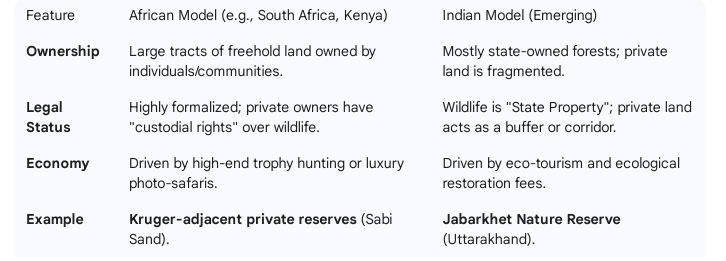
Private Wildlife Reserves: Africa vs. India
Private reserves play a critical role in global conservation, but their implementation varies significantly depending on the region’s legal and economic landscape.
1. The African Model: A Success Story:
In many African nations (such as South Africa, Namibia, and Kenya), private reserves are a cornerstone of the tourism economy and conservation efforts.
-
Land Ownership: Private individuals or communities often own the land outright.
-
Management: Owners have the legal right to manage wildlife, including “consumptive” uses (like regulated hunting) or “non-consumptive” uses (like luxury photographic safaris).
-
Economic Impact: High-end lodges fund anti-poaching units and habitat restoration.
-
Example: Sabi Sand Game Reserve (South Africa). It shares an unfenced border with Kruger National Park, allowing wildlife to roam freely while providing elite, private-sector-funded protection and tourism experiences.
2. The Indian Context: Potential vs. Reality:
In India, the situation is more complex due to strict land-use laws and the fact that almost all forest land is state-owned.
-
Legal Barriers: Most wildlife falls under the jurisdiction of the government (Forest Department). Private landholdings near forests are usually small and fragmented.
-
The “Potential”: There is a massive opportunity to create “buffer zones” or corridors on private lands to reduce human-wildlife conflict and expand habitats.
-
The “Reality”: Currently, many private “reserves” in India are actually just eco-resorts with little focus on genuine habitat restoration or scientific monitoring.
3. Case Study: Jabarkhet Nature Reserve (JNR):
Jabarkhet, located near Mussoorie, serves as a pioneering model for how private conservation can work in India.
How Wildlife Returned
-
Habitat Restoration: The project began by removing invasive species and stopping overgrazing and wood collection.
-
Water Management: Restoring old springs and creating water holes encouraged animals to stay within the area.
-
Passive Protection: By simply allowing the forest to regenerate and ensuring zero hunting or disturbance, species like leopards, black bears, and goral (mountain goats) returned naturally.
Balancing Tourism and Conservation:
-
Limited Access: Unlike public parks that often suffer from “over-tourism,” Jabarkhet limits the number of daily visitors.
-
Guided Experiences: Visitors must be accompanied by trained local guides, ensuring educational value and minimal impact on the environment.
-
Revenue Reinvestment: Entry fees go directly toward paying local staff and maintaining the trails/security, making the conservation effort self-sustaining.
4. A Model for India’s Future:
The success of Jabarkhet offers a blueprint for other private landowners in India:
-
Community Involvement: Hiring locals as “guardians” rather than just laborers.
-
Science-Based Monitoring: Using camera traps and biodiversity logs to track progress.
-
Buffer Zone Management: Focusing on land that borders existing National Parks to act as a protective “shield” for wildlife.
In 2025, the Jabarkhet Nature Reserve (JNR), near Mussoorie, turned ten years old. This is Uttarakhand’s first privately owned and operated nature reserve, meant to conserve wildlife and habitat as a primary goal.
The 1907 Guide to Mussoorie describes the hills around Dehradun as abounding with wildlife:
“These hills are clad with thick forest composed chiefly of Sal [Shorea robusta] and Sain [this could potentially refer to the crocodile bark tree or the Terminalia tomentosa]. The pine grows on the higher crests, and they were the home of many wild animals; tigers, leopards, sloth-bears, hyenas, deer, pig and porcupine used to abound in the jungles.”
In JNR, similar sightings are possible today: leopard, barking deer, goral, yellow-throated marten, leopard cat, jungle cat, black bear, porcupine, wild boar, red fox, jackal, black-naped hare, civet, and sambar. But this was not an easy journey.

October 17, 2025
October 16, 2025
October 6, 2025
September 24, 2025

