October 14, 2026
Daily UPSC Current : 14 Oct 2026/Polyfluoroalkyl Substances (PFAS): “Forever Chemicals”
Polyfluoroalkyl Substances (PFAS): “Forever Chemicals”
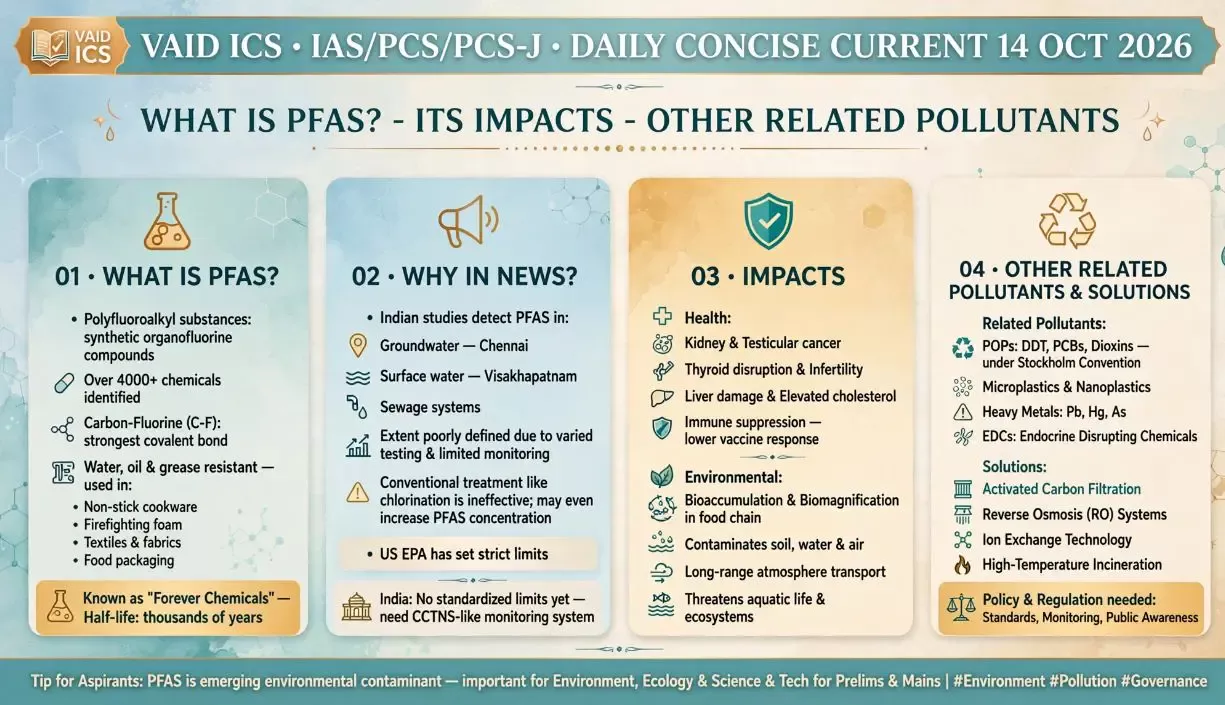
Why in news?: Recent environmental monitoring and scientific studies across India have detected elevated levels of toxic PFAS contamination in groundwater, surface water, seawater, and sewage. This has raised urgent concerns regarding drinking water safety, marine ecosystems, and long-term public health risks.
What are PFAS?
-
Definition: Per- and Polyfluoroalkyl Substances (PFAS) are a vast group of synthetic organofluorine compounds used extensively in industrial and commercial products since the mid-20th century.
-
Chemical Structure: Defined by extremely strong carbon–fluorine (C–F) bonds, making them highly resistant to heat, water, oil, chemical breakdown, and natural degradation.
-
“Forever Chemicals”: Termed so because their robust molecular structure prevents them from breaking down naturally, allowing them to persist in soil, water bodies, and living organisms for decades or centuries.
-
Major Applications: Non-stick cookware (Teflon), water-repellent clothing, stain-resistant carpeting, aqueous film-forming firefighting foams (AFFF), and grease-proof food packaging.
Why are PFAS a Concern in India?
-
Widespread Contamination: Environmental sampling has flagged widespread PFAS presence across coastal, urban, and industrial regions, including Tamil Nadu, Gujarat, Maharashtra, and West Bengal.
-
Groundwater Intrusion: A landmark IIT Madras study highlighted severe PFAS leaching into groundwater around unlined municipal solid waste dumpsites and industrial dump yards in Chennai.
-
Marine & Sewage Pollution: Joint research involving GITAM University identified up to 38 distinct PFAS compounds in untreated sewage effluent and coastal seawater around Visakhapatnam.
-
Treatment Limitations: Conventional municipal water treatment and biological sewage plants cannot remove these resilient compounds. In fact, some treatment processes unintentionally transform precursor chemicals into active, persistent PFAS.
Health and Environmental Impacts
-
Carcinogenic Risk: The International Agency for Research on Cancer (IARC) has formally classified:
-
PFOA (Perfluorooctanoic acid): Carcinogenic to humans (Group 1).
-
PFOS (Perfluorooctanesulfonic acid): Possibly carcinogenic to humans (Group 2B).
-
-
Human Health Hazards: Chronic exposure is linked to endocrine and thyroid disruption, immune system suppression, liver damage, elevated cholesterol, and developmental delays in children.
-
Ecotoxicity & Bioaccumulation: PFAS enter aquatic food chains, accumulating in fish and marine organisms, which severely impacts wildlife health and bioaccumulates up to human consumers.
Challenges in Measuring and Controlling PFAS
-
Non-Standardized Testing Protocols: Different research teams use varying testing lists and target limits, leading to an inconsistent national dataset.
-
Targeted vs. Non-Targeted Analysis: Standard lab tests check for a fixed list of well-known compounds (e.g., PFOA/PFOS) while missing thousands of unlisted variant molecules and precursor chemicals.
-
High Remediation Costs: Advanced removal methods like granular activated carbon (GAC), ion-exchange resins, and reverse osmosis (RO) require heavy infrastructure investment and complex waste disposal.
-
Lack of Baseline Data: India currently lacks a centralized, harmonized baseline inventory mapping nationwide PFAS concentration thresholds.
Regulatory Steps and Countermeasures in India
-
Bureau of Indian Standards (BIS): Reviewing the national drinking water specification (IS 10500:2012) through a specialized technical committee to introduce maximum permissible limits for emerging PFAS contaminants.
-
FSSAI Mandates: Drafting regulatory revisions under the Food Safety and Standards (Packaging) Regulations to ban or restrict PFAS coatings in paper, cardboard, and food-contact packaging materials.
-
CSIR-IITR Initiative: CSIR-Indian Institute of Toxicology Research (Lucknow) is spearheading research under a UNEP-funded project to establish baseline data and build multi-class chemical detection capacity.
-
Stockholm Convention & Article 25(4): India is a signatory to the Stockholm Convention on Persistent Organic Pollutants (POPs). Under Article 25(4), amendments adding newly listed POPs (such as PFOS/PFOA) require explicit national ratification before becoming legally binding in India.
Way Forward
-
Harmonized National Monitoring: Establish standardized, high-resolution testing protocols across national water laboratories and maintain a public database.
-
Precautionary Standards: Enforce clear interim drinking water standards and regulate industrial effluents containing fluorinated compounds.
-
Advanced Remediation Infrastructure: Upgrade municipal and industrial wastewater plants with multi-stage filtration technologies (GAC, membrane separation, and thermal destruction).
-
Phase-out and Safer Alternatives: Encourage chemical manufacturing industries to transition toward biodegradable, fluorine-free alternatives for non-stick coatings and firefighting foams.
-
Public Transparency & Extended Producer Responsibility (EPR): Mandate industrial disclosures for fluorine usage and establish EPR guidelines for industries handling fluorinated waste.
Conclusion
Addressing PFAS contamination requires moving away from reactive monitoring toward preventive regulation, comprehensive baseline data, and scalable remediation technologies. A proactive precautionary approach is imperative to safeguard India’s long-term drinking water security and public health
Polyfluoroalkyl Substances (PFAS): “Forever Chemicals”
Why in news?: हाल ही में जारी विभिन्न शोधों और वैज्ञानिक अध्ययनों के अनुसार भारत में भूजल (Groundwater), सतह के जल (Surface Water), समुद्री जल और सीवेज में PFAS की विषाक्त मौजूदगी दर्ज की गई है। इससे पेयजल की सुरक्षा, पर्यावरणीय प्रदूषण तथा दीर्घकालिक जनस्वास्थ्य के खतरों को लेकर गंभीर चिंताएँ पैदा हो गई हैं।
PFAS क्या हैं?
-
परिभाषा: Per- and Polyfluoroalkyl Substances (PFAS) कृत्रिम रसायनों (Synthetic Chemicals) का एक विशाल समूह है, जिसका उपयोग 20वीं सदी के मध्य से औद्योगिक और उपभोक्ता उत्पादों में व्यापक रूप से किया जा रहा है।
-
रासायनिक संरचना: इनमें कार्बन–फ्लोरीन (C–F) के अत्यंत मजबूत रासायनिक बंध होते हैं, जो इन्हें अत्यधिक तापीय और रासायनिक स्थायित्व प्रदान करते हैं।
-
“फॉरएवर केमिकल्स” (Forever Chemicals): अपनी मजबूत आणविक संरचना के कारण ये प्राकृतिक रूप से नष्ट नहीं होते और पर्यावरण, जल निकायों तथा जीवों के शरीर में दशकों तक बने रहते हैं।
-
प्रमुख उपयोग: नॉन-स्टिक कुकवेयर (Teflon), जल-रोधी और दाग-रोधी कपड़े, अग्निशमन फोम (AFFF), तथा ग्रीस-रोधी खाद्य पैकेजिंग सामग्री।
भारत में PFAS चिंता का विषय क्यों हैं?
-
व्यापक संदूषण: अध्ययन बताते हैं कि चेन्नई और विशाखापत्तनम जैसे प्रमुख तटीय और औद्योगिक शहरों के जल स्रोतों में PFAS के उच्च स्तर पाए गए हैं।
-
भौगोलिक प्रसार: गुजरात, महाराष्ट्र, तमिलनाडु और पश्चिम बंगाल जैसे राज्यों के जल निकायों में इसके गंभीर स्तर दर्ज किए गए हैं।
-
भूजल प्रदूषण: IIT मद्रास (2024) के शोध के अनुसार चेन्नई में कचरे के ढेरों (Dumpsites) के आसपास के भूजल में PFAS का उच्च रिसाव पाया गया है।
-
समुद्री और सीवेज प्रदूषण: GITAM विश्वविद्यालय तथा अंतरराष्ट्रीय सहयोगियों के अध्ययन में विशाखापत्तनम के समुद्री जल और सीवेज में 38 प्रकार के PFAS यौगिकों की पुष्टि हुई है।
-
जल उपचार की सीमाएँ: पारंपरिक जल शोधन प्रणालियाँ PFAS को हटाने में असमर्थ हैं। कई शोधन संयंत्रों में प्रिकर्सर (Precursor) रसायनों के परिवर्तित होने से प्रसंस्कृत जल में PFAS की सांद्रता और बढ़ जाती है।
स्वास्थ्य एवं पर्यावरणीय प्रभाव:
-
कैंसर का जोखिम: अंतरराष्ट्रीय कैंसर अनुसंधान एजेंसी (IARC) ने इनका वर्गीकरण इस प्रकार किया है:
-
PFOA (Perfluorooctanoic acid): मनुष्यों के लिए कैंसरकारी (Group 1)।
-
PFOS (Perfluorooctanesulfonic acid): मनुष्यों के लिए संभावित कैंसरकारी (Group 2B)।
-
-
मानव स्वास्थ्य पर प्रभाव: यह प्रतिरक्षा प्रणाली की विफलता, हार्मोनल असंतुलन, यकृत क्षति, कोलेस्ट्रॉल वृद्धि और बच्चों में विकास संबंधी बाधाओं से जुड़ा है।
-
पारिस्थितिकी पर प्रभाव: जल पारिस्थितिकी तंत्र में इसके लंबे समय तक बने रहने से जलीय जीवों और वन्यजीवों में इसका जैविक संचयन (Bioaccumulation) होता है।
मापन और नियंत्रण में प्रमुख चुनौतियाँ:
-
मानकीकृत परीक्षण का अभाव: विभिन्न अध्ययनों में अलग-अलग विश्लेषणात्मक विधियों का उपयोग होता है, जिससे राष्ट्रीय स्तर पर सटीक तुलना करना कठिन है।
-
अज्ञात यौगिक: मानक प्रयोगशाला परीक्षण केवल सूचीबद्ध रसायनों की जाँच करते हैं, जिससे अन्य विविध PFAS और उनके प्रिकर्सर छूट जाते हैं।
-
महँगी तकनीक: सक्रिय कार्बन अधिशोषण (GAC), आयन-विनिमय (Ion-exchange), और रिवर्स ऑस्मोसिस (RO) जैसी उन्नत विधियाँ अत्यधिक खर्चीली हैं।
-
राष्ट्रीय डेटाबेस की कमी: भारत में PFAS के समग्र प्रसार और सांद्रता का कोई एकीकृत राष्ट्रीय बेसलाइन डेटा उपलब्ध नहीं है।
भारत द्वारा उठाए गए कदम:
-
भारतीय मानक ब्यूरो (BIS): पीने के पानी के मानक IS 10500:2012 के संशोधन पर कार्य जारी है, जिसके तहत PFAS की अधिकतम सीमा तय करने पर विचार किया जा रहा है।
-
FSSAI का पहल: खाद्य संरक्षा और मानक (पैकेजिंग) नियम, 2018 में संशोधन प्रस्तावित करके खाद्य पैकेजिंग सामग्री में PFAS के उपयोग पर प्रतिबंध लगाने की योजना है।
-
CSIR-IITR का अध्ययन: CSIR-भारतीय विषविज्ञान अनुसंधान संस्थान, लखनऊ (UNEP के सहयोग से) भारत में PFAS के बेसलाइन डेटा तैयार करने पर कार्य कर रहा है।
-
स्टॉकहोम कन्वेंशन (Stockholm Convention): भारत स्थायी कार्बनिक प्रदूषकों (POPs) पर वैश्विक संधि का हस्ताक्षरकर्ता है, जिसके तहत PFOS और PFOA को विनियमित किया गया है।
-
भारत की स्थिति: अनुच्छेद 25(4) के तहत, कन्वेंशन के अनुबंधों में नए रसायनों को जोड़ने वाले संशोधन भारत पर तब तक स्वतः लागू नहीं होते जब तक भारत उन्हें औपचारिक रूप से स्वीकार/अनुसमर्थित (Ratify) न करे।
-
आगे की राह:
-
एकीकृत निगरानी: पूरे देश में एकसमान परीक्षण मानक और राष्ट्रीय स्तर पर PFAS निगरानी कार्यक्रम शुरू किया जाए।
-
सख्त विनियम: पेयजल और खाद्य पैकेजिंग के लिए वैज्ञानिक आधार पर अंतरिम सुरक्षा सीमाएँ तय की जाएँ।
-
उन्नत जल शोधन: नगर निगमों और उद्योगों में उन्नत झिल्ली (Membrane) तथा कार्बन अधिशोषण तकनीकों को लागू किया जाए।
-
सुरक्षित विकल्प: उद्योगों को गैर-विषाक्त और आसानी से सड़ने योग्य (Biodegradable) विकल्पों को अपनाने के लिए प्रोत्साहित किया जाए।
-
अनुसंधान एवं पारदर्शिता: परीक्षण के दायरे को बढ़ाकर इसमें प्रिकर्सर रसायनों को शामिल किया जाए और जल गुणवत्ता संबंधी डेटा को सार्वजनिक किया जाए।
निष्कर्ष:
PFAS संदूषण से निपटने के लिए टुकड़ों में निगरानी करने के बजाय रोकथाम-आधारित नियमों, विश्वसनीय राष्ट्रीय डेटा और किफायती शोधन तकनीकों को अपनाने की तत्काल आवश्यकता है। एक सतर्कता-पूर्ण दृष्टिकोण ही भारत की जल सुरक्षा और जनस्वास्थ्य की रक्षा कर सकता है।

May 19, 2026
October 17, 2025
October 16, 2025
October 6, 2025

