April 28, 2026
PLA’s Atlas Drone Swarm System (Atelasi):
What is the Atlas System?
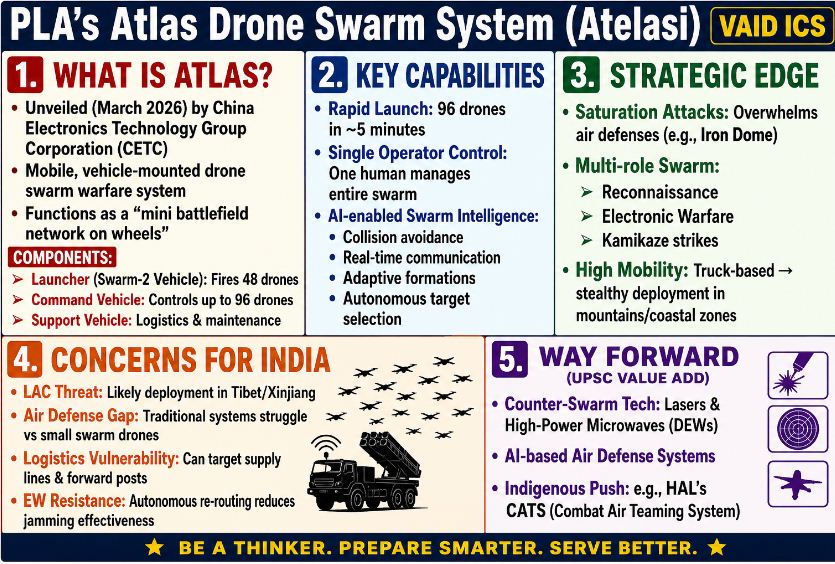
Unveiled in late March 2026, the Atlas system is a mobile, vehicle-mounted drone swarm platform developed by the China Electronics Technology Group Corporation (CETC). It is described as a “mini-battlefield network on wheels.”
Composition: The system consists of three distinct units:
- Swarm-2 Ground Combat Vehicle: The launcher unit. A single vehicle carries and launches 48 fixed-wing drones.
- Command Vehicle: The “brain” of the operation. It can simultaneously control up to 96 drones in a single swarm.
- Support Vehicle: Handles logistics, reloads, and maintenance.
Key Technical Capabilities:
- Mass Launch: The system uses a rapid-fire mechanism with a 3-second launch interval. It can put a full swarm of 96 drones in the air within 300 seconds (5 minutes).
- Single-Human Control: Despite the large number of drones, a single operator manages the entire swarm. This is often compared to “one person flying 100 kites with a single string.”
- Swarm Intelligence: Drones use AI algorithms to:
-
- Avoid mid-air collisions.
- Communicate and share information in real-time.
- Autonomously adjust formations based on environmental factors (like wind).
- Identify and discriminate targets independently (e.g., picking a command vehicle out of multiple targets).
Strategic Advantages :
The Atlas system seeks to “outsmart” traditional defense systems through Saturation and Autonomy:
- Saturation Attack: By launching nearly 100 drones simultaneously from different directions, it can overwhelm sophisticated air defenses (like the E-3 Sentry AWACS or Iron Dome) that are designed to track a limited number of high-speed targets.
- Multi-Role Flexibility: The swarm is “heterogeneous,” meaning it can mix different types of drones:
-
- Scouting/Reconnaissance: To gather intelligence first.
- Electronic Warfare: To jam enemy communications.
- Kamikaze/Strike: To destroy high-value targets.
- High Mobility: Because it is truck-launched and independent, it is easy to hide, camouflage, and operate from remote mountain regions or coastal areas, providing a tactical surprise.
Challenges & Concerns for India:
The deployment of the Atlas system along the Line of Actual Control (LAC) in Tibet or Xinjiang poses specific security threats:
- Air Defense Vulnerability: Traditional Indian air defense systems may not be optimized for “swarms” of small, low-radar-cross-section drones.
- Logistics Disruption: Swarms can be used to target supply lines and isolated forward posts in high-altitude terrain.
- Electronic Warfare: The “smart brain” of these drones makes them resistant to traditional jamming, as they can re-route and share data autonomously if one unit is blocked.
Way Forward :
- Counter-Swarm Tech: India needs to accelerate the development of Directed Energy Weapons (DEWs) like high-power microwaves and lasers to disable swarms instantly.
- Integrated Air Defense: Moving toward AI-enabled air defense networks that can track and engage multiple small targets simultaneously.
- Indigenous Development: Boosting projects like HAL’s Combat Air Teaming System (CATS) to match the “Intelligentization” of the PLA.

Citizenship (Amendment) Rules, 2026
May 19, 2026
Gist of daily Article /The Hindu 17oct 2025
October 17, 2025
Daily Gist of the Hindu/Indian Express : 16 Oct 2025
October 16, 2025
Daily Gist of The Hindu/Indian Express: 6 Oct 2025
October 6, 2025

