February 23, 2026
Parliamentary Privileges in India:
Parliamentary Privileges in India:
Parliamentary privileges are the sum of special rights, immunities, and exemptions enjoyed by the Houses of Parliament, their committees, and their members. They are essential to maintain the independence and dignity of the legislative process.
Constitutional Basis
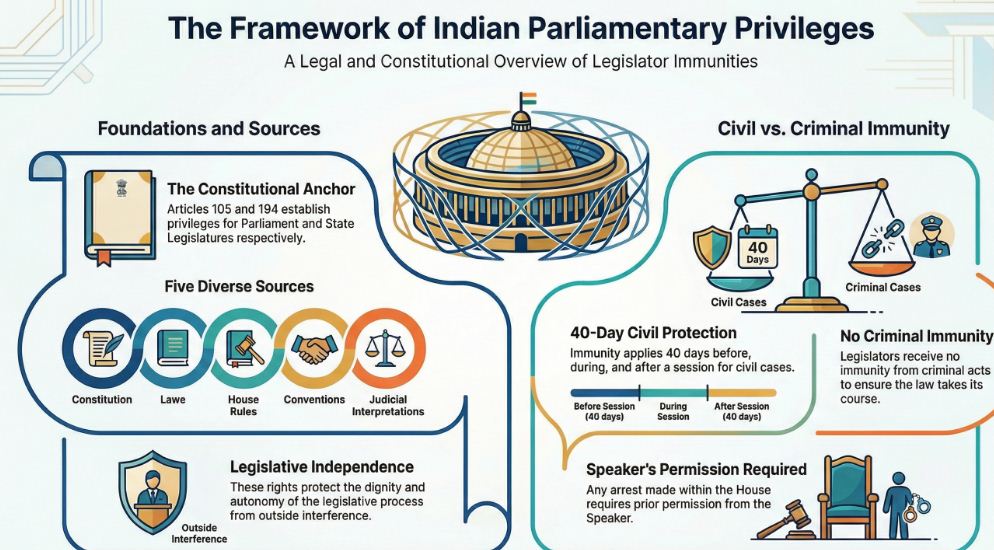
- Article 105: Deals with the privileges of the Parliament (MPs, Committees, and the Attorney General).
- Article 194: Deals with the privileges of State Legislatures (MLAs).
- Article 361: Provides separate privileges for the President and Governors (as they are part of the legislature but not members of the House).
Note: These privileges do not extend to the President of India, despite the President being an integral part of Parliament.
The Five Sources of Privileges:
Since India has not codified these privileges into a single law, they are derived from:
- Constitutional Provisions: Articles 105 and 194.
- Parliamentary Laws: Such as the Civil Procedure Code (Section 135A).
- House Rules: Rules of Procedure and Conduct of Business.
- Parliamentary Conventions: Traditions borrowed from the British House of Commons.
- Judicial Interpretations: Landmark SC judgments (e.g., the 2024 ruling on bribery).
Classification of Privileges:
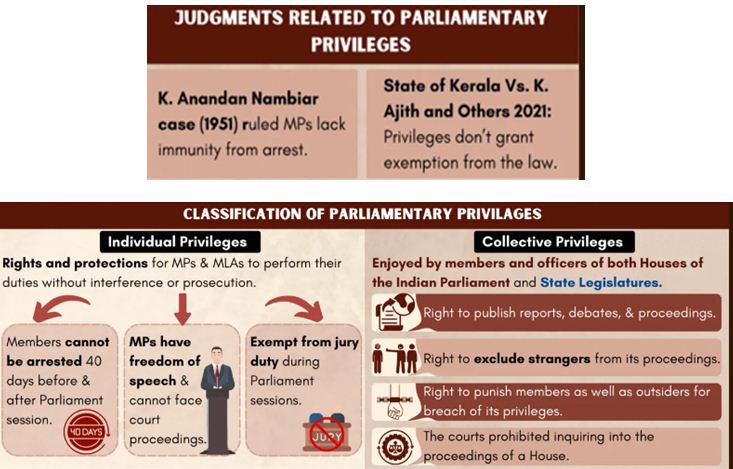
A. Individual Privileges (For the Member):
- Freedom of Speech: MPs have absolute freedom of speech inside the House. No member is liable to any court proceedings for anything said or any vote given in Parliament.
- Freedom from Arrest: * Immunity from arrest in Civil Cases
- Duration: 40 days before, during, and 40 days after a session.
- No Immunity in Criminal cases or Preventive Detention.
- Exemption from Jury Service: Members can refuse to attend court as a witness when Parliament is in session.
B. Collective Privileges (For the House):
- Right to Publish: The House can publish its reports and debates, or prohibit others from doing so.
- Right to Exclude Strangers: Power to hold “Secret Sittings” to discuss sensitive matters.
- Right to Regulate Internal Affairs: The House is the sole judge of its own proceedings. Courts cannot inquire into the validity of proceedings based on “irregularity of procedure.”
- Power to Punish: The House can punish members or outsiders for “Breach of Privilege” or “Contempt of the House” (e.g., through reprimand or imprisonment).
Limitations & Recent Judicial Clarity:
Privileges are not absolute. They are subject to:
- Article 121: Members cannot discuss the conduct of Supreme Court or High Court judges (except during a removal motion).
- Article 118: Rights are subject to the Rules of Procedure of the House.
The 2024 Supreme Court Landmark Ruling:
In a major shift, the SC ruled that:
- No Immunity for Bribery: An MP/MLA cannot claim immunity under Article 105/194 if they accept a bribe to vote or speak in a certain way.
- Reasoning: Bribery is a criminal act that is not essential to the “functioning” of a legislator. It undermines the “probity” of the House.
Challenges and Concerns:
- Conflict with Fundamental Rights: Often, “Freedom of Speech” of the MP (Art 105) clashes with the “Freedom of Speech” of the citizen/press (Art 19).
- Lack of Codification: Because privileges are not defined by a specific law, they are often perceived as “vague,” leading to potential misuse against critics or journalists.
- Accountability Gap: Historically, these were used to shield members from scrutiny; however, recent judgments are closing these loopholes.
Comparison Table: Civil vs. Criminal Immunity:
| Feature | Civil Cases | Criminal Cases |
| Immunity Available? | Yes | No |
| Timing | 40 days before/after & during session | Not Applicable |
| Arrest inside House? | Requires Speaker’s permission | Requires Speaker’s permission |
| Reasoning | To prevent obstruction of legislative duties. | Law must take its course for criminal acts. |

Gist of daily Article /The Hindu 17oct 2025
October 17, 2025
Daily Gist of the Hindu/Indian Express : 16 Oct 2025
October 16, 2025
Daily Gist of The Hindu/Indian Express: 6 Oct 2025
October 6, 2025
Daily Gist of Article /The Hindu /Indian Express: 24 Sep 2025
September 24, 2025

